
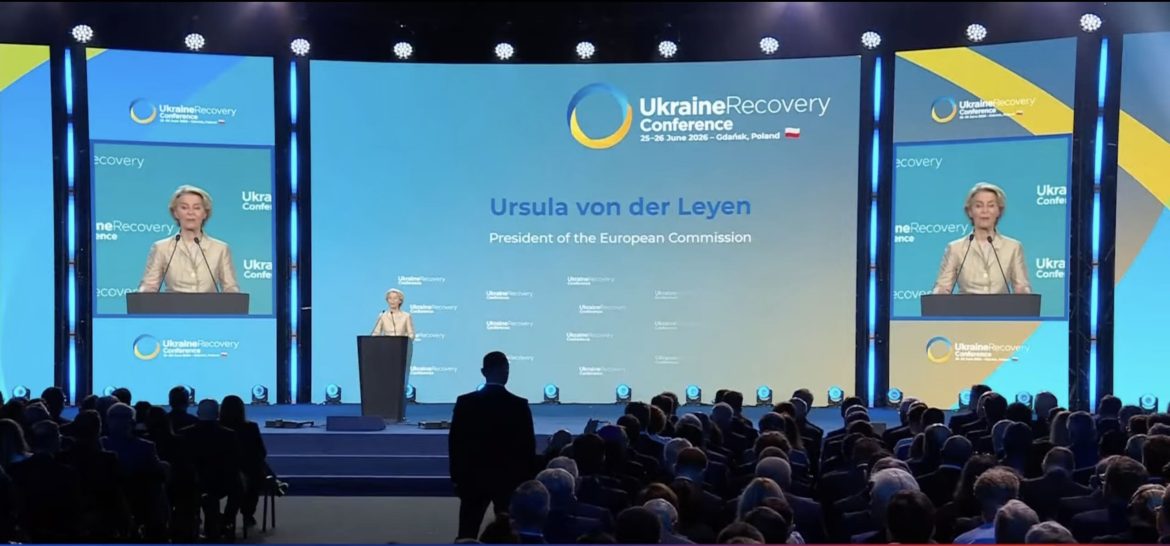
The Gdańsk recovery conference gave Kyiv new financial commitments, but it also showed how reconstruction, defence production and Ukraine’s EU path are now tied to unresolved political tensions inside Europe.
The European Union has released the first €3.2 billion tranche of a new €90 billion loan package for Ukraine, using this week’s recovery conference in Gdańsk to turn reconstruction pledges into immediate budget and defence support.
The payment, announced by the European Commission during the Ukraine Recovery Conference, is the first instalment under the Ukraine Support Loan. The package is intended to cover Ukraine’s urgent budgetary and defence-related needs in 2026 and 2027, at a time when Kyiv is trying to keep the state functioning while financing military resistance and repairing infrastructure damaged by Russian attacks.
The timing matters. The conference, co-hosted by Poland and Ukraine on 25 and 26 June, was designed as an investment and reconstruction platform. Its agenda covered energy, critical infrastructure, logistics, EU integration, local recovery, human capital and, for the first time, a dedicated security and defence dimension. The official conference programme described defence industrial capacity as both a security requirement and part of Ukraine’s future economic recovery.
That shift reflects the reality of the war economy. Reconstruction is no longer presented only as a post-war task. It is being linked to air defence, unmanned systems, military mobility, energy resilience, shelters, demining and the protection of civilian infrastructure. For Kyiv, the priority is not only to rebuild what has been destroyed, but to make future investment survivable under continued Russian pressure.
Ukrainian Prime Minister Yulia Svyrydenko said Ukraine expected to sign more than 160 agreements worth over €10 billion during the two-day forum in Gdańsk. According to Reuters, she also said Ukraine had signed a $3.39 billion agreement with the World Bank under the First Growth and Jobs Development Policy Operation.
The Commission said the EU had provided €211.3 billion in overall support to Ukraine since Russia’s full-scale invasion. It also said further funding would follow, including support for drone production. European Commission President Ursula von der Leyen said the EU-backed investment fund for Ukraine’s reconstruction was ready to proceed and could mobilise around €500 million this year.
The hard question is whether these commitments can be turned into projects. Ukraine’s reconstruction cost has been estimated by the World Bank, the United Nations, the European Commission and the Ukrainian government at $588 billion over the next decade. That figure is far beyond what annual conferences can deliver. It requires long-term public finance, private capital, war-risk insurance, procurement transparency, judicial reform and bankable projects.
The Gdańsk conference therefore exposed both the scale of support and the limits of the current model. Grants and loans can keep Ukraine’s budget afloat. They can also support energy resilience, defence production and emergency repairs. But private investors will still weigh legal risk, security conditions, insurance availability, corruption safeguards and the credibility of Ukraine’s reform process.
The political setting was also more complicated than the financial message. Polish-Ukrainian relations have been strained by a dispute over Second World War-era massacres and the naming of a Ukrainian military unit after the Ukrainian Insurgent Army. The issue has reopened a sensitive historical argument in Poland, where political figures have linked reconciliation to Ukraine’s European future.
Polish Prime Minister Donald Tusk used the Gdańsk forum to call for reconciliation, while trying to keep Poland’s role as a principal supporter of Ukraine’s recovery intact. The tension matters because Poland is central to Ukraine’s logistics, aid flows, defence support, refugee policy and European integration route. A dispute between Warsaw and Kyiv does not stop reconstruction finance, but it can complicate the politics around Ukraine’s EU path.
For Brussels, the conference was an attempt to show continuity. The EU wants Ukraine’s reconstruction to be aligned with accession reforms, energy integration, transport links and defence-industrial cooperation. That gives the recovery agenda a wider purpose: Ukraine is being prepared not only as a country receiving aid, but as a future part of the EU’s economic and security architecture.
The €3.2 billion tranche is therefore more than a budget payment. It anchors a broader European bet that Ukraine’s state, economy and defence sector can be sustained through a prolonged war and integrated into European systems before full reconstruction is possible.
The risk is that expectations outpace delivery. Conferences can produce declarations, funds and memoranda. Ukraine needs repair contracts, power equipment, functioning institutions, private investment and predictable financing. The Gdańsk meeting showed that Europe is still willing to commit money. The test is whether that money can be converted into durable recovery while the war continues.

