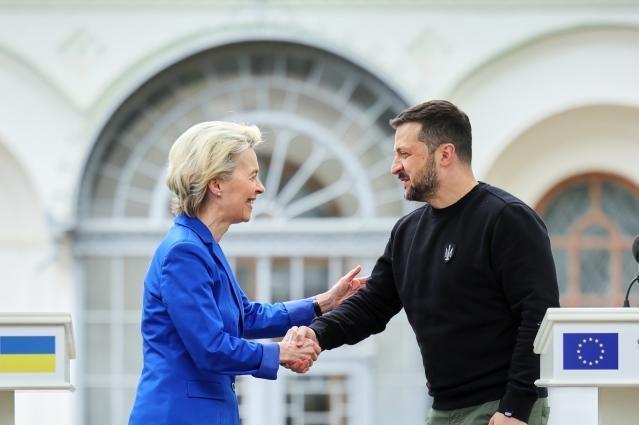
Ukraine’s effort to secure a sharply accelerated path into the European Union as part of any eventual peace settlement with Russia is meeting resistance from several key member states, exposing a widening gap between Kyiv’s political ambitions and the caution prevailing in major European capitals.
Governments including France and Germany remain reluctant to compress the accession timetable, despite Ukraine’s argument that EU membership should form part of a broader post-war security settlement.
The dispute goes to the heart of how the EU sees enlargement in wartime conditions. President Volodymyr Zelenskyy has pressed for a 2027 target date for membership, presenting accession not only as a strategic objective but also as a stabilising guarantee for Ukraine’s future after more than four years of full-scale war. Kyiv has linked that ambition to peace discussions, arguing that deeper integration into the bloc would strengthen democratic resilience, anchor reform and reduce the risk of renewed Russian pressure.
Yet the response from a number of EU governments has been guarded. Diplomats cited by Reuters said several capitals do not want to establish a precedent that could weaken the Union’s merit-based accession framework. Their concern is that any political effort to rush Ukraine through the process would call into question the credibility of the EU’s enlargement rules, which require candidate states to meet detailed standards across areas including the rule of law, judicial reform, market regulation and anti-corruption measures.
This caution reflects institutional reality as much as political hesitation. The European Commission states that Ukraine completed the screening phase of its accession preparations in September 2025. The next step is for member states to agree to open negotiating clusters, but that still depends on unanimity among all 27 governments. The process is not automatic, and progress can be slowed or blocked at multiple stages by national objections.
That procedural structure explains why enthusiasm in Brussels does not necessarily translate into movement at the level of the Council. While the Commission has been more open to finding ways to integrate Ukraine more deeply before full membership, several capitals appear unwilling to alter the fundamentals of enlargement. Some governments fear that awarding membership, or something close to it, on a politically compressed timetable would reduce leverage over reforms that are still seen as incomplete. Anti-corruption performance remains a particularly sensitive issue in internal EU discussions.
France and Germany are central to that debate. Both countries have backed Ukraine politically, financially and militarily since Russia’s invasion, but neither appears prepared to endorse a shortcut that would bypass the established accession sequence. Their position is significant because it suggests that resistance to a fast-track approach goes beyond the more predictable obstruction associated with Hungary and instead reaches into the EU mainstream.
Hungary nonetheless remains a critical factor. Reuters reported on 2 March that although Ukraine says it is close to completing the technical preparations needed to begin negotiations across all policy areas, actual movement has already been delayed by Hungarian opposition. Prime Minister Viktor Orbán has repeatedly used the unanimity requirement to slow decisions related to Ukraine, demonstrating that even if broader scepticism in Paris and Berlin were overcome, accession would still remain vulnerable to veto politics.
For Kyiv, the problem is therefore twofold. First, it must continue meeting demanding technical and legal conditions under the accession framework. Second, it must persuade member states that geopolitical necessity justifies more flexible handling without undermining the Union’s own standards. Ukrainian officials have floated ideas including phased access to EU benefits and continued monitoring of democratic and governance benchmarks, in an effort to bridge the gap between full membership and the current, slower model. But these proposals have yet to win broad support among governments.
The emerging picture is one of strategic sympathy but institutional restraint. Few in the EU dispute the political case for binding Ukraine more closely to Europe. The disagreement is over method and speed. For many capitals, the war has strengthened the argument for Ukraine’s European future, but not for rewriting the rules of entry. That means the accession process is likely to remain gradual, heavily conditional and subject to the internal politics of the Union itself.