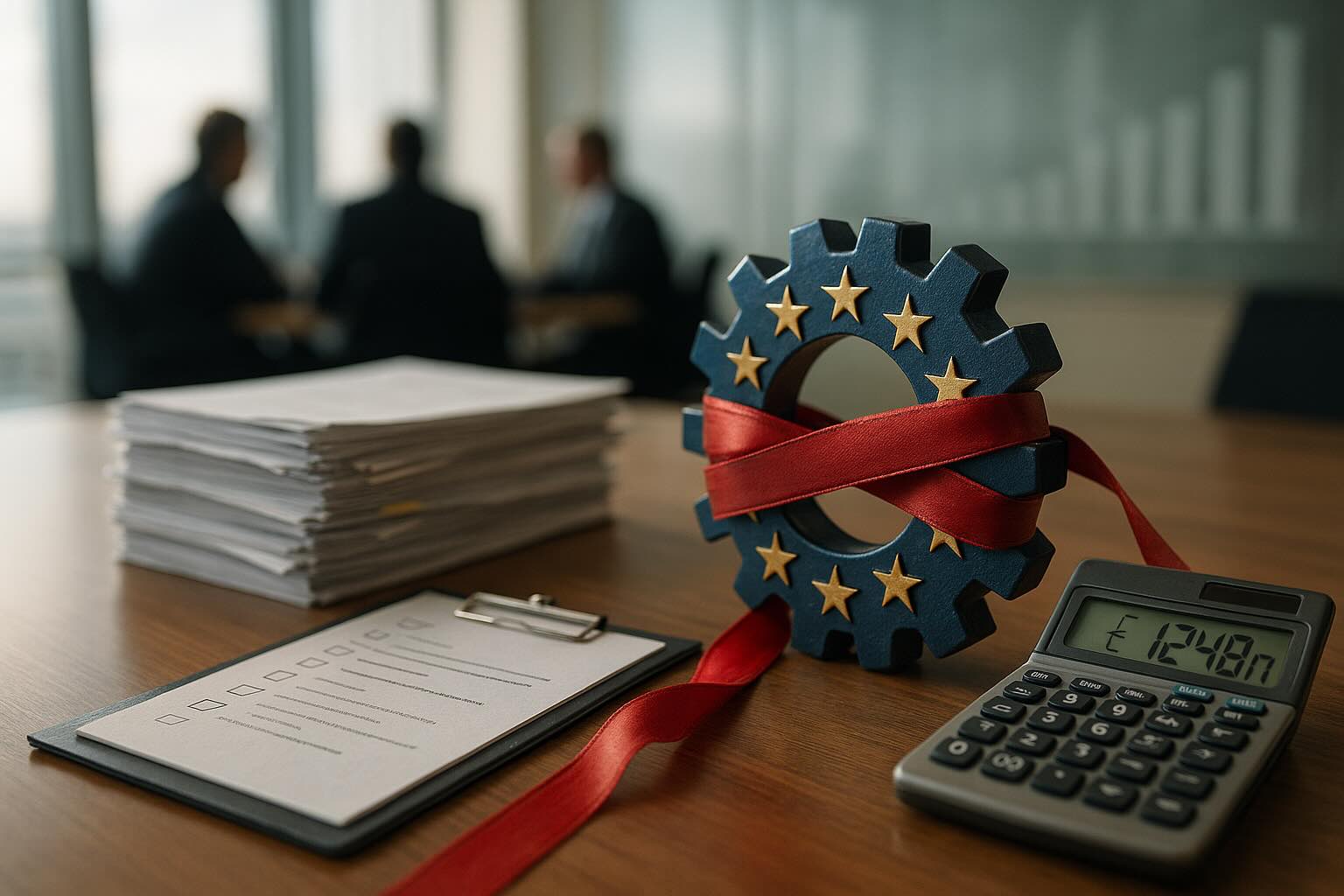
A Danish government study has estimated that forthcoming European Union legislation could add up to €124.2 billion a year in compliance costs across the bloc, a figure that will feed into finance ministers’ discussions on competitiveness later this week.
The estimate, prepared under Denmark’s rotating presidency of the Council of the EU, aggregates recurring costs derived from the European Commission’s own impact assessments of proposals still under negotiation.
According to reporting on the analysis, the projected annual burden would be split between businesses (€85.9 billion) and public administrations (€38.3 billion). In addition, the study indicates one-off adaptation costs of up to €69.9 billion for companies and €1.8 billion for authorities, reflecting initial investments required to meet new obligations. The authors did not quantify potential benefits of the rules—such as consumer gains, environmental improvements or risk reduction—citing the difficulty of monetising them consistently across policy areas.
The timing is deliberate. EU finance ministers meet informally on 19–20 September, with sessions on structural reforms and the economic effects of geopolitics. Denmark, which holds the Council presidency from 1 July to 31 December, has flagged regulatory simplification as a priority and is expected to use the gathering to press for closer scrutiny of the cumulative costs of new EU legislation.
EU leaders set the direction in March, calling for a “step change” to boost competitiveness and to “drastically reduce, as a matter of urgency, administrative, regulatory and reporting burdens” without undermining policy goals or the single market. Those European Council conclusions referenced the Commission’s competitiveness agenda—including the “Competitiveness Compass” and a set of simplification initiatives—and urged rapid treatment of related proposals.
The Commission has tabled several measures this year aimed at reducing red tape. In February it proposed an “omnibus” package to streamline sustainability reporting and due-diligence requirements, followed in May by additional steps that it said could save companies a further €400 million annually. Separately, recent analysis by the OECD summarises the EU-level objective to cut administrative costs for businesses by 25% overall—and by 35% for SMEs—over the 2024–2029 period.
Member state ministers have echoed the call for a simpler rulebook. At the Competitiveness Council in May, ministers discussed ways to make law-making more business-friendly, linking the effort to March’s leaders’ conclusions on reducing burdens. The Danish presidency programme likewise points to “robust” impact assessments that reflect realistic compliance costs as well as expected benefits.
The debate spans multiple policy files. Several governments have pressed to ease or recalibrate obligations in energy and climate legislation as part of the simplification drive, while others argue that scaling back would risk weakening environmental standards. A draft seen earlier this year showed countries seeking to cut red tape in energy laws, prompting mixed reactions from industry and civil-society groups.
Against this backdrop, the Danish presidency’s cost estimate is intended to inform choices rather than to propose specific roll-backs. By collating the Commission’s impact-assessment figures into a single headline number, Copenhagen aims to encourage ministers to monitor the “flow” of new obligations alongside efforts to trim the existing stock of rules. Danish officials have framed the exercise as a tool to improve policy design and sequencing, rather than as a verdict on particular proposals.
What happens next will hinge on finance ministers’ deliberations at the informal ECOFIN and subsequent Council work. Any structural changes to legislative drafting—such as enhanced cost-tracking, sunset clauses, or more systematic SME tests—would require inter-institutional agreement and would run in parallel with the Commission’s simplification packages already on the table. For now, the €124 billion annual figure provides a focal point for a wider discussion on how to reconcile regulatory objectives with the EU’s competitiveness agenda.
Denmark’s EU Presidency: Charting a Stronger Europe in a Shifting Global Landscape