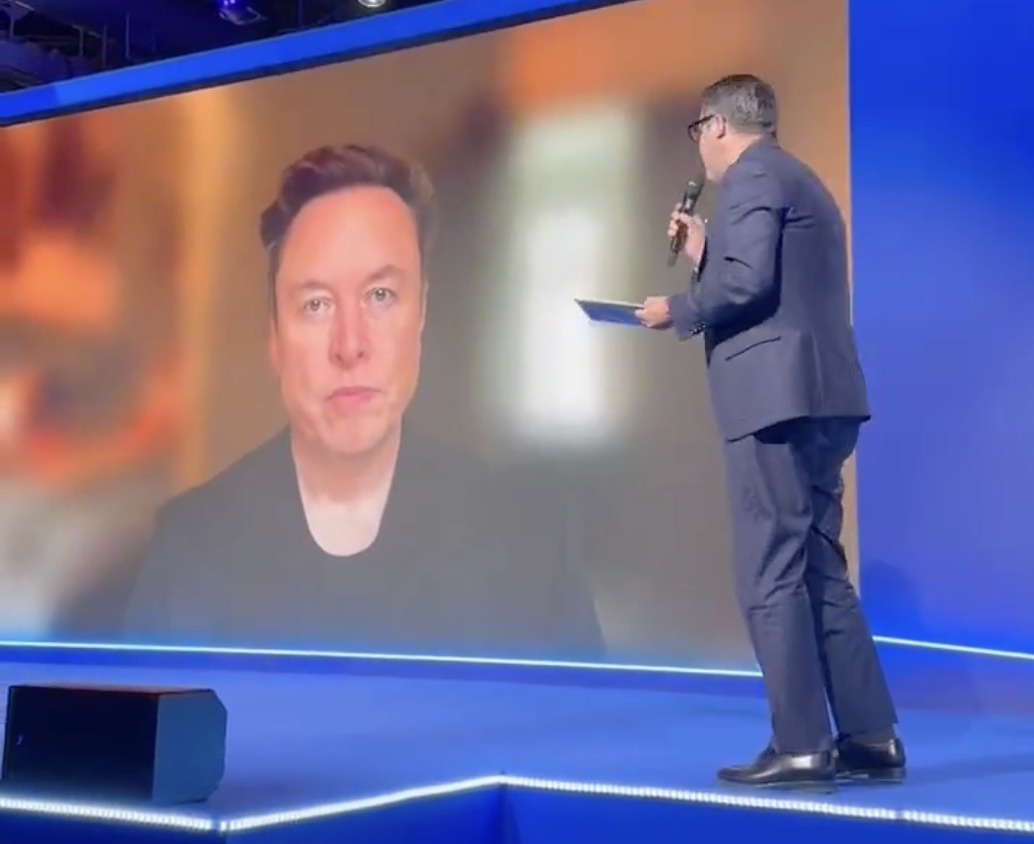
Elon Musk has thrown down the gauntlet to the political elites of Europe and America, demanding they tear down trade barriers or risk consigning their economies to second-rate status.
Speaking at the Lega Party’s congress in Rome — a setting few would associate with diplomatic caution — the world’s richest man made an unvarnished plea for a new transatlantic free trade zone.
His message was blunt: zero tariffs, zero barriers, or zero future.
.
“Without bold action, the West will simply lose,” Musk declared to rapturous applause. “The choice is simple: prosperity through openness, or decline through protectionism.”
Monk’s comments come as Washington and Brussels barrel toward a bruising trade war, after President Trump slapped hefty tariffs on European goods in a move that stunned policymakers on both sides of the Atlantic. Europe, predictably, has vowed retaliation, setting the stage for an ugly and self-defeating conflict.
But Musk — who has made a career out of upending stale orthodoxies — is having none of it.
“We cannot afford another century of economic trench warfare,” he said. “The walls must come down. Europe and America must stand together, or they will fall separately.”
No Time for Niceties
The choice of venue was no accident. Italy’s League Party, led by the irrepressible Matteo Salvini, is a thorn in the side of Brussels’ bureaucrats. Musk, in classic form, embraced the controversy rather than duck it, using the platform to bypass the dreary consensus of Eurocrats and speak directly to citizens.
Sources close to Musk confirmed that he views the EU’s labyrinthine regulations and America’s knee-jerk protectionism as twin threats to innovation — and to his own ambitions. His companies, from Tesla to SpaceX, rely on fast-moving global supply chains and frictionless access to markets. Tariff wars are, to put it mildly, bad for business.
Yet Musk’s call for radical change is unlikely to sit well with the political classes in Berlin, Paris, or Washington.
“He is right about one thing: the West is at a crossroads,” said a senior EU diplomat. “But expecting us to tear up our entire economic rulebook because Elon Musk said so? That’s not how this works.”
A New Atlantic Alliance?
Musk’s proposal is breathtakingly bold: a U.S.-Europe free trade zone modeled on NAFTA, but bigger and more ambitious, slashing tariffs and harmonising standards across industries from automobiles to aerospace.
It would, he argued, unleash a new industrial renaissance, positioning the West to outcompete China and emerging markets for decades to come.
“The East is rising,” Musk warned. “We either rise with it or get buried by it. A free trade zone is not charity — it’s survival.”
Some business leaders are quietly cheering him on. German car manufacturers, already hammered by American tariffs, have long yearned for closer economic ties with the U.S. Meanwhile, Silicon Valley firms, bristling at European data regulations, would relish the chance to operate under a more unified framework.
But political obstacles loom large. Memories of the failed TTIP (Transatlantic Trade and Investment Partnership) talks still haunt European capitals, where free trade is now a dirty word among the protectionist left and the nationalist right alike.
Musk Versus the Machine
To his critics, Musk’s latest intervention will smack of self-interest. After all, Tesla’s Berlin Gigafactory stands to gain handsomely from tariff-free access to U.S. markets.
But his supporters say that, as usual, Musk is simply seeing further ahead than the rest.
“Europe is behaving like a museum of the past while China builds the future,” said Professor Marco Zanetti, an economist at LUISS University. “Musk understands that if Europe and America don’t act together — and fast — they will become irrelevant.”
For Musk, irrelevance is the ultimate insult. His entire career has been built on making the impossible inevitable — from electric cars to commercial spaceflight.
The question is whether the political dinosaurs of Washington and Brussels are prepared to listen before the meteor strikes.
A Stark Warning
In his closing remarks, Musk pulled no punches.
“The West’s greatest enemy is not external,” he said. “It’s internal: complacency, bureaucracy, small thinking. Tear down the barriers, or be left behind.”
For a man who has spent his life betting on the future, Musk is now betting that Europe and America have one — if they have the courage to claim it.
As the room erupted in applause, it was clear at least one audience was willing to listen. Whether the politicians in Washington and the bureaucrats in Brussels follow suit is another question entirely.