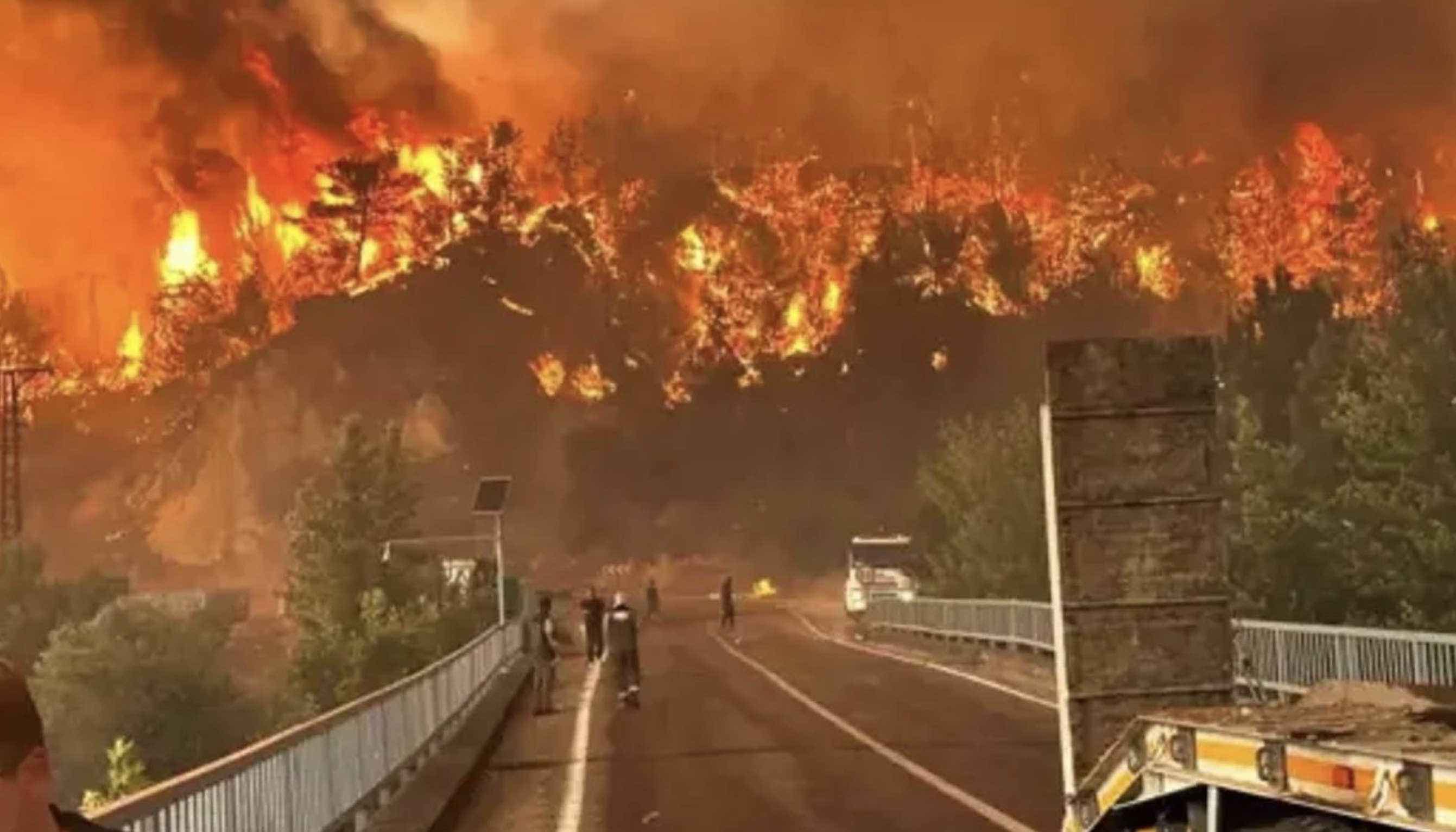
It begins, as it always does now, with smoke on the horizon. A pale ribbon at first, barely distinguishable from the haze of a midsummer Mediterranean sky. But within hours, it thickens, darkens, consumes the hills, then the houses—and finally, the lives of those who defend them.
By Wednesday morning, the air above Limassol was choked with ash. Planes roared overhead in slow, exhausted circuits, dumping water onto flames that refused to die. On the ground, villagers packed what they could—pets, documents, a few bags—and fled through a landscape fast turning to cinders.
By midday, Cyprus’s Ministry of Interior confirmed that more than 100 square kilometres had burned, at least 12 were dead, and hundreds of homes lost.
Across the sea, the news from Turkey was no better. Ten firefighters killed, overwhelmed by advancing firefronts in the provinces of Antalya and Mugla. More than a dozen blazes continue to rage as of Friday morning, despite a week of concerted international effort to contain them. Helicopters from Greece and Italy buzz the Turkish coastline. Cypriot authorities, meanwhile, have accepted Israeli and EU firefighting crews and aircraft. It is not enough.
Once again, southern Europe is at the mercy of a Mediterranean summer that no longer bears any resemblance to the one remembered from postcards. A season once associated with holidays, olives, and shade-dappled hills now carries the menace of death. The climate, we are told, has shifted. But the response of Europe’s institutions, as ever, lags behind the speed of the flames.
This latest spate of wildfires is neither new nor unexpected. What is striking is the extent to which Europe appears still, despite all previous disasters, flat-footed and reactive. Fire season now comes earlier, lasts longer, and costs more. Yet no pan-European coordination mechanism exists on the scale required. Nor does the EU Civil Protection Mechanism, bolstered in the wake of Greece’s 2021 infernos, appear anywhere close to adequate. The firefighting aircraft it co-funds are few; the bureaucratic delays in deployment long.
One cannot blame Brussels entirely. Cyprus and Turkey are, after all, not only geographically peripheral but also politically complicated. The EU’s aid to Cyprus—part of its member-state duties—arrives quickly. Turkey, not an EU member and with ties to Brussels constantly fraying, relies on the goodwill of others. That ten Turkish firefighters should die before sufficient international help arrived is, at minimum, an indictment of a geopolitics that sees human life sacrificed at the altar of unresolved disputes.
But there is a deeper and more troubling truth beneath these flames: southern Europe is burning because northern Europe—and much of the wider West—refuses to reckon with the consequences of its own inaction. The Mediterranean basin is warming 20% faster than the global average. Scientists have warned for years that without radical shifts in emissions policy, fire weather—long, dry spells of heat, wind, and drought—will become the norm from Lisbon to Lebanon. Yet at both national and EU level, political courage remains elusive.
The European Commission only weeks ago put forward a proposal to streamline environmental regulations, ostensibly to “ease burdens on business.” But what businesses, precisely, will thrive when cities burn, vineyards dry, and tourism evaporates in a haze of smoke? Germany and Poland have dragged their feet on phasing out coal. France’s nuclear fleet, once the continent’s pride, is overstretched and ageing. And in southern Europe, where adaptation is critical, governments remain slow to clear firebreaks, reinforce forestry services, or invest in early warning systems.
This is not mere administrative oversight—it is a dereliction of duty.
The price of that neglect is now being paid by rural Cypriots who will return to find charred ruins where homes once stood; by the Turkish families who buried their sons in blackened uniforms; and by the farmers whose olive groves, some a century old, are reduced to ash. As always, it is the least powerful who suffer most.
There is a danger, too, in assuming that such catastrophes are confined to the “edge” of Europe. The flames may be flickering in the Mediterranean, but the consequences will travel. Food prices will rise. Insurance claims will mount. Migration, both internal and external, will increase. And the political fallout—anger at government failure, erosion of trust, the rise of movements that promise protection at the cost of democracy—will not stop at the Alps.
What, then, must be done?
At the very least, Europe requires a vastly expanded firefighting air fleet, co-owned and deployed by a central authority not dependent on bilateral requests. A new Mediterranean Adaptation Fund must be established, not simply to mitigate emissions but to build the dykes, dig the wells, train the brigades and fortify the forests. And Brussels must do what it so often hesitates to: enforce. Make carbon compliance a requirement, not a target. Penalise delay. Reward foresight.
Because the alternative is visible now, dancing in the heat above Limassol, reflected in the tears of exhausted fire crews. Europe cannot claim ignorance, nor plead poverty, nor pass the buck. The continent is aflame, and the time for excuses has run out.
As the smoke clears and the funerals begin, one truth will remain: the Mediterranean is no longer Europe’s tranquil border—it is its burning heart. And what we do now will determine whether the rest of the continent follows it into the fire.
Main Image: MetinMAuthor via X
___________________________________________________________________________________________________________________________

“Every euro spent on a dodgy offset in a developing country is a euro not spent on upgrading a steel plant in the Ruhr, electrifying transport networks in France, or building green innovation hubs in Eastern Europe.”
___________________________________________________________________________________________________________________________