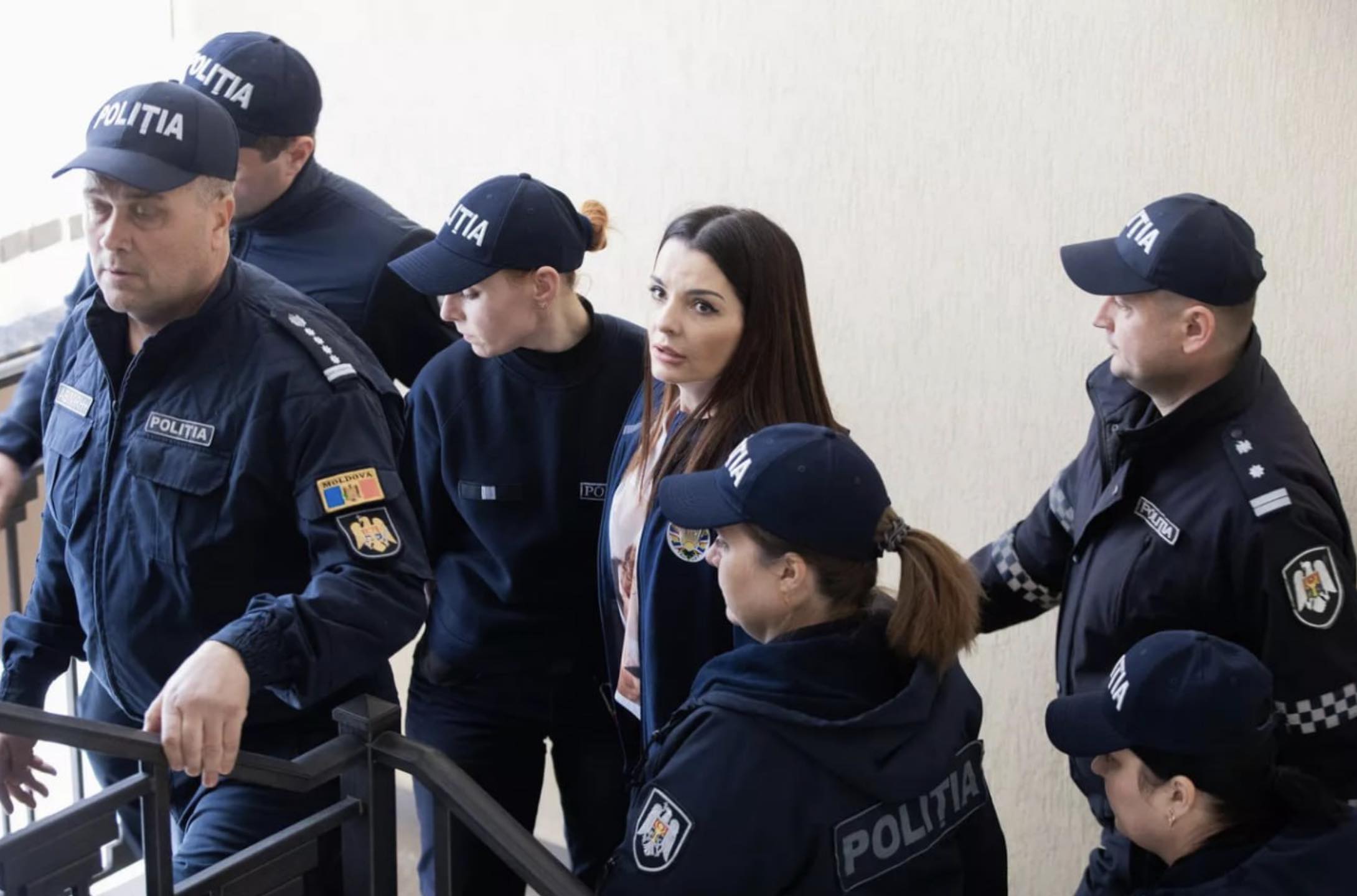
A Moldovan court has sentenced Evgenia Gutul, the controversial pro-Kremlin governor of the autonomous Gagauzia region, to seven years in prison for funnelling Russian money to bankroll a now-banned political party.
The verdict is being hailed by the pro-European government as a defence of national sovereignty, and denounced by Moscow as a political witch-hunt.
The ruling, handed down on Tuesday in Chisinau, concludes a case that has captured headlines across Eastern Europe and raised the temperature in Moldova’s volatile geopolitical balancing act between East and West.
Gutul, 37, who has openly courted support from senior Russian officials and repeatedly criticised Moldova’s pro-European government, was found guilty of channelling undeclared funds from Russia between 2019 and 2022 to finance the Shor Party – a populist, Moscow-leaning political formation outlawed last year on grounds of subverting democracy.
The court found that Gutul had “knowingly and systematically received and distributed illicit financial contributions from foreign sources with the purpose of influencing Moldovan politics,” a statement read. Prosecutors alleged that the scheme involved “millions of euros” routed through offshore accounts and hand-delivered cash transfers, all intended to prop up the now-defunct party founded by Ilan Shor, an exiled oligarch currently residing in Israel and convicted in absentia for his role in the 2014 “heist of the century” – the disappearance of $1 billion from Moldovan banks.
While prosecutors had pushed for a nine-year sentence, Judge Mihai Ursu handed down seven years, citing Gutul’s previously clean criminal record and her regional role as mitigating factors. Nevertheless, the court barred her from holding public office for five years and froze multiple assets allegedly linked to the illicit financing network.
Gutul, who has maintained her innocence throughout the proceedings, listened impassively to the sentence before being led away by security personnel. Outside the courthouse, over 100 of her supporters waved Gagauz flags and chanted “Freedom for Gutul!” – a striking display of loyalty to a leader who has consistently positioned herself as a thorn in the side of Moldova’s Western-leaning establishment.
“I am not guilty,” Gutul declared in a pre-sentencing statement. “This is not justice. This is political persecution against those who dare to speak the truth and defend Gagauzia’s rights.”
The Kremlin wasted no time in condemning the verdict. Dmitry Peskov, President Putin’s spokesman, said the ruling was “yet another sign that democracy is dead in Moldova,” and accused President Maia Sandu’s administration of “using courts to eliminate all opposition.”
The Moldovan government swiftly rejected that characterisation. Dorin Recean, the country’s pro-European prime minister, said the verdict was “the result of an independent judiciary operating in accordance with the rule of law” and insisted that no individual – regardless of political orientation – is above the law.
“This case was about illegal financing from a foreign state,” Recean told reporters. “It is not about silencing dissent. It is about protecting Moldova’s constitutional order.”
The case has underscored the profound political and ethnic divisions in Moldova, a small country of 2.5 million sandwiched between Romania and Ukraine. Since Russia’s full-scale invasion of Ukraine in 2022, the Moldovan government has accelerated its push toward EU membership and has grown increasingly vocal in its warnings about Russian interference.
Gagauzia – a Turkic-speaking autonomous region in Moldova’s south with just over 140,000 inhabitants – has emerged as a flashpoint in this struggle. While its autonomy is guaranteed under Moldovan law, its population has remained notably more sympathetic to Russia than the rest of the country, and turnout in elections has heavily favoured pro-Kremlin parties. Gutul’s election as the region’s bashkan (governor) in 2023 was hailed in Russian state media as a “victory for common sense” and a rebuke to Western “puppets” in Chisinau.
But her links to Moscow have long raised eyebrows. In recent years, Gutul has made multiple high-profile visits to Russia, including meetings with Kremlin deputy chief of staff Sergey Kiriyenko and a much-publicised photo op with Foreign Minister Sergey Lavrov. In June, she was added to the European Union’s sanctions list for “activities destabilising Moldova,” a designation that mirrored U.S. Treasury Department sanctions announced earlier this year.
The outlawed Shor Party, once Moldova’s most prominent pro-Russian political group, was officially dissolved by the Constitutional Court in June 2024, after authorities accused it of attempting to stage anti-government protests funded by illicit Russian money. Ilan Shor, who fled the country in 2019, is believed to be coordinating political agitation from abroad with tacit support from the Kremlin.
Gutul’s sentencing is likely to deepen tensions within Moldova and could provide fodder for Russian propaganda seeking to portray the country’s pro-European trajectory as divisive and undemocratic. Analysts warn that the court ruling may galvanise pro-Russian sentiment in Gagauzia, particularly if perceived as an attack on regional autonomy.
“Evgenia Gutul is being made an example of,” said Andrei Popescu, a political analyst at the Institute for Eastern Studies in Warsaw. “The Moldovan government wants to draw a red line against foreign interference, but that line cuts through the heart of Moldovan society.”
The sentence is not final and can be appealed. Gutul’s legal team has already announced plans to challenge the ruling in the Court of Appeals, and hinted that they may escalate the case to the European Court of Human Rights in Strasbourg.
For now, however, a long-standing political drama has reached its most dramatic turn yet. Whether the curtain falls here or continues into another act may depend on whether Moldova can weather its internal divisions while standing firm against external pressure.
And for Gagauzia, the verdict may either mark the end of an era—or the beginning of a much deeper crisis.
_______________________________________________________________________________________________________________________
Read Also: EU IMPOSES SANCTIONS ON GAGAUZIA’S LEADER AND OTHERS FOR DESTABILISING MOLDOVA
On 14th October 2024, the European Union introduced new sanctions targeting the leader of the autonomous region of Gagauzia in Moldova, along with several other individuals and one organisation, for actions aimed at destabilising the country.
_______________________________________________________________________________________________________________________