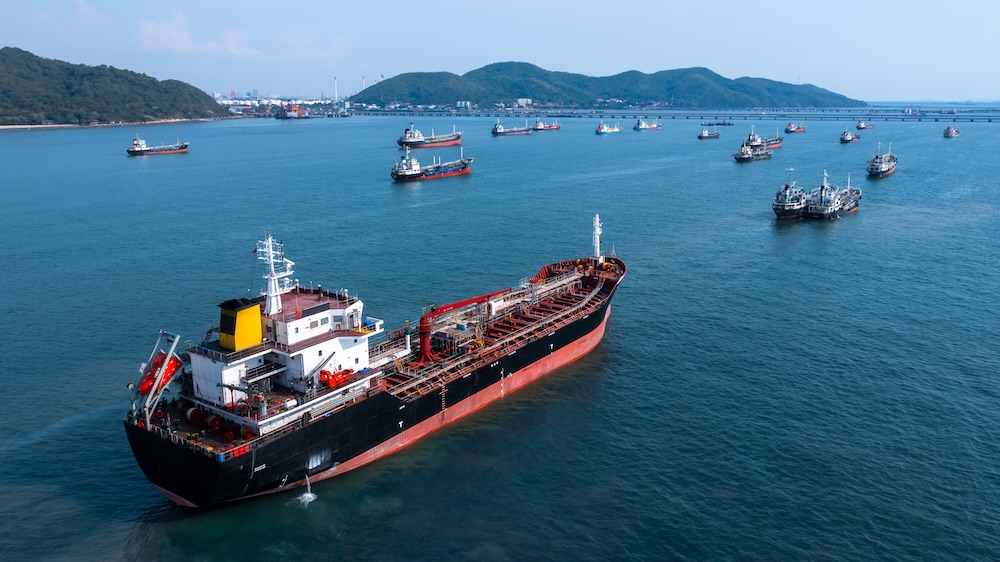
The decision by G7 governments and the European Union to consider replacing the oil price cap with a full ban on maritime services for Russian crude is presented as a major tightening of sanctions.
The proposal would prohibit shipping, insurance and other services for any cargo of Russian oil, effectively ending the 2022 price cap regime. Supporters argue it will choke off revenue for Moscow. Critics see something else: another round of symbolic measures that shift trade routes without reducing volumes.
The record of the price cap provides the starting point. The mechanism was meant to keep Russian barrels on the market while limiting revenue. In practice, Russia assembled a large “shadow fleet” of older tankers with opaque ownership, reflagged in jurisdictions far from the G7.
The share of Russian crude shipped on such vessels has steadily increased; EU research services estimate that by mid-2024 shadow fleet tankers were handling more than 80 per cent of Russian seaborne crude exports from Baltic and Black Sea ports. The result is that only a minority of Russian oil now depends on Western-controlled ships or insurers.
Even within the Western fleet the picture is changing. Greek-owned tankers once carried as much as 40 per cent of Russia’s crude exports under the price-cap framework. Enforcement pressure and lower cap levels have since forced many Greek operators out of the crude trade, with shadow fleet and non-Western owners filling the gap. A new maritime-services ban would therefore hit a segment of the trade that is already shrinking, while leaving untouched hundreds of tankers controlled by small, lightly regulated firms in the Gulf, Asia and various offshore jurisdictions.
ChatGPT said:
India’s recent reduction in direct purchases of Russian crude illustrates how the system adapts rather than contracts. Bloomberg reporting suggests that cargoes arriving in India next month could fall to around 600,000 barrels per day, the lowest level since early 2022, down from peaks above 2 million barrels per day. On paper, this looks like a sharp retreat. In reality, a growing share of Russian oil is being routed through intermediary countries. Egypt, for example, has sharply increased its imports of Russian crude and fuel oil in recent years, re-exporting to other buyers in the Middle East and Asia. Cargoes can be sold several times on paper while the same tanker continues on to India or elsewhere.
The same pattern can be seen in ship-to-ship transfers and blending. Investigations by media and think-tanks have documented tankers loading in Russian ports, stopping off South Asia to transfer cargoes at sea to other vessels, which then proceed to China or other destinations. Once oil has been blended with Kazakh, Iranian or other grades in a large tanker, assigning a clear “Russian” label to any given barrel becomes technically and legally difficult. Monitoring every movement would require a dedicated bureaucracy watching more than a thousand Russian-linked tanker liftings a year in real time, analysing satellite tracks and AIS gaps, and then persuading port states to act.
Sanctions have had a measurable impact on price rather than volume. A recent study by the Federal Reserve Bank of Dallas found that Russia was forced to accept discounts of around 30 dollars per barrel on its Urals crude in 2023 relative to pre-war levels. Western policymakers present this as evidence that the price cap works. Critics counter that the foregone revenue has not translated into a meaningful reduction in physical exports: Russian companies continue to ship roughly what they can produce and transport, while the gains from discounted barrels are captured by intermediaries.
Trading houses and small shipping firms buy Russian oil at heavily discounted prices and resell it to refiners with a mark-up that still leaves the final buyer paying less than for comparable non-Russian grades. Media and investigative reports indicate that some of these networks are linked, directly or indirectly, to political and business figures in Russia and in third countries, providing a channel for capital flight as well as profit. None of this reduces the physical flow of Russian barrels; it simply redistributes income along the supply chain.
India’s turn towards Guyanese crude is sometimes cited as proof that new supply sources can replace Russian oil. ExxonMobil and its partners have indeed built up Guyana into a significant exporter, with output expected to rise above 1 million barrels per day, and recent deals will send several million barrels to Indian refiners in late 2025 and early 2026. Yet Guyana’s capacity is limited relative to India’s total import needs, and Indian policy documents and statements continue to stress the importance of discounted barrels from Russia, Iran and Venezuela to contain costs.
The core criticism of the evolving sanctions regime is therefore not that it has no effect, but that its effect is misaligned with its stated objective. Oil sanctions have depressed Russian netbacks and forced Moscow to sell at a discount, but they have not produced an embargo in the traditional sense. Russian crude still reaches world markets in large volumes via a growing, opaque network of ships and intermediaries. As even some shipping analysts acknowledge, new EU measures may change the ownership and routing of tankers but are unlikely, on current evidence, to change the basic logistics of Russian oil exports.
If the G7 and EU proceed with a full maritime-services ban, it will mark a further escalation on paper. Whether it changes facts at sea is another question. For now, the experience of the price cap, the expansion of the shadow fleet and the persistence of complex trading schemes all point in the same direction: sanctions have made Russian oil cheaper and less transparent, but not significantly scarcer.