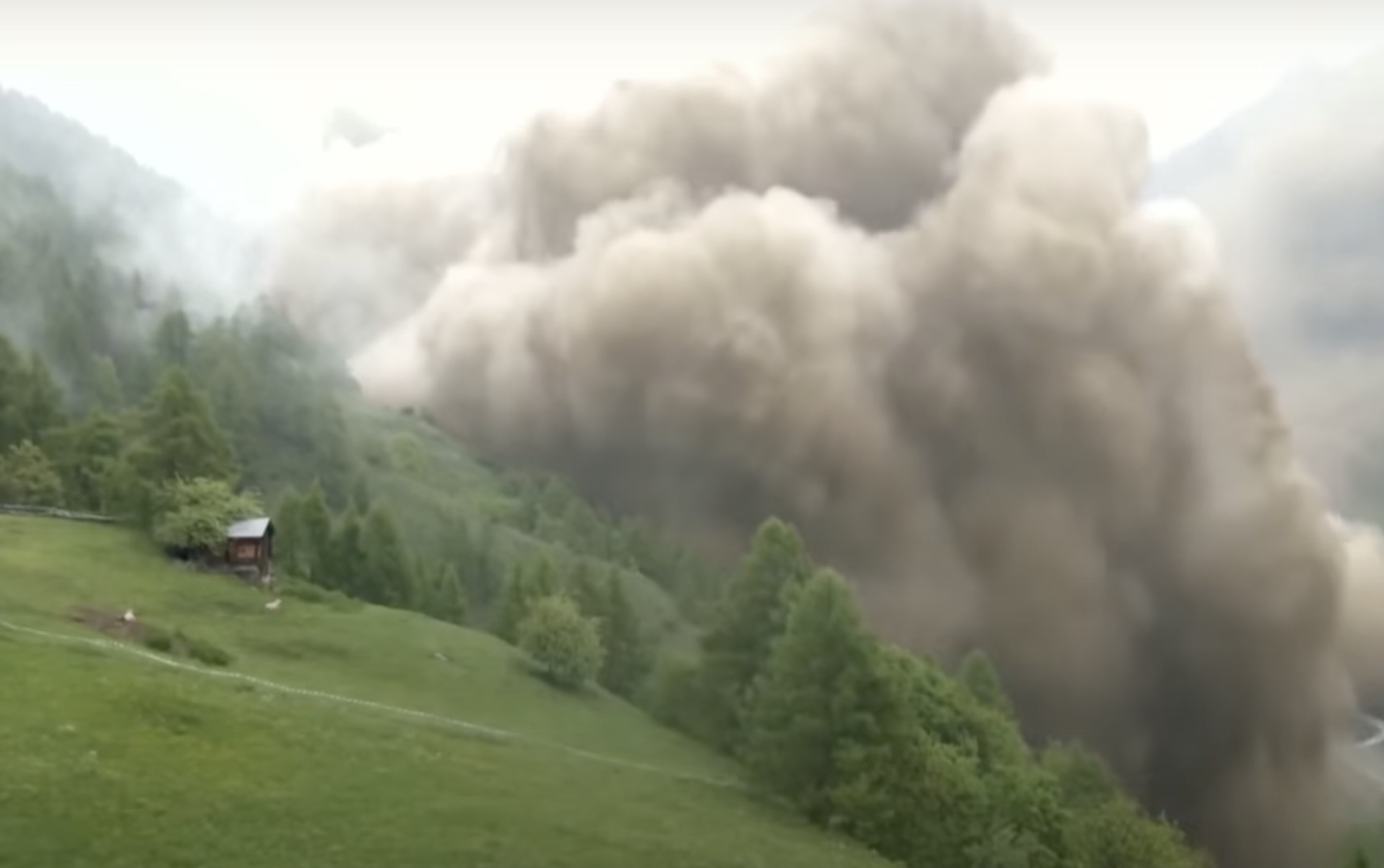
A catastrophic collapse of the Birch Glacier has buried much of the Swiss mountain village of Blatten beneath millions of tonnes of debris, with at least one person still reported missing.
The disaster, which struck on Wednesday afternoon, follows days of concern over the glacier’s stability and has prompted an emergency response involving federal authorities and military units.
Drone footage captured the moment a vast slab of ice and rock broke away from the mountainside at approximately 15:30 local time, unleashing an avalanche of mud and debris that swept through the valley. The collapse generated a deafening roar and left a dense cloud of dust lingering over the area. Much of Blatten now lies flattened.
The village, located in the canton of Valais, had been fully evacuated on 19 May after geologists raised alarms over the glacier’s deteriorating condition. Around 300 residents, along with livestock, were moved to safety in anticipation of a possible landslide. Some required airlift evacuation due to the terrain. Despite these precautions, one individual remains unaccounted for.
Matthias Bellwald, the mayor of Blatten, addressed the community with a message of resilience amid the devastation. “The unimaginable has happened,” he said. “We have lost our village, but not our heart. We will support each other and console each other. After a long night, it will be morning again.”
While no further injuries have been reported, damage to the village is extensive. Many homes have been completely destroyed, and local infrastructure is significantly compromised. Emergency assistance has been requested from the Swiss army’s disaster relief division. Members of the Federal Council are en route to assess the damage and coordinate support.
The Swiss government has pledged financial aid to ensure displaced residents can remain in the region, though whether Blatten itself can be rebuilt remains uncertain. In a further development, Raphaël Mayoraz, head of the cantonal office for Natural Hazards, indicated that neighbouring communities might also face evacuation orders depending on ongoing assessments.
Experts have linked the collapse to long-term environmental change. The accelerated melting of glaciers and thawing of alpine permafrost—conditions attributed to global warming—are destabilising mountain terrain throughout the region. Permafrost, often described as the ‘glue’ holding mountain structures together, is losing its integrity as temperatures rise, increasing the likelihood of rockfalls, landslides, and glacier collapses.
Henna Hundal, a climate policy specialist at Stanford University, stated in a media interview that “2024 was the hottest year on record,” with heat extremes affecting glacial systems worldwide. “We’re breaching historic thresholds. This isn’t just happening in the Arctic, but throughout alpine regions, and Blatten’s case is a stark example.”
Hundal noted that such events are no longer isolated. “We’re seeing a pattern: more frequent, more extreme weather and geological events driven by climate change. This includes not only glacier collapses but longer fire seasons, intense heatwaves, and severe storms. These are not anomalies—they are consistent with current climate models.”
Switzerland has seen similar incidents in recent years. In 2017, a massive landslide near the village of Bondo claimed eight lives. In 2023, residents of Brienz were evacuated due to fears the mountain above them could collapse. Though Brienz was spared complete destruction, residents have only been allowed limited returns.
The Swiss Glacier Monitoring Network’s latest report warns that without a significant reduction in global greenhouse gas emissions, the country’s glaciers could vanish entirely within the next century. The Paris Agreement, signed by nearly 200 countries in 2015, aimed to limit temperature rise to 1.5°C above pre-industrial levels, but many climate scientists now believe that threshold has already been exceeded.
The implications for alpine communities are considerable. As glaciers retreat and permafrost continues to thaw, more villages could face threats similar to Blatten’s. Efforts to adapt infrastructure, increase early-warning capabilities, and mitigate long-term climate risks are likely to become a more prominent feature of Swiss and European environmental policy.
For now, Blatten’s population remains displaced. With one person still missing and the village largely destroyed, recovery will be slow and difficult. Yet, as Mayor Bellwald underscored in his remarks, the communal spirit has not been lost: “We will rebuild our lives, even if not on the same ground.”
Read also:
The Overlooked Power of Water Vapour: How Warming Is Accelerating the Planet’s Hydrological Clock