We live in an absolutely critical time in the history of Ukrainian Polish relations. Ukraine is fighting for its existence with much assistance from many countries, including Poland. Poland itself is under tremendous stress due to the danger of Russian aggression. Yet with all this, suddenly Ukrainian Polish relations have soured.
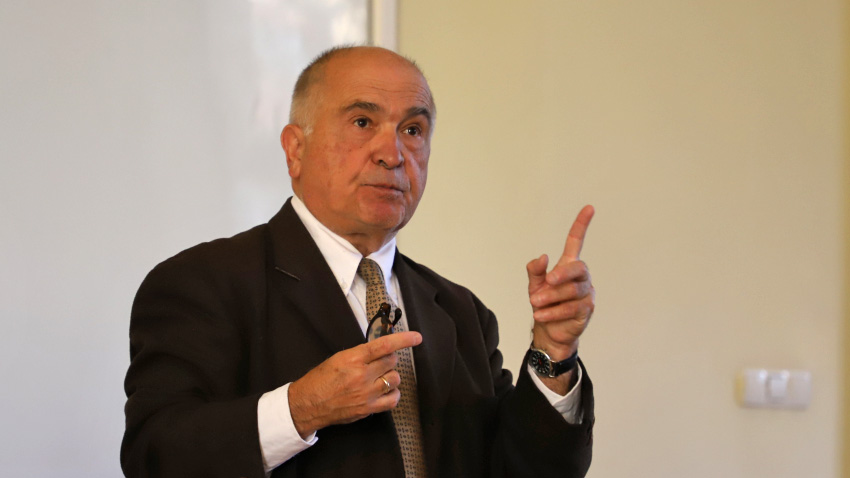
I am a Ukrainian American, now retired attorney at law and lifelong student of history. My legal practice consisted of not less than 50% Ukrainian American and Polish American clients. I consider myself a Ukrainian American even though my own mother was 50% Polish. I have travelled to Ukraine well over one hundred times and to Poland some fifty times.
.
In the course of my travels I have met with all the presidents of Ukraine and I have had the good fortune to meet and converse at length with Polish President Alexander Kwasniewski. For the sake of transparency in the case of Ukrainian Polish historical disagreements, granted I have sided with the Ukrainian position, for only two reasons: in history Poland invaded Ukraine three times while Ukraine has never invaded Poland. In terms of number of victims over the years the number of Polish victims does not come close to the Ukrainian side.
The current uproar is both dangerous and unnecessary. Revoking and surrendering state awards, condemnation of heroes of the other side is very shortsighted and helps only the mutual enemy. Frankly, it is childish. From the Polish side, sure the Ukrainian Insurgent Army (UPA), Stefan Bandera and Roman Shukhevych fought against the Poles who were invaders on Ukrainian territory. In the course they killed Polish soldiers, police, politicians and civilians. The Polish colonial administration in Ukraine including its police, military and even civilians including clergy killed Ukrainians, including civilians and clergy.
The current uproar appears to be a remnant of Soviet times when every opportunity was exploited by the Soviets to defame the Ukrainian nationalist liberation struggle. There is no doubt that the Russian Federation today is in every respect a successor to the USSR in word and deed.
It is my considered opinion that extending the current uproar and discontent into issues on the European continent, especially issues like integration and cooperation, is totally inappropriate. Had Ukraine been a member of European structures before Poland and raised historical issues in opposition to Polish aspirations I would have condemned such Ukrainian behavior.
The single most important issue from the Polish side has been Volhynia 1943. While I consider these events or honoring formations or individuals participatory in these events being totally irrelevant to the issue of Ukraine’s integration in European structures, nonetheless, for the sake of historical transparency I address these and other events.
The history of Volhynia 1943 is much more complex than the Polish side would lead one to believe. Frankly, it is one of the more complex events of Ukrainian Polish history. It is most often repeated particularly by Russians with the intention of effecting the old imperialistic mantra “divide et impera.”
Shortsighted Poles even today attempt to drive a wedge between contemporary normal Ukrainians and Poles. Even some relatively objective Polish historians have often referred to this event in supporting an argument that Ukrainians owe Poles an apology. There is even a Polish demand that Ukrainians should not honor their heroes such as the OUN, UPA and Stepan Bandera. Some Polish leaders including the current President of Poland, formerly chairing Poland’s Institute of National Memory while well educated apparently cannot get beyond his extreme views.
Fortunately, I have not heard from the Ukrainian side that Poland dare not honor its dictator of the 1920-30’s Josef Pilsudski who initated a program in Western Ukraine to pacify the Ukrainian population nor the brutal Polish Home Army which fought on Ukrainian territory and Ukrainian lands that became part of Poland after the war. Pilsudski and the Home Army are widely revered in Poland with no opprobrium from the Ukrainian side.
In this regard I consider today’s Ukrainians more tolerant than the current Polish population.
In the last Polish presidential election the electorate chose Karol Nawrocki, clearly a nationalist populist choice. It’s relevant to evaluate the current President of Ukraine. He is a Ukrainian of Jewish background who holds no grudges manifestly, but serves to preserve Ukraine from the Russian scourge. These are two very different people.
Those three names (Bandera, Shuhkevych, UPA) are not only considered sacred by many in Ukraine, but they have very often been the motivation behind the defence of Ukrainian lands today. The hymn of the Ukrainian nationalists, the Organization of Ukrainian Nationalists, has become the hymn of the military forces of Ukraine today. Attacking those symbols is attacking today’s Ukrainian defence effort.
I would like to address briefly the writings of several historians on Volhynia 1943. Serhii Plokhy, a Ukrainian American historian often cited on this subject, who resides and works in the United States. Plokhy wrote in his seminal history on Ukraine, “The Gates of Europe:”
“The influx into Volhynia, soon after the Soviet victory at Stalingrad in February 1943, of Soviet partisan units led by Sydir Kovpak triggered the Ukrainian-Polish conflict. They received support from some Polish settlers in Volhynia, who viewed the Soviets as potential allies against the Ukrainians. Ukrainian and Polish historians still argue over whether the OUN leadership sanctioned Ukrainian attacks on Polish villages and, if so, on what level. There is no doubt, however, that most victims of the ethnic cleansing were Poles.
Estimates of Ukrainians killed as a result of Polish actions in Galicia and Volhynia vary between 15,000 and 30,000, whereas the estimates for Polish victims are between 60,000 and 90,000—two to three times as high. The Germans, while not actively involved in the Ukrainian-Polish conflict, incited both sides to continue it, sometimes supplying weapons to the combatants. If they could not control the countryside, they could at least keep their enemies divided. They also benefited from UPA operations against the advancing Red Army.”
Plokhy’s numbers are unsubstantiated, but he does introduce at least two additional elements to this history, the role of the Nazis and the Soviet partisans. He should have mentioned in addition the role of the Polish Home Army, the Polish civilian population which consisted entirely of political colonizers, who were hostile to Ukrainians and aggressive, the advancing Red Army and Polish communist forces. Thus including the Ukrainian Insurgent Army (UPA) there were at least seven actors in Volhynia in 1943 all involved in myriad conflicts, none of which except the UPA, benefited the Ukrainian liberation struggle. The UPA which may have consisted of 100 thousand personnel at its peak and throughout Western Ukraine was compelled to fight off six enemies. That is particularly relevant as to events in Volhynia and the number and composition of the victims.
The ambiguity, particularly as to the number of victims, is addressed albeit indirectly by the America historian Timothy Snyder. He wrote that many Polish civilians were recruited or willingly joined the Nazis or the Soviet partisans. Timothy Snyder estimated that as many as seven thousand Poles joined the Soviet partisans in Volhynia in 1943. Many more had joined prior to 1943. Snyder wrote:
“The Soviet partisans offered Poles the opportunity to pacify Ukrainian villages deemed to shelter nationalists. This made the UPA’s task in Volhynia harder, but also simpler: harder since the UPA had brought about the Soviet-Polish cooperation it had intended to preempt; simple because the cleansing of Poles now had both operational and propaganda significance in the UPA’s more important struggle with the Soviets.”
The last Polish census which included Volhynia was conducted in 1931 after more than a decade of Polish rule there and a policy of pacification. To pacify Ukrainians meant to rip out their souls so that they would become docile and passive (Dictator Pilsudski’s policy). The basis for the census was the language spoken without regard to mixed marriages. I imagine the census taker simply asked whether the family spoke Polish and how many were in the family.
Most Ukrainians in Polish occupied Western Ukraine had to speak Polish to attend school and so they did. Both my parents spoke Polish fluently in 1931 so I suspect that they were counted as Poles. My mother had both parents, a brother and a sister who also spoke Polish. My father had both parents, six brothers and sisters, two died young so at least seven persons in that family may have been counted as Polish.
There was a war and borders changed. The next census occurred well after the War (1946) and did not include Volhynia because Volhynia was no longer a part of Poland. No scientific or demographic calculation of the 1943 losses in Volhynia has ever been made. Inasmuch as many Poles refer to the events of 1943 in Volhynia as a massacre, the numbers put forth are more than likely exaggerated in favor of the Poles.
Much history about this period was and is written by Polish historians. There are subjective reasons for this. Volhynia 1943 has become the preeminent point of contention against Ukraine by Poland.
Nevertheless, historiography without scientific documentation is the by-product of learned yet biased human beings who are very imperfect. In this case historians first establish their position based on personal bias and then look for facts to support that position. This is known as the teleological approach to historiography. That is wrong, but unfortunately sometimes appears in written history. After all history is written by victors not the defeated.
Consider the history of Polish officers slaughtered at Katyn in 1941. History recounted the slaughter as a crime of the Nazi regime because it was so presented by the Soviets who were victorious in the war. It was only after the Soviet Union fell that the truth was revealed. The Polish officers at Katyn were slaughtered not by the Nazis but by the Soviets. A Polish president died honoring those victims as a result of a plane crash. While the truth about the Katyn slaughter was revealed, the death of President Kaczynski and many others remains a mystery.
I believe that the numbers of Volhynia 1943 are a guessing game. I would submit that Serhiy Plokhy, based on his writings has not provided adequate sources for his conclusions or calculations in this regard. I have never seen any primary sources on this subject only anecdotal. Plokhy simply assumes the accuracy of calculations made by Polish historians such a Grzegorz Motyka who came up with the number 60-90 thousand Poles. Frankly I have never seen primary substantiation for that number by either Plokhy or Motyka and I have read both. I listened to Motyka at a joint Ukrainian-Polish conference in Przemysl in 2007. His findings were unsubstantiated.
Polish historian Vladyslav Filar has suggested a lower number, 60-70 thousand Poles. On the other hand Ukrainian historian Volodymyr Serhijczuk has suggested 20 thousand Poles and twice that many Ukrainians (40 thousand). Serhijczuk provided some context:
“Immediately after the arrival of the Germans on the Ukrainian lands, a fierce struggle broke out between the Ukrainian people, who refused to be enslaved, and the German invader who was enslaving. The Poles, instead of becoming a common front against a common enemy, followed the anti-Ukrainian cries raised by their chauvinistic and irresponsible leadership, harnessing the Polish chauvinistic masses who lived on the Ukrainian lands to this end. Mass denunciations and provocations against the Ukrainians were poured out, followed by beatings, robbery, executions, burning of villages, throwing women and children into the fire and other wild orgies, which were organized in Ukrainian villages by the glorified Polish krypo, Sonderdinst, Banschutz, Volksdeutsche and other Polish agents in the German service, in alliance with the brutal Gestapo. These Hitlerite murderers and henchmen also included members of the Polish underground.”
Another Ukrainian historian Mykola Posivnych wrote:
“1. Polish research by Władysław and Ewa Siemaszko recorded the deaths of about 19,000 people by name or through eyewitness accounts and were identified by surname. Ewa Siemaszko, taking into account possible unknown victims, puts forward a hypothetical figure of up to 60,000 Poles killed in Volhynia
2. Polish Institute of National Remembrance — IPN: The Polish state puts the figure at about 100,000 Poles killed. However, this figure covers a wider time period (1943–1945) and a much larger territory, including Eastern Galicia, the Kholm region and Podlasie
3. Soviet wartime reports estimated Polish losses in Volhynia at approximately 20,000 people, while reports from the Polish Home Army underground in those years (1944) gave an initial estimate of 15,000 killed.
4. In retaliation actions by the Polish Home Army (PHA) and self-defense, Polish police in German service and among Soviet partisan units, the losses of Ukrainian civilians in Volhynia are estimated to be between 10,000 and 18,000 people.
5. The Ukrainian Catholic University (UCU) research project “Victims of the Ukrainian-Polish Confrontation in 1939–1947”, led by Professor Ihor Galahid of the University of Gdańsk, has established that in total, about 30,000 Ukrainians died during the 1939–1947 confrontation (including Volhynia, Galicia, Kholm, Lemko, and Nadsiania). Based on testimonies, documents, and church metrics, UCU researchers estimate the number of Ukrainians killed in Volhynia at between 9,000 and 10,000.”
So where do we go from here? The numbers are so disparate and the evidence so unreliable that serious scholarship here is essentially absent. No doubt Volhynia 1943 was tragic. It was inhabited by more that 90% Ukrainians (even Polish scholars admit that the population of Volhynia in 1943 was only 8% Polish) and that there were at least six enemy forces as pointed out above that were intent on killing Ukrainians. Thus Professor Volodymyr Serhijczuk’s number must be given much validity. His sources are Ukrainian ethnographers compiling numbers from various villages so the product is hardly infallible, but certainly must be afforded some credibility.
There is yet another very important factor. Volhynia was and is historically Ukrainian land. Ukrainian Polish history is three quarters of a millennium long and quite difficult at least as far as the Ukrainian side is concerned.
I evaluate historical findings with my own brand of inquiry which relies on the conviction that all historians are biased and only as trustworthy as their sources. Frankly, in the case of Volhynia 1943 the sources are suspect or lacking. Naturally, I have my own biases. There is a solution to this dichotomy. Consider the facts. They are certainly not on the side of historians who are simply guessing. There must be an alternative when historiography does not provide the answer. More than eighty years later there is none.
Ukrainian Polish relations became better in recent years, probably because both sides needed each other. There is a war going on, the biggest in Europe since World War 2. Many Ukrainian migrants have found refuge and work in Poland which is good for them. At the same time they have enhanced the Polish economy because they have taken jobs that most Poles refuse and they pay taxes. I have seen this in my travels to Ukraine through Warsaw, Krakow, Rzeszow and Przemysl. There are Ukrainian restaurants in Krakow serving Ukrainian food. Przemysl not surprising has a robust Ukrainian community. The Polish there are often supportive, but sometimes hostile, especially the Carmelites who represent the Polish Catholic Church.
Frankly, Ukrainians while they are defending their land, they are protecting Poland from the Russians. Russia is the foremost enemy of both as well as the Baltic states, the former satellites and, perhaps, even more as the Russian appetite historically has no boundaries.
Prime Minister Donald Tusk and Foreign Minister Radoslaw Sikorski have proven to be valuable allies. On the other hand Polish President Karol Nawrocki remains a belligerent Polish nationalist. Most recently surprisingly Sikorski has reversed course based on Ukraine naming one of its regiments after the UPA. This blind animosity is misguided and could be very dangerous.
I recall a meeting in 1997 with Polish President Kwasniewski. We spoke for more than one hour. He spoke Polish and I spoke Ukrainian. There was an interpreter but we decided to speak directly. We were of like mind as to Ukrainian-Polish relations. We recognized that the history was difficult but it was incumbent upon the two sides to reconcile for the future without forgetting. There was and remains a much greater existential menace.
This is what Ukrainians have to reconcile. Aside from the three invasions over centuries, Polish rule on Ukrainian territory including that of the Polish Catholic Church was brutal. Poles were also responsible for an attempted genocide of Ukrainians who lived on Ukrainian territory which was allocated to Poland following World War 2. The number of victims that were killed or forcible relocated “to solve the Ukrainian problem” in Poland numbered one hundred fifty thousand. This was widely known as Akcja Wisla and it was a blatant example of ethnic cleansing with documentation showing an intent to “rid Poland of the Ukrainian problem.”
Events in Volhynia in 1943 have to be examined in this context. All the actors were responsible for the killing. Was there brutality? Yes, on all sides? Even the Polish civilian colonizers actively participated in the brutality assisting the Polish Home Army and then as Timothy Snyder and Volodymyr Serhijczuk pointed out many joined the Soviet partisans and the Nazis. Many were killed by the Soviet partisans, the Nazis and the UPA as well as the incoming Red Army. Ukrainians were killed by the Soviets, the Nazis, the Polish Home Army, the Polish civilian colonizers, the Red Army and the Polish communist forces. Perhaps, more Poles died because they were not innocent bystanders but active participants. Perhaps, more Ukrainians perished because they were more numerous and had more enemies.
I travel to Ukraine three times a year. Because of the war I fly to Poland and then make my way to Ukraine. Invariably I travel to Przemysl where a pedestrian crossing into Ukraine is located. This is the most expeditious crossing. In the back of my mind I am aware that Przemysl or Peremyshl was Ukrainian land, but I go along with today’s reality and for the sake of Ukrainian-Polish good neighborly relations. Despite my own experiences at the Polish border from primitive Polish border officials, I understand that there is a more important purpose. I do not necessarily keep quiet, but I do maintain an element of decorum.
The events of 1943 Volhynia are important today for one purpose only: to understand how Russia today continues to follow the “divide et impera” paradigm to suit its own imperialistic purpose. For Russia, Ukraine and Poland are the enemy and there is nothing easier to exploit than old wounds and animosities. Clearly there are willing dupes in both camps. I refuse to be one of them.
One final thought. There is a village in today’s Poland which once was Ukrainian (Lemko) land. Its name is Pavlokoma. It’s a particularly interesting venue because in March 1945 it was the site of a massacre. Ukrainians said that the Polish Home Army (PHA) had massacred 366 Ukrainian civilian residents. Poland did not deny the occurrence but rebutted the accusation, insisting that those were fatalities of the soldiers of the UPA which had been fighting the PHA. I visited the grave site of the victims. Surprisingly enough for the sake of transparency but frankly, incriminating to the Poles, there was a monument with inscriptions including the names, dates of both birth and death of the interred. The predominant number had female names and many showed their lifespan as being less than eight years.
I said to myself, how do you account for that and insist that this was not a massacre. My visit was recent. There was another reaction. How was this not covered up, how was this monument allowed to stand? But it was. There are good people everywhere among both nations. The Polish villagers of Pavlokoma let the monument with its damning inscriptions stand.
We should remember Volhynia 1943 and other places like Pavlokoma 1945 and we cannot forget Akcja Wisla 1947. We cannot and should not forget. But we need to move on. There is a great evil that threatens both nations and probably Europe and the world – Russian aggression. For the sake of future generations, let’s learn to heal wounds and work together.
Click here for more Op-Ed by Askold S. Lozynskyj on EU Today
__________________________________________________________________________________________________________________
Click here for more News & Current Affairs at EU Today
Click here to check out EU TODAY’S SPORTS PAGE!
___________________________________________________________________________________________________________________