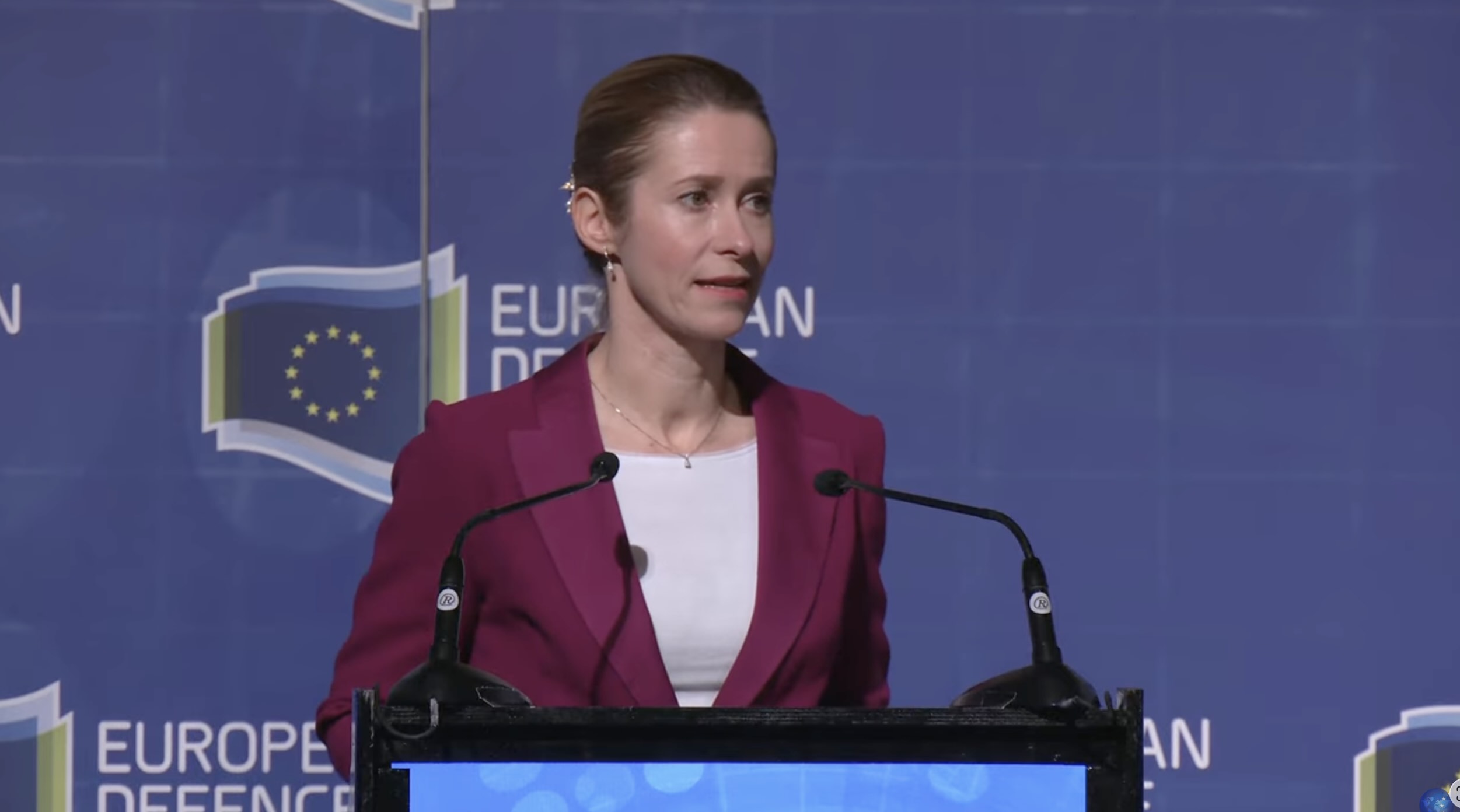
EU foreign policy chief Kaja Kallas told a European Defence Agency conference that Europe is no longer Washington’s main strategic focus and must take greater responsibility for security within NATO and in EU policy.
Speaking at the European Defence Agency’s annual conference on Wednesday, Kallas said the United States would remain “Europe’s partner and ally” but argued that European capitals should plan for a strategic environment in which American attention is increasingly directed beyond Europe.
“Europe is no longer Washington’s primary centre of gravity,” Kallas said, adding: “This shift has been ongoing for a while. It is structural, not temporary.”
Her remarks followed a period of heightened tension between European governments and the Trump administration, including a dispute over Greenland that tested relations between Washington and Copenhagen and prompted wider European debate about dependence on US security guarantees.
Kallas framed the moment as part of a broader weakening of international norms. She said the risk of “a full-blown return to coercive power politics, spheres of influence and a world where might makes right” was real. In the same speech she described Russia as a “major security threat”, China as a “long-term challenge” and the Middle East as “completely unpredictable”.
Using a school bell metaphor, Kallas said Europe was “dangerously close to the third bell”, and argued that governments should act with urgency across four areas: defence capability, defence industry, partnerships and innovation.
The EU’s top diplomat called for a shift from predominantly national approaches to more collective European action inside NATO and in EU security policy.
“As the US is setting its sights abroad and beyond Europe, NATO needs to become more European to maintain its strength,” Kallas said. “And for this, Europe must act.
Kallas’ intervention comes amid an active debate inside the alliance about burden sharing and European “pillar” capabilities. Euronews reported that NATO Secretary General Mark Rutte has faced criticism in Brussels and Paris after dismissing the prospect of Europeans becoming independent in security and defence, as the EU pursues new defence-spending and industrial initiatives.
In her address, Kallas argued that Europe’s core problem was not only the amount spent on defence but the way it is spent. She highlighted “fragmentation” and a lack of “complementarity” in European capability development, saying this makes Europe slower and reduces its effectiveness. She called for a shift “away from thinking like nations, towards acting jointly, as Europeans”, including in investment, procurement, maintenance and training.
She also pointed to gaps in “strategic enablers” that are too costly or complex for individual member states to develop alone, and urged governments to balance innovation with the continuing need for traditional systems as warfare evolves.
Kallas used the conference to pose questions that have become more prominent as the EU expands defence-related policy. She asked whether Europeans could identify “European” NATO capability targets that the EU could help to support, and whether member states could consider establishing EU military capabilities financed and owned collectively.
Beyond capability planning, Kallas pressed industry to accelerate output. She said Europe faces an “urgent need” to fill gaps while sustaining military support for Ukraine. In the same speech she referred to supporting Ukraine with €60 billion in military aid for 2026 and 2027, and argued that European industry must “deliver” so that additional spending does not flow largely to non-European suppliers.
The speech referred to EU measures intended to stimulate demand and joint procurement, including “Rearm Europe” and the SAFE instrument, and to a wider push to aggregate demand across member states. Kallas said this required political as well as industrial decisions: broader sharing of risk and responsibility among member states, and tighter coordination between EU institutions, the European Defence Agency and national governments.
Kallas’ message combined reassurance about the alliance with a warning about reliance. “No great power in history has ever outsourced its survival and survived,” she told delegates.