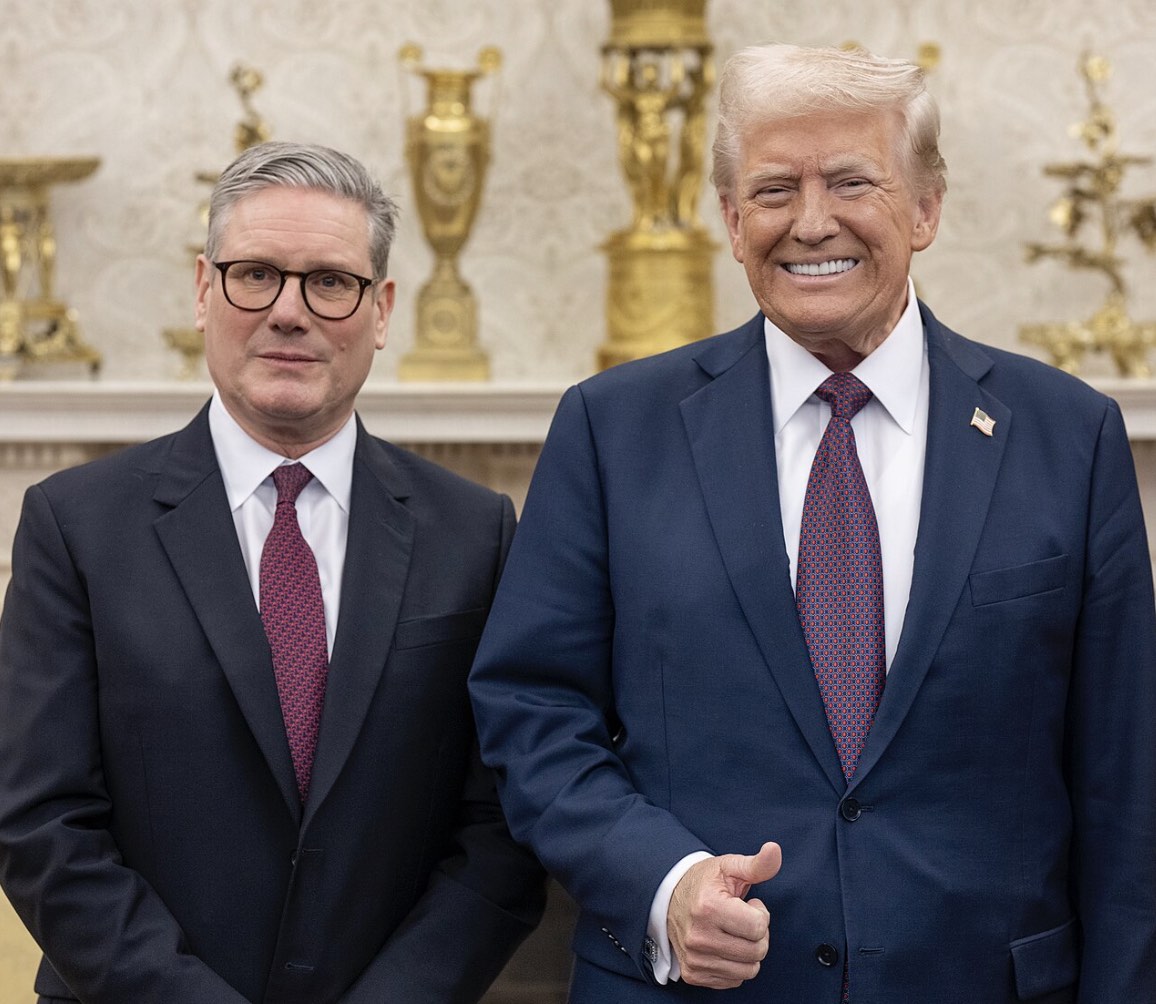
There were smiles, handshakes, and a carefully orchestrated photo opportunity in the Rose Garden with Prime Minister Keir Starmer standing beside President Donald Trump, both men proclaiming a “new chapter” in Anglo-American relations.
But look past the optics, and the reality is painfully clear: this deal is a triumph of style over substance, and it exposes the Prime Minister as little more than a supplicant in a game he doesn’t understand.
Critics on both sides of the Atlantic have wasted no time in calling the agreement what it is: symbolic fluff. Former trade minister Penny Mordaunt, hardly a voice prone to hyperbole, dismissed it as “underwhelming”. Labour backbenchers were left simmering over the total absence of parliamentary scrutiny, with some reportedly blindsided by the announcement altogether. This is the government of transparency and accountability, we were told. Yet the most consequential international agreement of Starmer’s premiership to date was treated like a private handshake deal, not a matter for democratic oversight.
Even the deal’s defenders admit it isn’t really about trade. “This deal isn’t about trade volumes – it’s about diplomacy,” Sir Ivan Rogers, the UK’s former ambassador to the EU, said. “Starmer wants to show he can manage a mature relationship with Trump, and Trump wants a win he can frame as pro-American.” In other words, it’s theatre. A performance carefully choreographed to reassure Washington and distract London.
But if symbolism is the point, what does this symbolise? For Starmer, it marks a dramatic pivot from his former posturing as a moralistic critic of Trumpism to a man willing to clasp hands with the most divisive American president in modern history for the sake of a few headlines. Gone is the former barrister who once lambasted Boris Johnson for being too cozy with populists. In his place stands a hollow pragmatist, desperate to prove himself on the world stage — even if it means abandoning every principle he once claimed to hold.
Indeed, this entire episode encapsulates what is increasingly clear about Starmer’s premiership: he stands for very little beyond political calculation. This was the man who promised to bring honesty and integrity back to government. Yet here he is, lending credibility to Trump — a man who tried to overturn a democratic election, mocks NATO, and regards multilateralism as a punchline. What sort of signal does that send to Britain’s allies, let alone its own electorate?
Of course, the irony is that Starmer’s desperate courtship of Trump may prove utterly fruitless. The deal itself contains few concrete provisions of economic significance. There are vague promises about regulatory alignment and cooperation on digital services, but no reduction in tariffs, no real access to US markets for British agriculture or services, and certainly no sign of the sweeping agreement Leave voters were once promised. This is not a “big beautiful” trade deal, to borrow Trump’s parlance. It is a diplomatic fig leaf designed to disguise the fact that Britain is still adrift.
Labour’s own benches know it. Several MPs have already voiced concern about the lack of consultation, with some questioning whether the government has learned anything from the Brexit era’s disastrous approach to international negotiation. Back then, the problem was Conservative arrogance. Today, it is Labour timidity. Starmer may have replaced Johnson’s bluster with quiet competence, but the outcome is the same: Britain on the back foot, grateful for scraps from Washington’s table.
What makes this all the more galling is that Starmer had a real opportunity to carve out a distinctive post-Brexit foreign policy — one grounded in democratic values, multilateral cooperation, and a reassertion of British interests. Instead, he has chosen the path of least resistance: appease Trump, avoid hard questions, and hope no one notices the vacuum at the heart of his leadership. It is a strategy of survival, not vision.
And survival, one suspects, is precisely what this deal is meant to ensure. With his domestic agenda faltering and polls beginning to tighten, Starmer needed a moment — something to seize the headlines and portray himself as a statesman. But leadership is not about looking the part. It’s about making decisions that reflect a coherent vision. A photo op with Trump is not strategy; it’s an admission that you have none.
In the end, the symbolism of this deal may endure — just not in the way Starmer intended. It will be remembered not as a milestone in UK-US relations, but as the moment Britain’s Prime Minister showed he would rather flatter a volatile American president than level with his own people. For all the talk of maturity, this was not diplomacy. It was desperation.
As for Trump, he got exactly what he wanted: another notch in his belt, another foreign leader dancing to his tune. Britain, meanwhile, is left holding a document full of platitudes, fronted by a Prime Minister who seems to believe that symbolism is a substitute for strength.
How long before the British public demands something more substantial?
Main Image: – https://twitter.com/WhiteHouse/status/1895235579773886901