
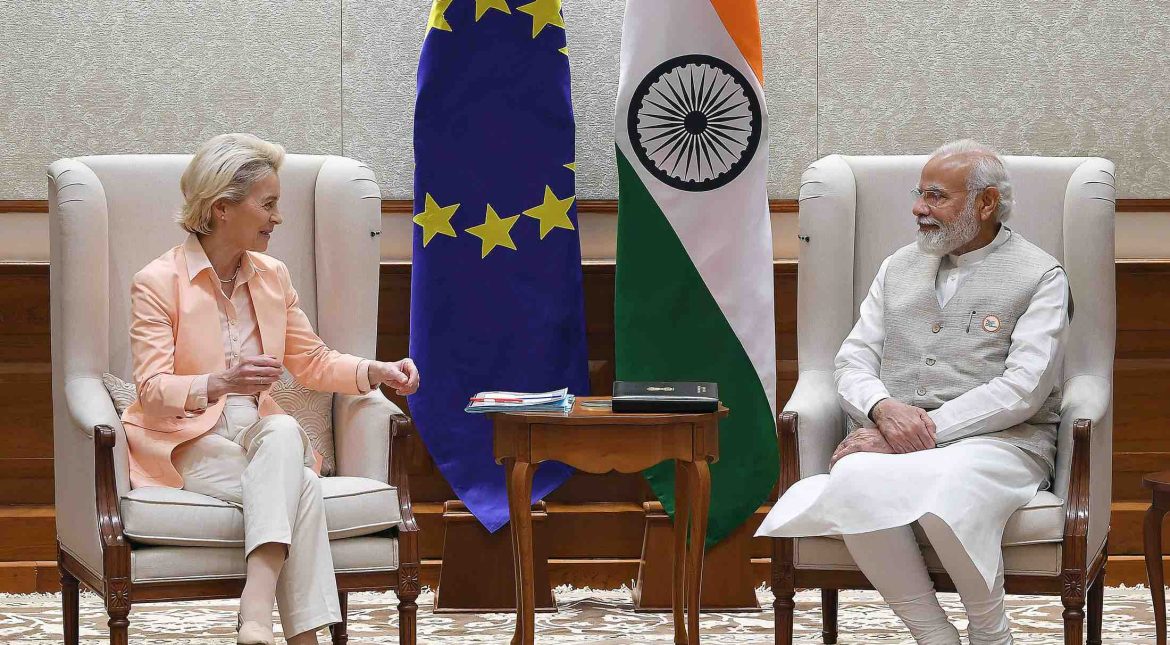
After years of false starts and diplomatic drift, Europe and India appear finally poised to conclude one of the most consequential trade agreements of the decade.
According to officials familiar with the talks, Brussels and New Delhi are expected to announce the conclusion of negotiations on a long-awaited free trade agreement at their summit this week — a moment that marks not merely the end of a negotiation, but the beginning of a strategic recalibration.
For too long, the India–EU trade relationship has been defined more by unrealised potential than concrete achievement. Talks were first launched in 2007, stalled repeatedly, and ultimately frozen for nearly a decade. That they have now been revived and brought to a conclusion says much about the changing global order — and about the growing confidence of both partners that closer economic cooperation is not just desirable, but necessary.
At its simplest, the deal promises practical benefits on both sides. European exporters stand to gain improved access to one of the world’s fastest-growing major markets, with tariffs reduced on cars, wines, spirits and industrial goods. Indian manufacturers, meanwhile, will enjoy easier entry into the EU’s vast consumer market for textiles, chemicals, pharmaceuticals and electronics. Bilateral trade already exceeds $130 billion annually; the agreement aims to take that figure considerably higher.
But to focus solely on tariffs would be to miss the wider significance. This agreement is as much about geopolitics as it is about commerce.
A Strategic Alignment in an Uncertain World
In an era defined by trade wars, supply-chain disruptions and mounting distrust between major powers, the decision by the European Union and India to deepen economic ties carries real symbolic weight. Both are large, pluralistic democracies navigating a world in which economic leverage has become a tool of statecraft.
For Brussels, the logic is clear. Europe has spent the past decade grappling with the risks of over-dependence — first on Russian energy, then on Chinese manufacturing. Strengthening ties with India offers diversification, resilience and a foothold in the Indo-Pacific that aligns with Europe’s long-term strategic interests.
For India, the deal represents something equally important: recognition. As New Delhi seeks to position itself as a manufacturing and technological powerhouse, enhanced access to the European market reinforces its status as a central player in global trade rather than a peripheral one. It also reduces reliance on any single partner at a time when trade relations with Washington have become more unpredictable.
A Vote of Confidence in Globalisation — Reimagined
Critically, the agreement also reflects a more mature model of globalisation. This is not the blunt, one-size-fits-all liberalisation of the 1990s, but a calibrated partnership that acknowledges regulatory differences while seeking alignment where it matters — on standards, investment protection and digital trade.
European negotiators have been keen to ensure that environmental and labour considerations are embedded in the agreement, while Indian officials have pushed back against what they view as protectionism by another name. That both sides have nonetheless reached common ground suggests a growing pragmatism in international trade diplomacy.
There will, inevitably, be compromises. Some European farmers remain wary of increased competition, while certain Indian industries fear regulatory complexity. Yet these concerns are not signs of weakness; they are the price of serious engagement. What matters is that the overarching direction is clear and constructive.
Economic Gains with Political Momentum
The timing of the agreement is also notable. With growth prospects in Europe subdued and India continuing to expand at pace, the economic complementarities are hard to ignore. European firms bring capital, technology and expertise; India offers scale, demographic dynamism and an increasingly sophisticated industrial base.
Moreover, the deal is likely to act as a catalyst for wider cooperation — from clean energy and critical minerals to digital infrastructure and research collaboration. In this sense, the trade agreement is less an endpoint than a foundation.
Ratification will still take time, particularly within the European Parliament, where trade deals face rigorous scrutiny. But the political momentum appears stronger than in previous attempts, buoyed by a shared understanding that strategic autonomy does not mean isolation.
A Signal Beyond Europe and India
Perhaps most importantly, the India–EU agreement sends a message beyond its signatories. At a moment when economic nationalism is on the rise and multilateral institutions are under strain, it demonstrates that open trade, negotiated carefully and fairly, remains possible.
This is not a naïve embrace of free markets at any cost, but a deliberate effort to shape globalisation rather than retreat from it. In that sense, the deal may prove influential well beyond the confines of Brussels and New Delhi.
If confirmed this week, the agreement will stand as a reminder that diplomacy, patience and mutual interest can still prevail in international economics. For Europe and India alike, it is a rare piece of genuinely good news — and one that deserves cautious celebration rather than reflexive scepticism.
Main Image: By Prime Minister’s Office, https://commons.wikimedia.org/w/index.php?curid=117587868
Click here for more News & Current Affairs at EU Today
Click here to check out EU TODAY’S SPORTS PAGE!
_____________________________________________________________________________________________________________________________

