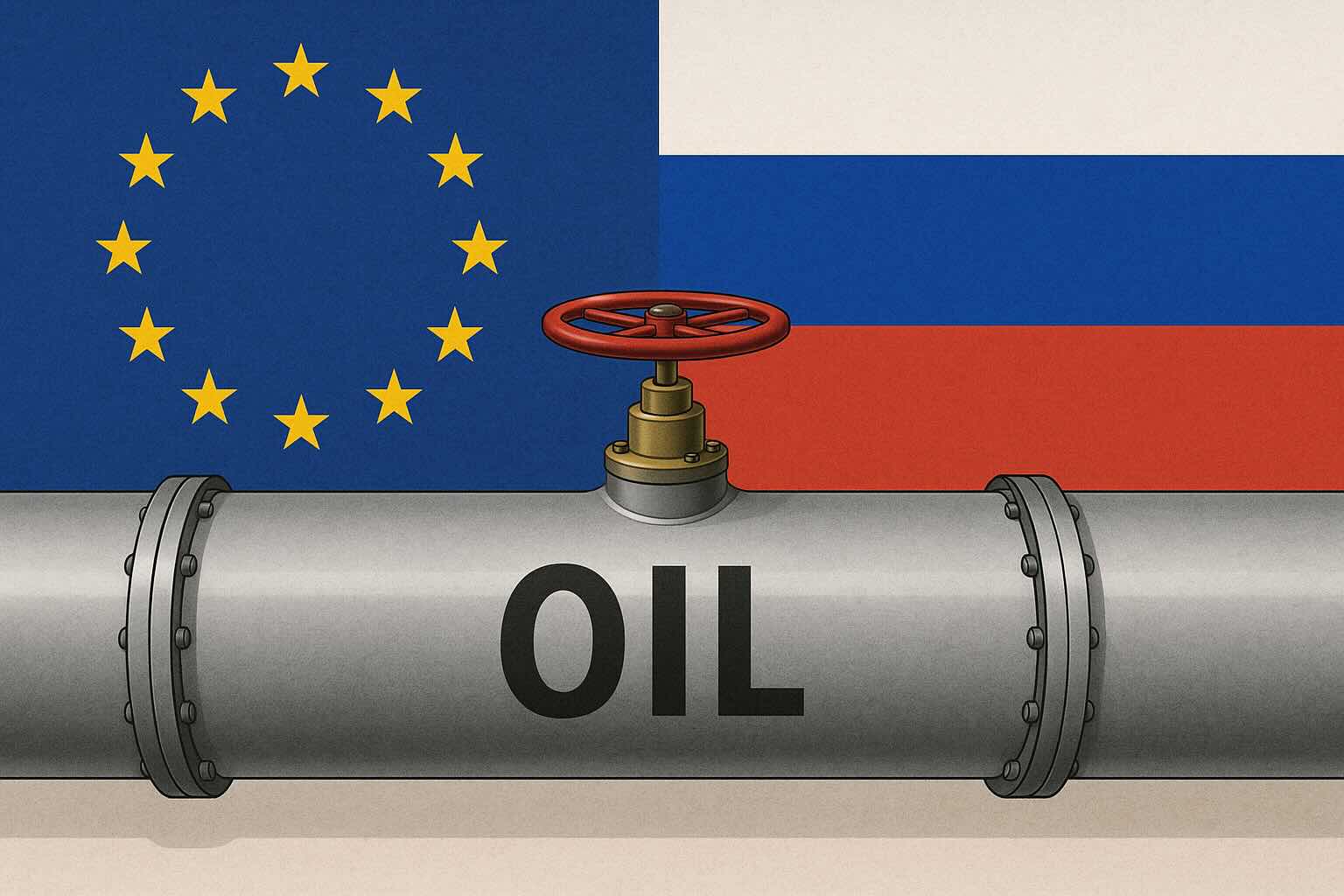
When Washington turns the screws on Moscow, it is often allies and partners who find themselves squeezed hardest. Nowhere is that clearer than in India, which has emerged as one of the biggest beneficiaries of discounted Russian crude oil — and now, one of the biggest targets of America’s new sanctions drive.
At the Asia Pacific Petroleum Conference (APPEC) on 8th September, Gunvor’s global head of research, Frederic Lasserre, warned that sanctions aimed at Russian oil buyers would mean little unless they directly touched India and China, the two markets that have effectively kept Russia’s oil revenues flowing despite years of Western pressure. Anything less, he argued, was “pure rhetoric” — symbolism without bite.
It was a sobering assessment, because it left India staring down the barrel of punitive measures. President Donald Trump has already slapped a 50 per cent tariff on Indian imports, portraying it as punishment for enabling Moscow’s war economy. Treasury Secretary Scott Bessent confirmed that Washington and Brussels are now weighing secondary sanctions, designed to penalise not just Russia but the nations that keep trading with it.
For New Delhi, this poses a strategic dilemma of the highest order. Since 2022, Russia has become one of India’s most important energy partners. Cut off from Western markets, Moscow offered crude at sharp discounts. India, hungry for cheap energy to power its breakneck growth, snapped it up. Within two years, Russia overtook Saudi Arabia and Iraq to become India’s largest crude supplier. By some estimates, more than 40 per cent of India’s oil imports now come from Russian barrels.
The economic rationale was unassailable. India’s refiners profited handsomely, often re-exporting refined products to Europe at a margin. Consumers benefited from lower inflationary pressure, a crucial factor for Prime Minister Narendra Modi’s government. Strategically, the purchases gave India energy security at a moment when the Middle East remained volatile.
But the political costs are rising. Washington’s tariff has already rattled India’s export-oriented industries. If secondary sanctions escalate — for instance, restricting access to dollar clearing or Western insurance for tankers — Indian refiners could face crippling uncertainty. Oil flows might be diverted through the so-called “shadow fleet” of ageing tankers, but at higher risk and cost.
The bigger issue is geopolitical. India has long prided itself on “strategic autonomy” — cultivating ties with both Washington and Moscow, while refusing to be dragged into either camp. This balancing act has grown more precarious since the Ukraine war. Western capitals expected India, as a fellow democracy, to distance itself from Russia. Instead, New Delhi doubled down, calculating that its national interest trumped Western solidarity.
That calculation may soon be tested. The Shanghai Cooperation Organisation summit last week saw Narendra Modi walking in step with Vladimir Putin and Xi Jinping, projecting solidarity against Western economic coercion. Yet India is not China. It still values its strategic partnership with the United States — from defence procurement to technology transfers — as a counterweight to Beijing’s rise. Sanctions on Russian oil buyers therefore risk driving a wedge into one of Washington’s most important Indo-Pacific alliances.
The irony is that sanctions rarely achieve their intended outcome when applied asymmetrically. Reuters analysis shows Russia’s oil trade has simply re-routed eastwards, with Asia now taking around 80 per cent of its exports. Discounts have narrowed, meaning Moscow’s coffers are far from empty. India’s refiners, meanwhile, are already adept at navigating the price-cap regime, using third-party traders and alternative shipping arrangements.
What Washington is really signalling is less about economics than politics: an effort to force India to choose. But history suggests New Delhi resists such binary choices. During the Cold War it championed the “non-aligned movement,” playing East and West off one another to preserve its independence. Today, the same instinct endures. Indian officials argue that buying Russian oil is not complicity but pragmatism — a way of stabilising global markets and keeping domestic growth on track.
Still, pressure will mount. If sanctions make Russian barrels harder to insure or finance, Indian refiners will face higher costs. If tariffs remain, exporters will feel the sting. And if Washington couples sanctions with incentives — preferential access to U.S. LNG, or expanded defence technology sharing — India may find the trade-off more tempting.
For now, however, Modi shows little sign of buckling. His government insists that energy policy cannot be dictated from abroad. With oil demand forecast to outpace China’s growth this year, India is unwilling to risk shortages or soaring prices for the sake of Western signalling. Domestic politics also play a role: cheaper fuel is vital to sustaining the economic momentum on which Modi’s popularity rests.
The risk is that India becomes collateral damage in a sanctions regime that has already shown diminishing returns. Instead of isolating Russia, the measures may harden an emerging bloc of energy-hungry nations determined to chart their own course. In the long run, Washington may discover that trying to strong-arm India — a country it needs to balance China — is a self-defeating strategy.
Sanctions work best when they are broad, coordinated, and clearly linked to achievable goals. Today’s patchwork of measures looks more like improvisation: tariffs here, caps there, and threats of secondary sanctions that may never be enforced. For India, that means uncertainty. For the West, it means risking the goodwill of the very partner it needs most in Asia.
As Lasserre warned, without action against buyers like India and China, sanctions are little more than theatre. Yet if Washington does follow through, it may find the backlash far outweighs the benefits. India, the world’s most populous democracy and a rising economic giant, is unlikely to bend easily.
In the end, the question is whether America values isolating Russia more than anchoring India in its strategic orbit. The answer will shape not only the future of global oil flows, but the balance of power in Asia for decades to come.