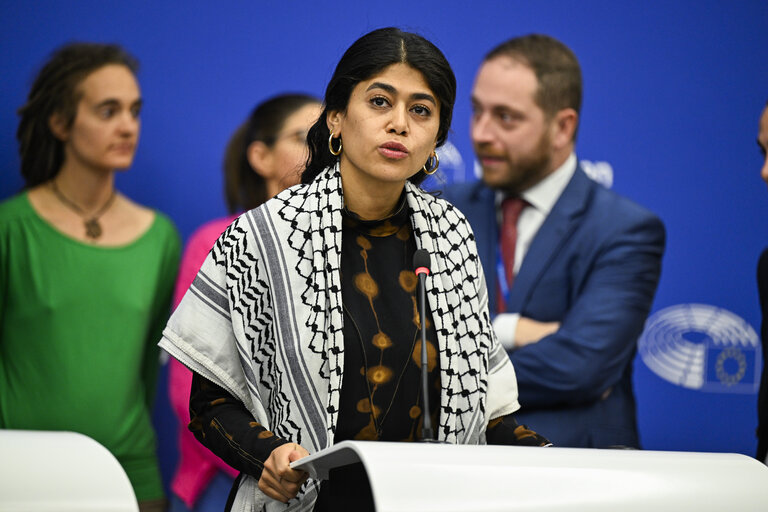
The arrest, prosecution and political fallout surrounding French MEP Rima Hassan has quickly become a flashpoint in a wider debate about security, free expression and the limits of political activism in France.
When placed alongside the government’s controversial decision to ban a major Muslim gathering in the Paris region, a picture emerges of a country navigating an increasingly fraught intersection of domestic security concerns and ideological confrontation.
At the centre of the storm is Hassan, a first-term Member of the European Parliament elected in 2024 on the ticket of the far-left France Unbowed movement. A vocal advocate for Palestinian causes, she has built her profile on outspoken criticism of Israel and Western foreign policy. That prominence, however, has now drawn her into a legal battle that could define both her career and the broader boundaries of political speech in France.
.
The case against Hassan stems from a social media post referencing a 1972 attack carried out by the Japanese Red Army at Lod Airport in Israel, in which 26 people were killed. French authorities allege that her comments amounted to an “apology for terrorism,” a serious criminal offence under French law. Following her arrest and several hours in police custody, prosecutors confirmed she will stand trial in July 2026. If convicted, she could face up to seven years in prison and a substantial financial penalty.
Hassan has denied wrongdoing, and her allies have been quick to frame the prosecution as politically motivated. Figures within France Unbowed argue that the case reflects an attempt to silence dissenting voices, particularly those critical of Israel or supportive of Palestinian activism. This narrative has found resonance among parts of the European left, where concerns over shrinking space for controversial political speech have been growing.
Yet the French government has taken a markedly different stance. Interior Minister Laurent Nunez has stressed that the law is clear: endorsing or appearing to justify acts of terrorism crosses a legal red line. In this framing, Hassan’s case is not about politics but about maintaining the integrity of laws designed to combat extremism and protect public safety.
The controversy does not exist in isolation. It comes at a time of heightened security tensions across France, driven in part by fears of both Islamist and far-right violence. These concerns were underscored by a recent decision by Paris police to ban a large annual gathering of French Muslims scheduled to take place in Le Bourget, just north of the capital.
Authorities justified the ban by citing a “significant terrorist risk,” warning that the event could become a target for attacks or be disrupted by extremist groups. The decision followed a foiled bombing attempt in Paris reportedly linked to a pro-Iranian network, reinforcing the perception of an elevated threat environment.
Officials also pointed to a “particularly tense” national and international context, including ongoing conflicts in the Middle East and an increasingly polarised domestic political climate. In such conditions, large-scale gatherings—even those intended as peaceful cultural or religious events—are viewed through a security-first lens.
Critics, however, argue that the ban risks stigmatizing Muslim communities and undermining civil liberties. For them, the juxtaposition of Hassan’s prosecution and the cancellation of the gathering is telling: both, they suggest, reflect a broader tightening of state control over politically sensitive expression and assembly.
Supporters of the government reject that interpretation, insisting that the measures are proportionate responses to genuine threats. France, after all, has experienced multiple terrorist attacks over the past decade, and public tolerance for risk remains low. In this context, pre-emptive action is often framed as a necessary, if imperfect, tool of governance.
What makes the current moment particularly volatile is the convergence of these issues. Hassan’s case touches on international politics, identity and historical memory, while the gathering ban speaks to domestic cohesion and the challenge of managing diversity under pressure. Together, they highlight the difficulty of balancing competing imperatives: security versus liberty, prevention versus participation.
There is also a European dimension. As a sitting MEP, Hassan’s prosecution raises questions about parliamentary immunity and the extent to which national authorities can pursue legal action against elected representatives for political speech. While the European Parliament has so far limited its response to procedural observations, the case is likely to be closely watched in Brussels and Strasbourg.
Meanwhile, the broader political climate in France continues to evolve. The government is reportedly preparing new legislation aimed at preventing the infiltration of religious organisations by extremist elements, a move that could further reshape the landscape in which groups operate.
For Roma Hassan, the immediate future is clear: a court appearance in July that will place her statements, intentions and political identity under intense scrutiny. For France, the implications are wider and more enduring. The outcome of her trial—and the public reaction it provokes—may well influence how the country navigates the delicate balance between safeguarding its citizens and preserving the freedoms that underpin its democratic system.
Main Image: Laurie DIEFFEMBACQ © European Union 2024 – Source : EP Usage terms: Identification of origin mandatory
France Draws a Firm Line on Security as Paris Muslim Gathering Is Banned
Click here for more News & Current Affairs at EU Today
Click here to check out EU TODAY’S SPORTS PAGE!
___________________________________________________________________________________________________________________