
Vessels listed in or commercially associated with Cool Carriers have appeared in European cocaine-smuggling cases across Denmark, Ireland, Britain and Estonia. The company’s Russian-linked ownership history and senior management background raise wider questions over maritime due diligence, vessel control and sanctions screening in Europe.
European authorities are confronting a problem that sits between organised crime, maritime logistics and sanctions enforcement: the use of legitimate cargo routes by cocaine-trafficking networks, including vessels linked to companies with opaque or politically sensitive ownership histories. The European Commission has already identified ports and logistics chains as a priority vulnerability through its European Ports Alliance, which is intended to support port authorities, customs services and shipping companies in countering organised crime.
One case now attracting attention is Cool Carriers, a major refrigerated shipping operator whose vessels have been cited in separate European cocaine-related investigations and court proceedings. The company specialises in reefer shipping — the refrigerated transport of fruit and other perishable cargo — a sector known to be vulnerable to cocaine concealment, particularly in banana shipments from Latin America, as shown by OCCRP reporting on cocaine hidden in Ecuadorian banana cargoes bound for Russia.
Cool Carriers describes itself as the world’s largest operator of specialised refrigerated vessels, operating 50 ships with more than 30 million cubic feet of cargo capacity. Its listed fleet includes Cool Explorer, Cool Eagle, Cool Express and Baltic Spirit. The company presents itself through European-facing structures, with offices including Cyprus and Sweden, but its modern corporate history includes a significant Russian link. In 2014, NYK Europe announced that Baltic Reefers, based in St Petersburg, had acquired NYKCool AB, after which the business returned to the name Cool Carriers. Industry outlet Fruitnet described the transaction as placing the Sweden-based group under Russian ownership.
That background matters because the issue is not simply whether drugs were hidden on or near individual vessels. It is whether European authorities have sufficient visibility over the companies, managers, charterers, owners and commercial operators behind high-risk cargo routes. In shipping, the entity that operates a vessel commercially may be different from the registered owner, the technical manager, the crew employer and the party controlling onboard activity. bne IntelliNews reported this distinction in relation to Cool Carriers’ response to Danish allegations, while the EU’s Ports Alliance reflects the broader concern that criminals exploit precisely such logistics and control gaps.
The strongest criminal case concerns Cool Explorer. The Irish Examiner reported from Ireland’s Special Criminal Court that GPS-tagged cocaine bags found on Danish beaches were linked by prosecutors to a failed plot involving a Panama-flagged ship called Cool Explorer. The court heard that a rigid inflatable boat from West Cork had allegedly attempted to meet the vessel off the British coast in March 2024. A later court report said that around 850kg of cocaine washed up in Denmark, and that GPS devices attached to the bags matched coordinates used by Cool Explorer. Seven of the ten men arrested in the case later pleaded guilty to conspiracy to import drugs, according to further Irish Examiner reporting.
Danish reporting has widened the issue. bne IntelliNews, citing TV2, reported allegations that cocaine consignments were thrown overboard from Cool Explorer and Cool Eagle, which were transporting bananas from Ecuador to St Petersburg. Cool Carriers rejected the allegations as “categorically false”. Its chief operating officer, Glenn Selling, told bne that the company was only the commercial operator of the vessels, not their owner, crew employer or day-to-day operational controller. That denial is significant, but it also illustrates the central policy problem: criminal networks may exploit precisely those divided layers of responsibility.
A British case adds a further example. In October 2023, the UK National Crime Agency said police divers had recovered 137kg of cocaine from a Panamanian-registered ship carrying bananas at Sheerness. The drugs, worth about £10 million, were hidden below the waterline in four large holdalls. The NCA did not name the ship publicly, but The Maritime Executive identified it as Cool Express by reference to the visible IMO number. The vessel is listed among the Cool Carriers fleet.
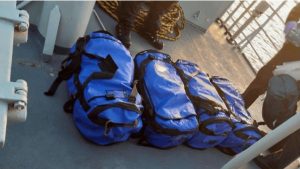
Cocaine on board the Cool Express
A third case, involving Baltic Spirit, is more ambiguous but still relevant to the risk picture. Estonian authorities detained the vessel in February after receiving information from foreign partners about suspected smuggling while it was travelling from Ecuador to St Petersburg. Estonian public broadcaster ERR later reported that no narcotics were found and the vessel was released. The Insider reported that Baltic Spirit was operated by Cool Carriers Ltd, a Cyprus-registered company. That outcome does not remove the wider concern: a vessel on a Latin America–Russia route was considered sufficiently sensitive for intervention by an EU border state.
The route itself is not incidental. OCCRP has reported that cocaine concealed in banana shipments from Ecuador has increasingly appeared on routes linked to Russia. Russian officials announced a major seizure of cocaine hidden in bananas from Ecuador, while intelligence cited by OCCRP described Russia as an “important player” in the diversification of trafficking routes. Ecuador is also central to the global banana trade, making refrigerated cargo both economically legitimate and attractive to traffickers.
The company’s senior management background adds another layer of scrutiny. Cool Carriers’ own team page lists Mikhail Ganyushin as chief executive, Maxim Nazimok as group managing director and David Kukhalashvili as head of chartering. The company’s announcement of Nazimok’s appointment says that he previously served as chief financial officer of Solidcore Resources, formerly Polymetal, and had earlier worked in corporate finance.

Top managers of Cool Carriers: screenshot from the company’s website
This is relevant because Polymetal’s Russian structure later became subject to US sanctions. OFAC has stated that the US Department of State designated Russia-based Polimetall AO in May 2023, while clarifying that the blocking sanctions applied to that entity and companies majority-owned by it, not automatically to the wider parent group. Solidcore also announced that Vitaly Nesis and Maxim Nazimok had resigned from executive positions with the Russian-registered JSC Polymetal and its subsidiaries after the designation.
Fakty, the Ukrainian outlet that first assembled these strands into a broader investigation, also points to alleged indirect links between Ganyushin’s business circle and Boris Usherovich, a Russian businessman associated by compliance researchers with Russian Railways-related sanctions-evasion networks. Kharon has described Usherovich and Aleksey Krapivin as key figures whose companies facilitated imports of goods needed for Russian railway maintenance despite sanctions. The public material checked does not establish that Usherovich owns or controls Cool Carriers, but the alleged connection underlines why beneficial ownership and related-party screening matter.
The sanctions issue should therefore be understood precisely. This is not a case where Russian links alone justify designation. Nor does the public record show that Cool Carriers itself is sanctioned. The question is whether European regulators are equipped to identify hidden control, economic benefit or operational influence when a company has Russian-linked ownership history, Russian corporate management backgrounds, Cyprus-facing structures and vessels operating on routes repeatedly associated with narcotics risk. The European Commission’s Russia sanctions guidance makes clear that restrictive measures are aimed at Russia’s war capacity, while ownership, control and circumvention are central to enforcement.
That question has direct policy relevance. The EU’s 20th Russia sanctions package strengthened measures against circumvention, shipping networks, the shadow fleet and third-country channels used to evade restrictions. But sanctions enforcement depends on information: who owns the vessel, who controls it, who charters it, who earns from it, who insures it, who manages the crew, and who benefits from the cargo flow. Without that visibility, both organised crime and sanctions evasion can exploit the same gaps.
For EU member states, the Cool Carriers case points to a practical enforcement agenda. Port authorities and customs agencies should be able to subject high-risk refrigerated cargo routes to enhanced inspection, consistent with the EU’s European Ports Alliance. Financial intelligence units should be able to trace payments between shipowners, operators, charterers, cargo interests and intermediaries. Company registries should be able to identify beneficial owners and politically exposed or sanctions-relevant links, a concern reflected in wider EU work on beneficial ownership and anti-money-laundering rules. Europol and Eurojust should be able to connect cases where the same vessels, operators, routes or cargo patterns appear across several jurisdictions.
The lesson is not that every Russian-linked shipping company is criminal, or that every vessel on an Ecuador–Europe–Russia route is suspect. The lesson is that Europe’s enforcement systems still struggle with fragmented maritime responsibility. A vessel can be legally owned by one entity, commercially operated by another, technically managed by a third, crewed by a fourth and used by criminals without any single layer accepting responsibility. That problem is visible in Cool Carriers’ own response reported by bne IntelliNews, where the company distinguished commercial operation from ownership, crewing and onboard control.
Cool Carriers has denied operational involvement in allegations reported by Danish media. That denial deserves to be reported. But the pattern of cases involving vessels listed in or commercially associated with its fleet still raises a question Europe cannot avoid: when high-risk cargo routes, Russian-linked corporate histories and divided vessel-control structures overlap, who in the European system is responsible for connecting the dots? The question is directly linked to the EU’s stated priorities on port security, organised-crime enforcement and sanctions circumvention.



