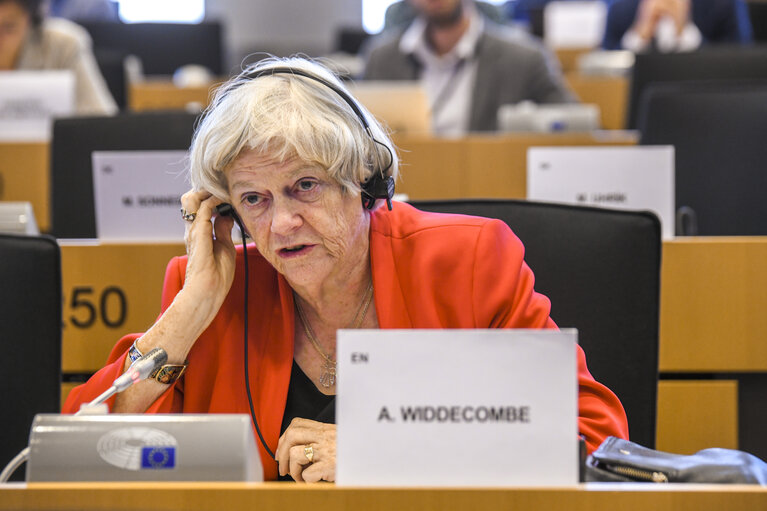
The passing of Ann Widdecombe closes a chapter in British public life that is unlikely to be repeated.
Reports of her death have rightly prompted tributes from across the political spectrum, and although many will remember the television personality, the bestselling author or the irrepressible parliamentary performer, those of us who were lucky to know her will remember somebody rather different: a politician whose convictions were not crafted for electoral convenience but forged long before focus groups became the currency of Westminster.
I first came to know Ann through the London Swinton Circle, that venerable Conservative debating society which for decades has attracted parliamentarians, journalists, diplomats and thinkers prepared to exchange ideas rather than slogans. She later remained a familiar figure during her years in the European Parliament.
In both settings, she was precisely the same person the public saw. There was no private Ann and public Ann. The wit was genuine, the courtesy unfailing and the opinions entirely her own.
That consistency is perhaps her greatest political legacy.
British politics has become increasingly professionalised. Today’s aspiring ministers are often schooled in message discipline, social media presentation and the careful avoidance of controversy. Ann Widdecombe belonged to an older tradition in which politicians were expected first to possess beliefs and only afterwards to communicate them. Whether one agreed with her conclusions was almost secondary. One never doubted that she had arrived at them honestly.
It is difficult to overstate how refreshing that was.
During her long career as a Conservative Member of Parliament, she emerged as one of the party’s most recognisable voices. Her tenure as Shadow Home Secretary demonstrated a seriousness about criminal justice that was sometimes caricatured by opponents but has aged remarkably well. She believed that government owed its citizens security, that the law should command public confidence and that victims deserved at least as much consideration as offenders. Those arguments, once dismissed by some as unfashionably robust, have steadily returned to the centre of political debate.
Ann was never afraid to stand outside the prevailing consensus.
That independence occasionally frustrated her own party as much as it did her political opponents. Yet healthy political parties have always relied upon independent minds as well as loyal administrators. Conservatism, at its best, has been a broad church precisely because it accommodates strong personalities rather than suppressing them.
She was unquestionably one of those personalities.
The Swinton Circle debates offered a revealing glimpse into her character. She listened carefully, challenged assumptions without rancour, and invariably preferred reasoned argument to theatrical point-scoring. Afterwards she was just as likely to continue the conversation over a glass of wine as she had been to dominate the discussion itself. There was an intellectual curiosity about her that rarely featured in television caricatures.
That quality remained evident in Brussels. The European Parliament has often been dismissed in Britain as an anonymous institution populated by anonymous politicians. Ann was neither. Even those who profoundly disagreed with her respected her willingness to engage directly and without pretence. She possessed something increasingly scarce in politics: the confidence to disagree without becoming disagreeable. She always maintained her integrity.
Modern commentators sometimes describe conviction politicians as divisive. Personally, I have always found the opposite to be true.
Democracies require people prepared to articulate clear positions because genuine debate cannot exist if everyone speaks in carefully calibrated platitudes. Ann understood that politics is ultimately an argument about ideas, not simply a competition for favourable headlines.
There was, too, an unmistakable sense of duty about her public life. Politics was never merely a career. It was a vocation. She approached parliamentary service with seriousness, diligence and an almost old-fashioned belief that elected representatives should say what they mean and mean what they say.
That is a rarer virtue than Westminster sometimes cares to admit.
Her departure from the Conservative Party over Brexit inevitably altered the final chapter of her political career, but it should not diminish what came before. For more than three decades she helped define modern British Conservatism, challenging colleagues and opponents alike to think more deeply about questions of justice, sovereignty, personal responsibility and national identity. Even when history ultimately judged against her on particular issues, nobody could accuse her of trimming her sails to suit the political weather.
Integrity carries its own authority.
The public often warmed to Ann precisely because she appeared immune to the relentless pursuit of popularity. In an age increasingly dominated by image consultants, she remained gloriously indifferent to fashion. She never sought celebrity, yet celebrity found her. She never chased public affection, yet she earned widespread respect because people instinctively recognised authenticity when they encountered it.
Looking back now, what strikes me most is not any single speech or parliamentary exchange but the consistency of the woman herself. The Ann Widdecombe who spoke at the Swinton Circle was the Ann Widdecombe who debated in Westminster, represented Britain in Brussels and appeared before millions on television.
The same Ann Widdecombe who delighted millions with her appearance on Strictly Come Dancing in 2010.
British politics has produced many successful politicians. It has produced rather fewer memorable ones. Ann Widdecombe belongs firmly to the latter category.
She leaves behind a political culture that would benefit enormously from rediscovering some of the virtues she embodied: intellectual honesty, moral courage, civility towards opponents and the confidence to hold convictions that did not shift with the prevailing winds.
She was never the easiest politician to agree with, she was, however, among the easiest to respect. She was also a lovely lady, and a real Conservative.
Main Image: Photographer: Emilie GOMEZ © European Union 2019 – Source : EP Usage terms: Identification of origin mandatory
__________________________________________________________________________________________________________________
Click here for more News & Current Affairs at EU Today
Click here to check out EU TODAY’S SPORTS PAGE!
___________________________________________________________________________________________________________________