
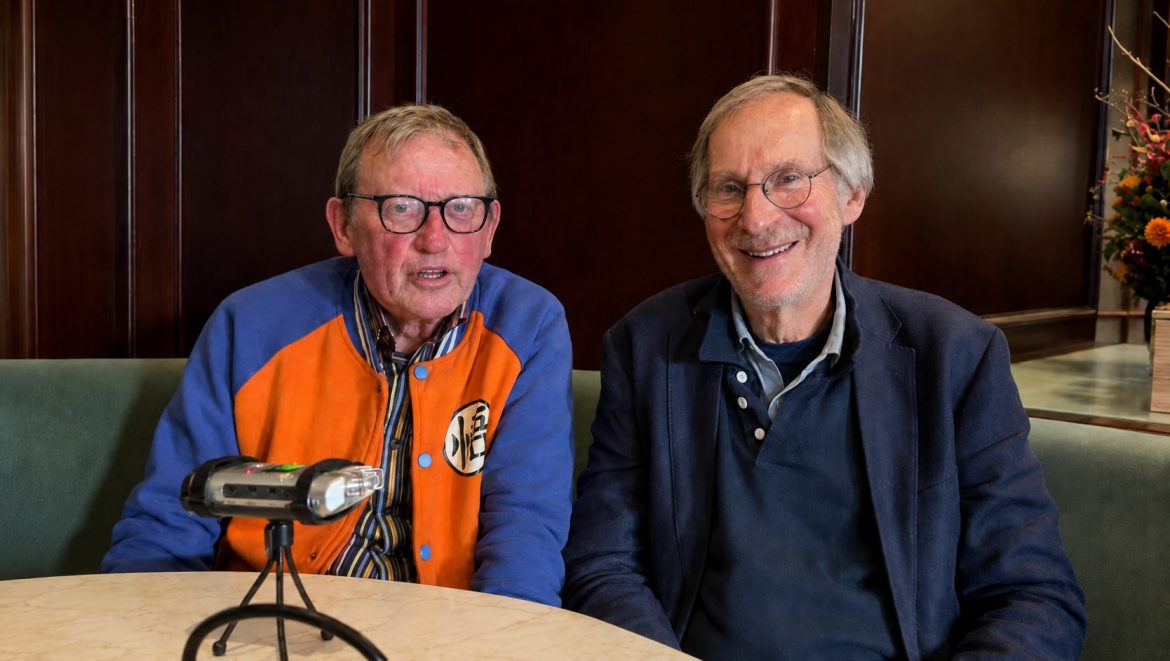
In a new podcast recorded in Antwerp, American jazz pianist David Janeway speaks with Leo Reijnders of The Cloudknitters about music, psychiatry, spirituality, artificial intelligence and the continuing role of art in public life.
American jazz pianist David Janeway joined artist and broadcaster Leo Reijnders of The Cloudknitters for a podcast recorded in Antwerp shortly before Janeway’s performance at De Muze, one of the city’s long-established jazz clubs.
The conversation, recorded on 14 May 2026, followed the release of Janeway’s new live trio album, Live at Blue Llama, and forms part of his wider European tour, which has brought the pianist back to Belgium and France after previous appearances in Brussels.
The interview opens with Janeway reflecting on his earliest contact with music. He describes growing up in a family where “everyone played the piano”, including his parents, grandparents and sister. His first instrument was a toy piano, before formal classical lessons began when he was still a young child.
“I would say that I was born playing the piano,” Janeway tells Reijnders, explaining that music was already part of the family environment before it became a professional direction. He studied classical piano until his early teens, but later moved towards jazz after hearing Oscar Peterson, whom he saw perform when he was about 14.
That encounter, he says, changed the direction of his life. At the time, he had been playing rock and roll in bands, but jazz offered something he did not find in classical music: improvisation.
“I felt a little stifled after a while with classical, having to play exactly what’s written on the paper and not being able to improvise,” he says. Jazz, by contrast, became the form that allowed him to explore sound, structure and freedom at the same time.
Janeway links that musical development to Detroit, where he grew up. He describes the city’s African-American musical tradition as central to his formation, citing the influence of gospel, swing, bebop, blues and Motown. In his account, Detroit was not simply a background, but a living musical environment in which jazz was part of a wider cultural history.
The conversation also moves beyond music. Janeway discusses his second professional life as a psychiatrist, a field in which he worked for three decades before retiring around five years ago to return to music full-time. He sees a clear connection between psychiatry and jazz, particularly in the disciplines of listening, response and improvisation.
Both, he says, depend on attention to the person or musicians in front of you. In psychiatry, as in jazz, no two encounters are identical. There are tools, but also a need to respond in the moment.
“Each person is different and each session is different,” Janeway says. “There is a lot of improvisation.”
Reijnders and Janeway also discuss whether jazz is intellectual, emotional or spiritual. Janeway does not present the answer as a choice between categories. He describes music as something that can pass through the player when ego is set aside, creating a shared experience between musicians and audience.
“If the music is being played with this kind of openness,” he says, “the music is playing us.”
That idea leads into a broader discussion of art and society. Janeway argues that artists, musicians, writers and performers have a public role because they protect freedom of expression and human connection. He says the arts are particularly important at a time when political pressure, censorship and technological change are reshaping public life.
The interview also touches on artificial intelligence. Janeway expresses concern about what he sees as a growing process of dehumanisation, including in healthcare and public services, where human contact is increasingly replaced by automated systems. In that context, he argues, music and art retain a practical importance because they bring people together in a shared physical and emotional space.
For Janeway, jazz clubs remain part of that human setting. People come not only to hear music, but also to connect with others, listen, relax and experience something that cannot be fully standardised or automated.
The podcast includes short excerpts from Janeway’s new album, allowing the conversation to sit alongside the music that prompted it. His latest EU Today feature described Live at Blue Llama as a live trio recording with bassist Robert Hurst III and drummer Billy Hart, recorded at the Blue Llama Jazz Club in Ann Arbor, Michigan.
In Antwerp, however, the focus is not only on the album, but on the wider artistic life behind it: childhood discipline, Detroit jazz, New York, psychiatry, improvisation and the continuing search for human meaning through music.
The result is a conversation less about promotion than reflection. It presents Janeway as a musician still rooted in the jazz tradition, but also as an artist thinking about the place of creativity in a world where personal expression, attention and live human encounter are becoming more important, not less.
David Janeway returns with new album Live at Blue Llama ahead of European tour

