
Campaigners from the Belgian Anti-fur Movement (BAM) demonstrated outside the Louis Vuitton store in Antwerp on Saturday, stepping up pressure on luxury brands still associated with the fur trade while the European Commission prepares its long-awaited response to the Fur Free Europe citizens’ initiative in March.
EU Today spoke at the protest with BAM representatives, including Bart Vandesande, coordinator and spokesperson for the Belgian Anti-fur Movement, who said the Antwerp action was part of a broader campaign aimed not only at individual luxury brands but at securing a Europe-wide ban on both fur farming and the sale of fur products across the bloc.
The Antwerp demonstration followed actions in Brussels last week, where GAIA, BAM and members of the Fur Free Alliance gathered in front of the European Commission’s Berlaymont headquarters to call for a definitive end to the fur industry in Europe. GAIA said the Brussels action was intended to remind the Commission that it must now decide whether to move towards an EU-wide prohibition or opt instead for more limited animal welfare rules.
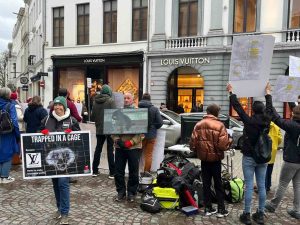
Protesters gathered outside the Louis Vuitton store in Antwerp
For BAM, the focus on Louis Vuitton is deliberate. The movement has repeatedly targeted brands within the LVMH group, arguing that major luxury houses still play a role in sustaining demand for fur even as much of Europe has moved away from production. Campaigners say their message is straightforward: if Europe is serious about ending the fur trade, action must address not only farms but also the retail market.
That argument reflects the central demand of the Fur Free Europe European Citizens’ Initiative, which called on the Commission to prohibit the keeping and killing of animals for fur production and to ban the placing on the EU market of farmed fur and products containing it. The initiative cleared the required threshold with 1,502,319 validated signatures and support across 18 Member States, making it one of the most significant successful citizens’ initiatives in the field of animal welfare.
Under the Commission’s published timetable, Brussels is due to communicate by March 2026 on what it considers the most appropriate follow-up. The options outlined by the Commission include proposing a prohibition, after a transition period, on keeping and killing mink, foxes, raccoon dogs and chinchillas for fur, and a corresponding prohibition on placing fur from those farmed animals on the EU market. The alternative would be EU legislation setting welfare standards rather than an outright ban.
That decision has become more politically significant after the European Food Safety Authority published its scientific opinion in July 2025. EFSA concluded that the main animal welfare problems in fur farming stem from the size and barren nature of cages and said that most of the negative welfare consequences identified could not be significantly reduced within the current production system. The opinion has been widely cited by campaigners as evidence that stricter technical standards would not resolve the core issue.
 BAM presents itself as a direct-action anti-fur movement focused on pressuring brands and retailers to adopt fur-free policies. Its public campaigning has centred particularly on LVMH brands operating in Belgium. Campaign material from the group says that Louis Vuitton and Dior remain targets until LVMH adopts a fur-free policy. Separate advocacy groups have also continued to list LVMH among the major luxury groups without a public fur-free commitment covering brands such as Louis Vuitton and Dior.
The Belgian dimension is also important. Fur farming has already come to an end in Belgium, but campaigners argue that banning domestic production is only a partial measure if imported fur can still be sold. GAIA says fur production in Belgium ended definitively in 2023, yet the sale of fur remains legal, which is why activists are increasingly directing their efforts towards shops, fashion houses and EU institutions rather than farms.
Last week’s demonstration in Brussels underlined that broader strategy. GAIA and the Fur Free Alliance said more than 15 Member States, including Belgium, have already banned fur farming, and argued that the next logical step is legislation covering both production and sales across the European Union. They also pointed to continuing public pressure in Belgium, where GAIA says polling indicates support for restrictions on fur sales.
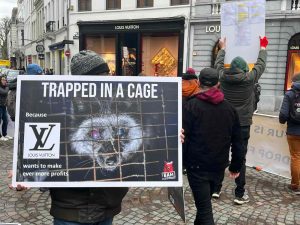 For the activists gathered in Antwerp on Saturday, the objective is therefore twofold: to increase pressure on a luxury brand they regard as emblematic of the remaining fur market, and to keep public attention on the Commission before its March decision. Whether Brussels now opts for a full legislative ban or a narrower welfare-based approach will determine whether campaigns such as BAM’s can claim they have helped push the issue from the pavement outside a shop window to the centre of EU lawmaking.



