
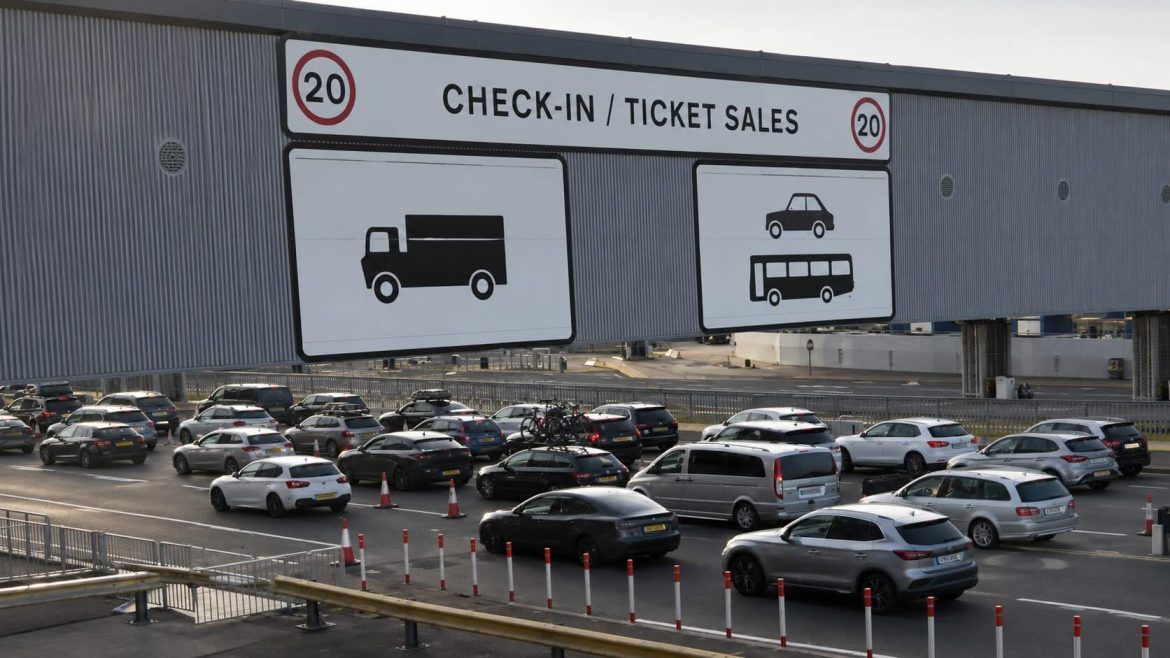
The summer travel pressure at Dover shows how a border technology delay can quickly become a political and economic problem for the UK-France corridor.
The Port of Dover is facing renewed concern over congestion as the busiest summer travel weekend begins with parts of the EU’s Entry-Exit System still not operating as intended for car passengers.
The Guardian reported on 17 July that French border police at Dover are having to rely on manual logging for non-EU travellers because of software problems affecting the automated system. The report said Dover expected thousands of cars on Friday and Saturday, while domestic travel pressure and hot weather added to wider transport strain.
The Entry-Exit System is meant to replace manual passport stamping for non-EU nationals entering the Schengen area by recording biometric and travel data. It is a border-control modernisation project, but Dover has always been a difficult test case because of high volumes and juxtaposed French controls on UK soil.
The risk is practical, not abstract. If kiosks, software or processing flows fail at peak times, delays build quickly. The port has spent heavily preparing for the system, but infrastructure investment does not solve the problem if the operational technology is not ready.
The issue also matters for EU-UK relations. Border friction remains one of the most visible consequences of Brexit for ordinary travellers and freight operators. Even when a problem is technical, it is experienced politically: queues, missed sailings and local disruption become evidence of a system that is not working.
For Brussels, the challenge is credibility. The EU wants more secure external borders and better data on short-stay entries. But security systems lose public support if they are associated with avoidable disruption at high-volume crossings.
For the UK, Dover is a national pressure point. The port carries a large share of roll-on, roll-off traffic and holiday travel. Congestion can spill into Kent roads, logistics schedules and local policing.
The EES rollout will remain a test of whether digital border control can handle real-world travel peaks. A system designed to make checks more efficient cannot be judged only by its legal architecture. It will be judged by whether people and goods keep moving.

