
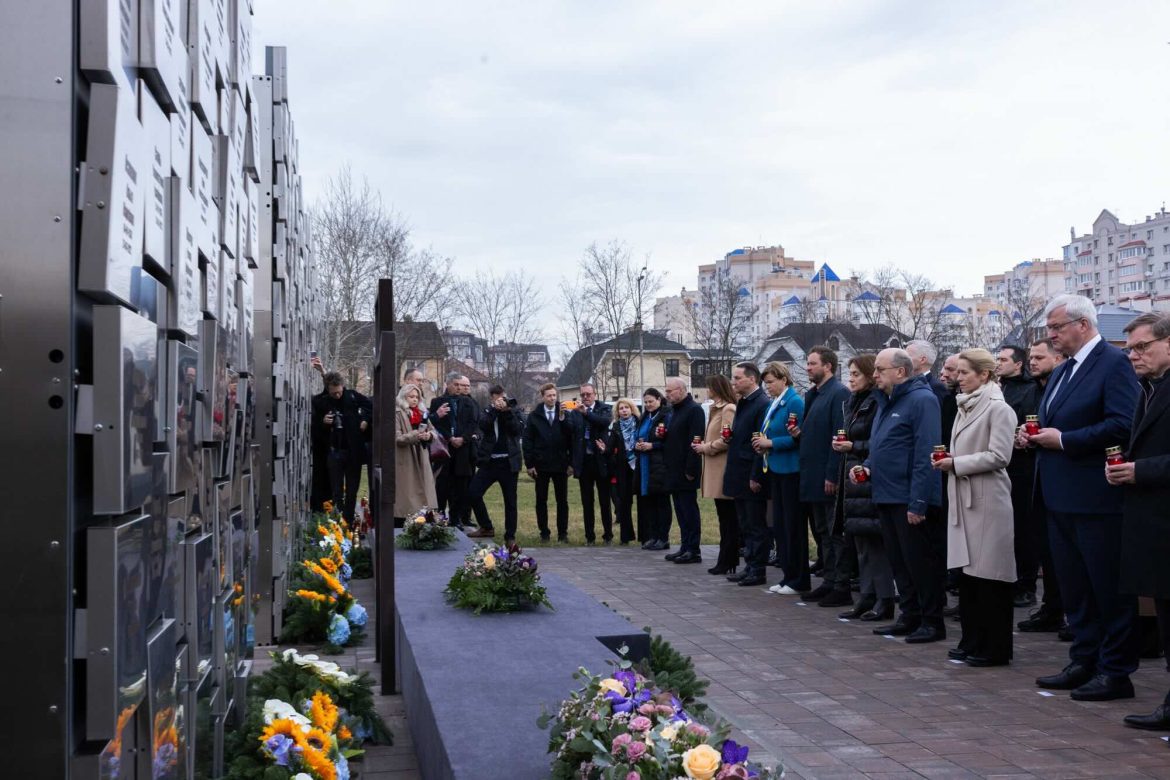
Kaja Kallas and a group of European foreign ministers arrived in Kyiv on 31 March to mark four years since the Bucha killings, in a display of support for Ukraine that comes amid continuing EU divisions over financial and political backing.
The European Union’s foreign policy chief, Kaja Kallas, and several EU foreign ministers arrived in Kyiv on Tuesday, 31 March, to mark the fourth anniversary of the Bucha killings and to reaffirm support for Ukraine at a time when the bloc remains divided over key elements of assistance to Kyiv. The delegation travelled to the Ukrainian capital for the commemoration as Hungary continues to block a major EU financial package and opposes moves on Ukraine’s accession path.
Ukrainian Foreign Minister Andrii Sybiha said the anniversary was a moment to advance efforts on accountability for Russian crimes. He said “comprehensive accountability” was necessary to restore justice in Europe. The visit was therefore not only symbolic but also tied to Ukraine’s longer-running effort to secure broader European backing for legal mechanisms aimed at prosecuting Russia’s aggression.
Bucha, a town outside Kyiv, became one of the most prominent early symbols of atrocities committed during Russia’s full-scale invasion. More than 400 civilians were killed there in 2022. The Council of the European Union said on 16 March that it had sanctioned nine individuals held responsible for the Bucha massacre, while Reuters’ reporting on those sanctions said more than 1,400 civilians were killed during the 33-day Russian occupation of the area. Russia has denied responsibility and has said the events were staged by Ukraine.
‘From Bucha to Brussels’: Baltic and Nordic states seek entry ban on Russian combatants
The Kyiv visit comes against a difficult political backdrop for the EU. At the Foreign Affairs Council on 16 March, the Council said ministers discussed support for Ukraine, including a €90 billion Ukraine Support Loan for 2026–2027, and ways to increase pressure on Russia. Reuters reported on 31 March that Hungary is blocking that loan and also opposing progress on Ukraine’s membership process. The result is a familiar contrast in EU policy towards Ukraine: strong public declarations of solidarity alongside continuing internal disagreement over money, sanctions pressure and the longer-term political framework for backing Kyiv.
Kallas has been publicly clear that Ukraine remains central to European security. After the 16 March Foreign Affairs Council, the Council quoted her as saying ministers were clear that Ukraine remained “Europe’s top security priority” and that attention to Ukraine would not be allowed to fade. The 31 March visit was consistent with that line, but it also served as a reminder that maintaining focus on Ukraine has become more politically demanding as the EU manages competing crises, including the Middle East conflict and its effects on energy markets.
The commemoration also had a practical diplomatic purpose. Ukraine is hoping to build support for a Special Tribunal to address the crime of aggression. According to that reporting, eight countries had already expressed willingness to take part. Moscow has rejected such efforts and warned that participation would be treated as a hostile act. The issue of accountability has become increasingly prominent in European diplomacy as military and financial support debates have grown more contested inside the bloc.
EESC calls for special international tribunal on “crimes of aggression against Ukraine”
The visit took place as Russian attacks continued elsewhere in Ukraine. On 30 March Russian strikes on central and northern regions killed two people and injured more than 20. That ongoing military pressure forms the immediate context for the Bucha anniversary and explains why European leaders continue to frame support for Ukraine as both a matter of principle and a matter of continental security.
For Brussels, the significance of the Kyiv visit lies less in any single announcement than in what it illustrates about the current state of EU policy. The bloc is still capable of visible diplomatic unity on Ukraine, particularly on questions of war crimes and symbolic support. But the dispute over the €90 billion package shows that consensus is harder to secure when solidarity must be converted into long-term financial and political commitments. On 31 March, the message in Kyiv was one of continued backing. The unresolved question in Brussels is how far that backing can be carried into concrete decisions in the months ahead.

