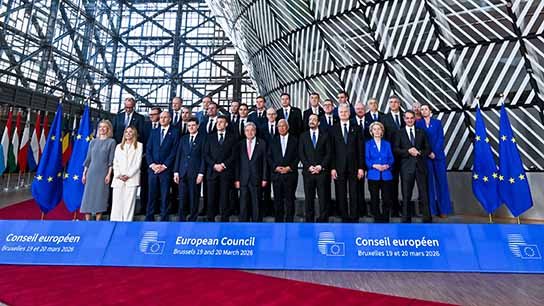
EU leaders ended their March summit without resolving Hungary’s blockade of a €90 billion support loan for Ukraine, but Commission President Ursula von der Leyen said Brussels would now work on alternative means to deliver the money.
The European Union is preparing to look for another route to provide a promised €90 billion loan to Ukraine after Hungary maintained its opposition at this week’s European Council, forcing Brussels to consider how to preserve a package leaders had expected to begin disbursing in April.
Speaking after the summit in Brussels, European Commission President Ursula von der Leyen said the EU would “find ways” to ensure the financing reaches Kyiv despite the continuing Hungarian veto. The intervention followed a tense meeting in which other leaders criticised Budapest for blocking a package that had been politically agreed in December and is intended to support Ukraine’s budget and wider wartime resilience through 2026 and 2027.
According to the European Council meeting page, the first disbursement under the package had been expected in April. The same material states that EU leaders had agreed in December 2025 to provide a €90 billion support loan for 2026 and 2027, while also calling on non-EU partners to help cover the remaining financing needs identified for Ukraine.
The immediate obstacle is Hungary. Prime Minister Viktor Orbán refused to lift his objection during the summit, despite sharp criticism from fellow leaders. Reuters reported that European Council President António Costa described Hungary’s stance as unacceptable, while German Chancellor Friedrich Merz called it an act of disloyalty that damaged the Union’s credibility.
The dispute has developed at a sensitive moment for the Union. The European Council’s conclusions on Ukraine repeated the bloc’s line that Russia must agree to a full, unconditional and immediate ceasefire and that Ukraine’s sovereignty and territorial integrity remain non-negotiable principles. Yet the summit also exposed how difficult it remains to translate political unity into decisions when unanimity is required on parts of the budgetary framework.
Hungary’s position is tied to a separate quarrel over the Druzhba pipeline route through Ukraine. Reuters and other current reporting say Budapest has linked its approval to the restoration of oil flows after damage to the route earlier this year. That has turned what might otherwise have been a technical financing file into a broader confrontation over sanctions, energy dependence and the limits of solidarity inside the bloc.
For Brussels, the issue is not only whether Ukraine receives the money, but how. Earlier reporting indicated that the package relies on several legal acts, with at least one part requiring unanimity because it affects the EU’s multiannual financial framework and the budget headroom used to guarantee common borrowing. That is why the Commission’s search for a workaround matters: any alternative would need to preserve the substance of the support while avoiding the point at which Budapest can block the package.
Hungary blocks EU’s €90bn Ukraine loan by vetoing budget amendment
The wider political cost is also clear. The summit had been expected to address not only Ukraine but also the Middle East crisis, competitiveness, defence, migration and the next budget cycle. Instead, Hungary’s veto again pushed the question of internal EU cohesion to the front of the agenda. That matters because the Union has already renewed its Russia sanctions listings until September, and several capitals want further pressure on Moscow rather than another prolonged institutional standoff.
Ukraine, for its part, has been pressing for speed. President Volodymyr Zelenskyy told the European Council that the financial situation remained difficult and that unblocking the package was important for resilience. His appeal underlined a basic point for Brussels: even where there is overwhelming political support for Kyiv, delay in EU decision-making carries practical consequences.
The Commission has not yet set out the legal mechanism it will now pursue. What is clear is that the package, as originally designed, has not survived the summit intact. The next question is whether Brussels can reconstruct it quickly enough to keep the April timetable broadly credible and to show that one national veto cannot indefinitely derail a central EU commitment made in wartime.