
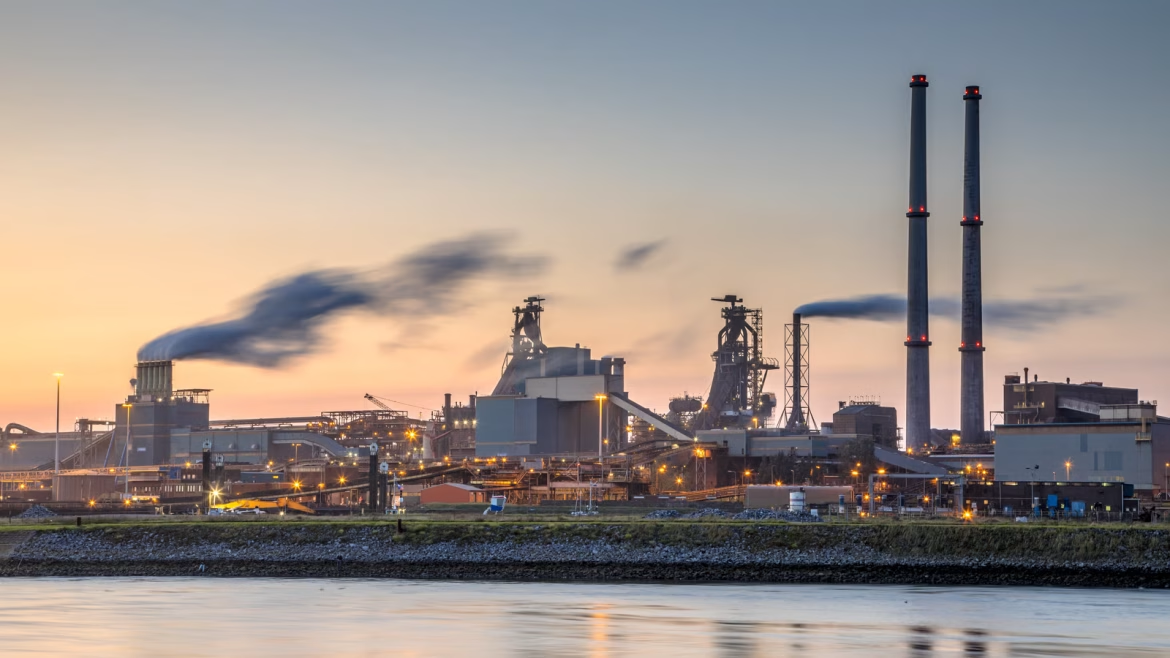
Brussels is considering slower emissions reductions and additional free allowances for energy-intensive industry, reopening the central argument over whether the EU can protect manufacturing without weakening the credibility of its carbon market.
The European Commission is considering changes to the EU Emissions Trading System that could slow required emissions reductions and extend free carbon allowances for industry, as competitiveness concerns place the bloc’s climate architecture under renewed political pressure.
The review is being presented as a response to high energy costs, weak investment and competition from producers operating under less demanding carbon rules. The danger is that targeted industrial relief becomes a broader retreat from the price signal intended to drive decarbonisation.
Why the ETS matters
The ETS requires power stations, industrial installations, airlines and shipping companies to surrender allowances for covered emissions. The total cap falls over time, making pollution progressively more expensive and rewarding investment in cleaner production.
Most power-sector allowances are auctioned. Energy-intensive manufacturers receive a share for free where policymakers judge that carbon costs could push production and emissions outside the EU, a phenomenon known as carbon leakage.
The Commission’s current free-allocation framework uses performance benchmarks designed around the most efficient installations. Those benchmarks tighten over time, requiring companies either to cut emissions or buy more allowances.
Competitiveness pressure is real
European steel, chemicals, cement, glass and other heavy industries face electricity and gas costs that can exceed those of competitors. They are also expected to finance new furnaces, hydrogen systems, carbon capture and electrification while demand remains uncertain.
Free allowances can preserve investment and prevent abrupt plant closures during the transition. Slower benchmark reductions may also recognise that low-carbon infrastructure is not arriving as quickly as earlier policy assumptions required.
But relief has an opportunity cost. If companies expect repeated relaxation whenever carbon prices become politically difficult, they may delay investment and continue relying on older assets.
EU Today has tracked how energy shocks are already forcing changes in industrial and household policy. An ETS revision would go further because it changes the long-term market signal rather than providing temporary crisis support.
The CBAM connection
The EU’s Carbon Border Adjustment Mechanism is intended to charge selected imports for embedded emissions as free ETS allowances are phased down. Extending free allocation can therefore complicate the timetable and legal logic of the border measure.
EU producers want protection against imports made under weaker climate rules, but trading partners may challenge a system that combines border charges with continued domestic free allocation. Brussels must show that the two instruments do not create double protection.
Reform or retreat
A credible review can improve the ETS without abandoning its purpose. The Commission could target support at demonstrable investment, reward contracts that deliver emissions reductions and adjust benchmarks where infrastructure delays are outside a company’s control.
It could also distinguish between temporary exposure and structural non-competitiveness. A plant waiting for a delayed electricity connection faces a different problem from one whose business model depends indefinitely on free emissions. Treating both identically would waste allowances and weaken incentives for the facilities already investing.
A weak review would distribute free permits broadly, slow the cap and reduce pressure without obtaining modernisation in return. That would lower near-term costs but increase the scale of cuts required later to meet the 2040 and 2050 climate objectives.
The political test is therefore conditionality. Industry needs predictable relief where European policy has failed to provide affordable clean energy or infrastructure. Taxpayers and cleaner competitors need assurance that support purchases transformation rather than postponement.
Europe’s carbon market has survived previous price collapses and reforms because governments ultimately defended the declining cap. Competitiveness now presents a different challenge: not whether carbon pricing exists, but whether it remains strong when its costs become industrially visible.

