
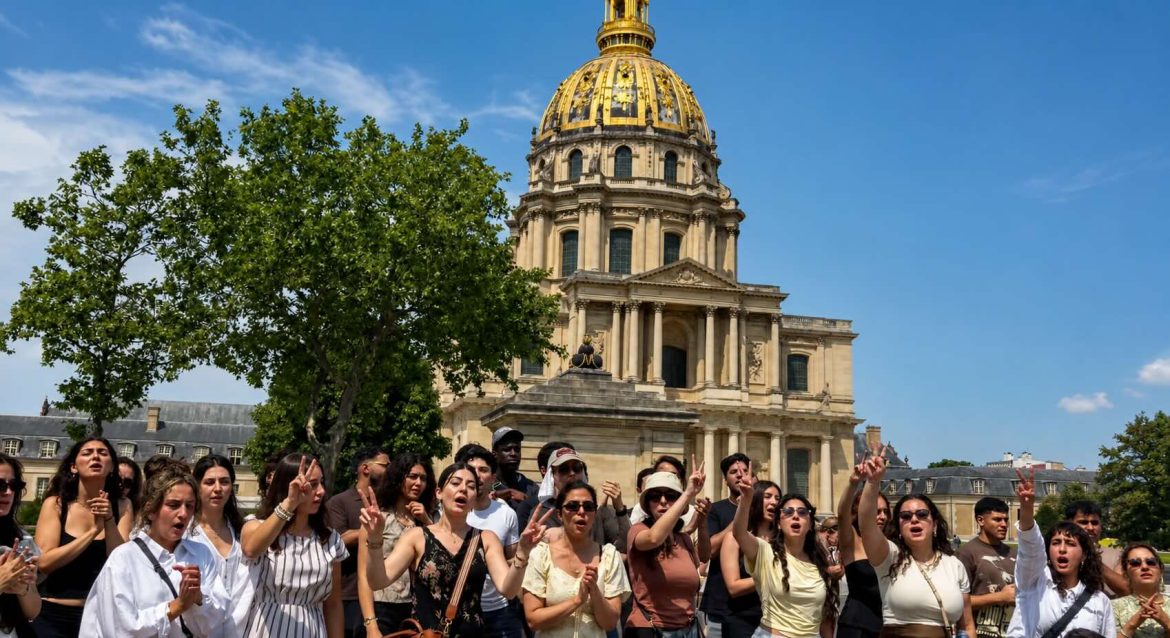
French police arrested 20 people in Paris after demonstrators defied a ban on an Iranian opposition rally, turning a public-order decision into a test of France’s handling of protest rights during sensitive diplomacy with Tehran.
The rally, organised by the Paris-based National Council of Resistance of Iran, had been called to protest against political executions in Iran. Several hundred demonstrators gathered at Place Vauban, near Les Invalides, before police moved to disperse them.
French police had banned the demonstration shortly before it was due to take place, citing the risk of clashes between opposing activist groups. The NCRI dismissed that justification as unfounded and challenged the decision, but a Paris court rejected the appeal on Saturday.
The timing made the ban politically sensitive. It was announced after a call between French Foreign Minister Jean-Noël Barrot and Iranian Foreign Minister Abbas Araghchi, as European governments were trying to keep diplomatic channels open with Tehran amid wider regional tensions. France’s foreign ministry denied asking for the rally to be cancelled and said the protest had not been discussed during the call.
The dispute leaves Paris facing two competing pressures. The authorities say they acted to prevent disorder at a time of heightened tension. The opposition group argues that a peaceful political protest was restricted while France was in direct contact with the Iranian government.
The issue matters beyond one banned rally. European governments regularly criticise Iran over executions, repression and the treatment of dissent, while also seeking diplomatic channels on security, nuclear and regional questions. The Paris case shows how those two tracks can collide when foreign policy, diaspora politics and domestic policing meet in the same place.
The NCRI has long used France as a base for organising against the Iranian authorities. It is linked to the People’s Mojahedin Organisation of Iran, or MEK, a group outlawed by Tehran and sharply opposed by the Islamic Republic. Its rallies in and around Paris have previously drawn large crowds and international political figures critical of Iran’s government.
Saturday’s arrests are unlikely to end the argument. For the French authorities, the court’s rejection of the appeal supports the legality of the ban. For the NCRI and its supporters, the decision will be cited as evidence that Iranian opposition activity can still face restriction in Europe when diplomatic sensitivities are high.
The immediate security incident was limited. The wider question is more difficult: when European governments condemn political repression abroad, how far can they restrict protests against that repression at home without appearing to send a conflicting signal?

