
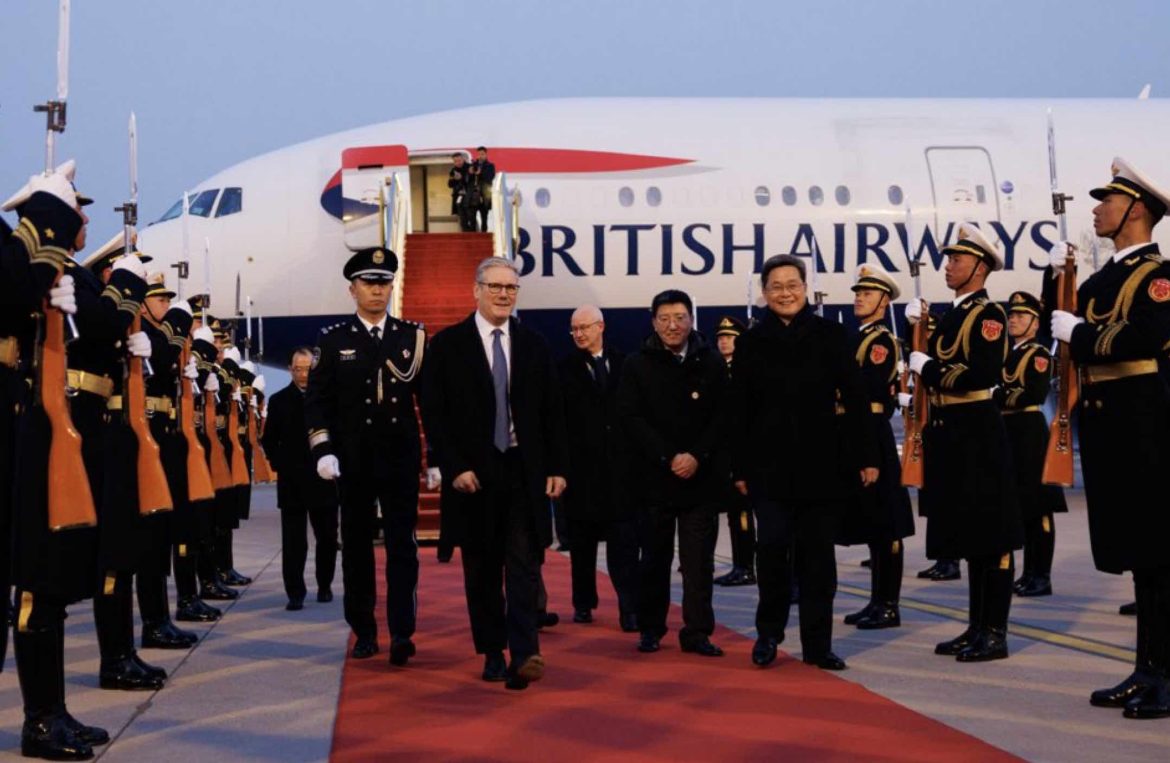
Is Keir Starmer confused? Or worse, is he willingly blind to the stark realities of the Communist regime he is now courting in Beijing?
This is not rhetorical flourish; it is a genuine challenge to the Prime Minister’s judgment as he embarks on a reset with the People’s Republic of China that will have profound consequences for the United Kingdom’s security, values and global standing.
This week, Sir Keir made his state visit to China, the first by a British Prime Minister in eight years, flanked by business leaders and trumpeting tariff cuts on Scottish whisky and a 30-day visa-free scheme for British travellers. On the surface, these may sound like wins. But when the global backdrop includes warnings from allies — including the United States — that rapprochement with Beijing is “very dangerous” for the UK, one must ask: what is the Prime Minister thinking?
Starmer’s talk of a “sophisticated relationship” with China suggests a balancing act between economic opportunity and strategic caution. Yet that balance now seems lopsided, if not outright delusional, given what we know about the Chinese Communist Party’s conduct at home and abroad.
Take, for example, the colossal decision to allow China to build a new “super-embassy” in London — a sprawling complex near key infrastructure, raising red flags from UK security agencies about espionage risks. This is not a paranoid exaggeration. Intelligence officials have cautioned that such a facility could be used to monitor communications and even target British systems. How does this serve Britain’s national interest? And how does it reflect clarity of thought?
It gets worse when we look beyond statecraft and into the moral abyss that is China’s human-rights record under President Xi Jinping. For years, independent investigations and human-rights groups have documented severe abuses against ethnic and religious minorities that might amount to crimes against humanity. The repression of Uyghur Muslims in Xinjiang — involving mass internment, forced indoctrination and abuses widely viewed as genocidal by experts — did not end with a change in diplomatic posture; allegations persist that Beijing’s security apparatus remains deeply repressive.
Yet Starmer’s engagement with Xi has been greeted by Chinese state media as an economic pivot rather than a moral reckoning. Beijing interprets this as tacit approval — or at least acquiescence — in exchange for access to British markets.
Let us not sugarcoat the horror: beyond internment camps and cultural erasure, there are credible allegations — upheld by independent bodies — that the Chinese regime has conducted forced organ harvesting from prisoners of conscience, including Falun Gong practitioners and other minorities. Evidence compiled over decades points to a system in which organs are sourced from detained prisoners at astonishingly short notice, suggesting that coercion and state involvement are at play.
And this is not ancient history. Reports this year indicate that religious persecution continues unabated, with practitioners dying in custody under suspicious circumstances and families struggling to learn the truth due to intense state censorship and surveillance.
We are talking about a regime that — according to MPs and human-rights advocates in the UK — has denied religious freedom, perpetrated forced labour and inflicted brutal punishment on people for their beliefs. These are not abstract foreign reports; they are real human tragedies involving Uyghurs, Falun Gong followers, Tibetan Buddhists, Christians and countless others. British parliamentarians have repeatedly called on the government to speak up — not just for realpolitik, but because denying these abuses chips away at the moral fibre of our own democracy.
In this context, what Starmer calls “clear-eyed” engagement rings hollow when economic incentives are repeatedly placed above human suffering. You do not have to be isolationist to recognise that some partnerships require moral lines that should not be crossed. A true leader understands that trading freedoms for feasibility often leads to the entrenchment of tyranny, not its reformation.
And yet, reports suggest that human-rights concerns were discussed only in the blandest, most circumspect terms, buried in “private” meetings and far overshadowed by economic headlines. This is not pressure; this is appeasement.
If the Prime Minister believes that engaging China on trade while hoping for the best on human rights is a strategy, then he should provide specifics: which abuses will he actively challenge? Which prisoners of conscience will he demand the release of? Which genocidal policies does he refuse to tolerate? Vague allusions to “frank dialogue” will not do when countries like ours once led the defence of democratic norms and basic decency.
Worse still is the impression that the UK is wilfully ignoring the pleas of its own diaspora communities — Uyghur and Tibetan Britons who have accused Starmer of turning a blind eye to genocide and repression by simply making a trip seem routine.
This is not just about economics or even national security. This is about the United Kingdom’s identity as a nation that once stood unequivocally for liberty, human rights and international law. Those principles are not optional. They are not negotiable if we wish to retain any semblance of moral authority.
Meanwhile, the United States — under a President who is hardly complimentary — has publicly warned of the dangers of closer UK–China entanglement. That warning should be sobering, not dismissed as the grumbling of an ally with a different worldview.
So, I return to the central question: is Keir Starmer confused? Or worse, is he blind to the atrocities carried out by the regime he now embraces at the expense of our security and values? A confused leader might still be guided back to solid ground by principled advisers; a blind leader will drift, unknowingly, into a geopolitical abyss.
We deserve clarity. We deserve answers — not bromides about “sophisticated relationships” and “mutual trust.” If this is strategy, it is a dangerously incoherent one. If it is principle, then the principle is deeply flawed.
Because the United Kingdom must never forget that diplomacy without moral moorings can quickly become complicity. And a nation that trades its convictions for convenience may find itself richer in deals but impoverished in dignity.
There is, too, an uncomfortable historical footnote that makes Starmer’s studied nonchalance towards China’s authoritarian Communist regime all the more jarring.
As a young man in 1986, he joined an international work camp in communist Czechoslovakia, a well-intentioned scheme to restore a memorial to victims of Nazi atrocities.
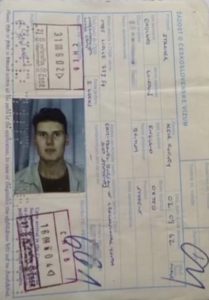
Recently unearthed archives show that the camp was closely monitored by the state’s secret police, with Starmer’s full personal details — name, date and place of birth, passport number and family address — logged in the “Foreign Intelligence Main Directorate” files.
His visa application, complete with passport photograph and handwritten notes, was separately retained by the Cold War security services.
Whilst no wrongdoing is alleged – Starmer appears nothing more than what Lenin would have referred to as a “useful idiot” – Westerners duped into saying good things about bad regimes – the episode is a sobering reminder of how instinctively totalitarian systems surveil even the most benign Western idealism — a lesson one might have hoped today’s Prime Minister would have learned.
Click here for more News & Current Affairs at EU Today
Click here to check out EU TODAY’S SPORTS PAGE!
_____________________________________________________________________________________________________________________________

