
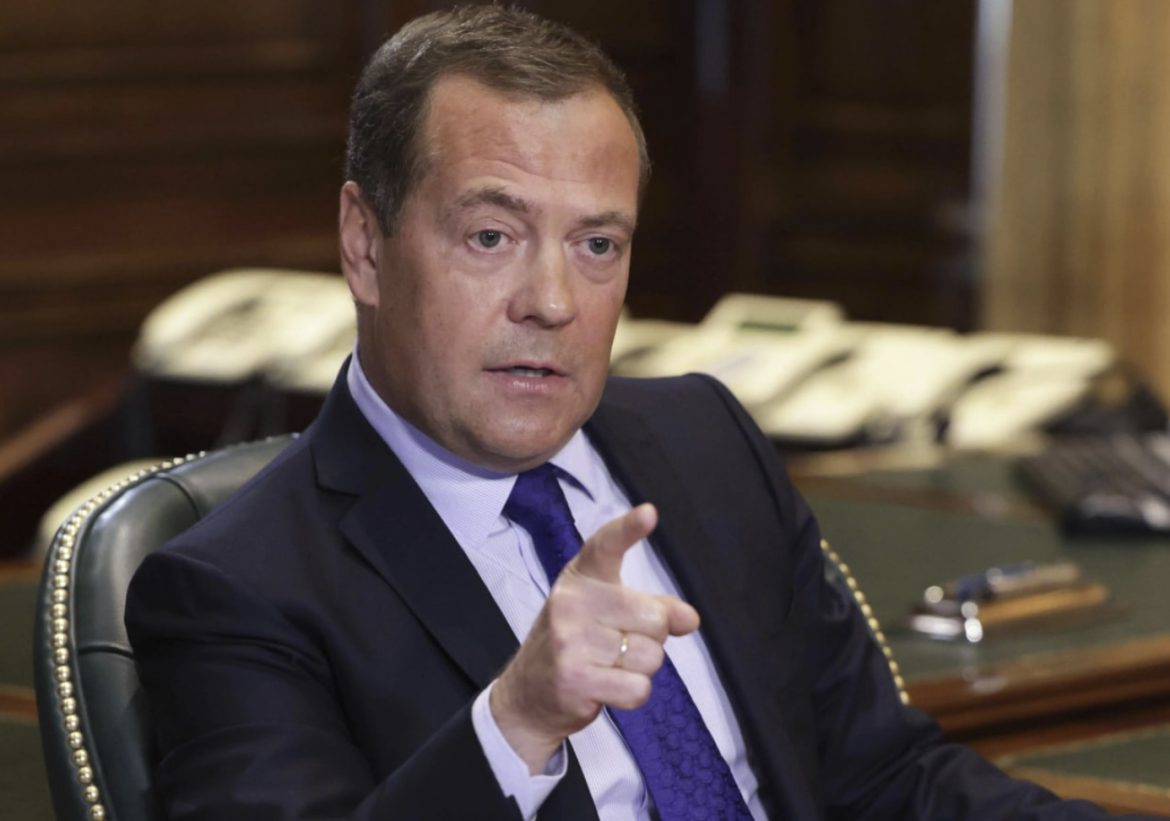
The language used by Dmitry Medvedev on Friday was framed by Moscow as a warning. In European capitals, however, it is likely to be read as something far more serious: a threat directed at civilian populations inside NATO territory.
The former Russian president’s remarks followed a dramatic escalation in tensions after a drone believed to have originated from a Russian attack on Ukraine crashed into a residential building in the Romanian city of Galați, injuring two people and triggering renewed concerns about the war’s increasingly porous borders.
Speaking after the incident, Medvedev suggested Europeans should prepare for more such episodes. According to Reuters, he said citizens in countries supporting Ukraine should expect drones and other consequences of the conflict to reach their territory.
The distinction between a warning and a threat is not merely semantic. Warnings generally describe risks beyond the speaker’s control. Threats imply agency. Medvedev’s comments appeared to fall firmly into the latter category, implying that further incidents affecting European territory are an inevitable consequence of governments backing Kyiv.
For NATO members already grappling with Russian cyber operations, sabotage investigations and repeated airspace violations, the statement is unlikely to be dismissed as rhetorical excess. Instead, it will reinforce a growing perception that the Kremlin increasingly views intimidation of European societies as a legitimate instrument of statecraft.
The Romanian incident itself marked a particularly sensitive moment. Authorities said a drone struck an apartment building during a wider Russian attack against targets in neighbouring Ukraine. The event represented one of the most serious spillovers of the war into alliance territory since Russia’s full-scale invasion began in 2022.
NATO Secretary-General Mark Rutte responded by reaffirming that the alliance would defend “every inch” of member territory, language deliberately designed to underscore the credibility of Article 5 collective defence commitments.
Romanian President Nicușor Dan described the incident as unprecedented and called for a coordinated response among allies. European and North American leaders swiftly expressed solidarity with Bucharest, reflecting concerns that accidental or deliberate escalation risks are rising as the conflict drags into its fifth year.
Moscow, meanwhile, sought to preserve ambiguity. Russian President Vladimir Putin said it was too early to determine whether the drone was Russian and suggested it could have belonged to Ukraine. Such denials have become a familiar feature of Kremlin crisis management, particularly when incidents occur beyond Ukraine’s borders.
Yet Medvedev’s intervention complicated that effort. While the Kremlin attempted to cast doubt on responsibility, the deputy chairman of Russia’s Security Council appeared to move in the opposite direction, effectively arguing that Europeans should become accustomed to such events.
That message carries broader implications. Over the past two years, European intelligence services have repeatedly accused Russia of conducting or encouraging hybrid operations across the continent, including cyber attacks, infrastructure disruption, GPS interference and suspected sabotage campaigns. Moscow has consistently denied involvement.
Against that backdrop, Medvedev’s comments can be interpreted as an attempt to normalise instability within Europe. The underlying logic is straightforward: if European governments continue supplying weapons, ammunition and financial support to Ukraine, then European citizens should expect to bear some of the consequences.
For policymakers in Brussels, Berlin and Paris, that argument crosses an important threshold. It shifts responsibility from military actors to civilian populations and implicitly presents non-combatants as legitimate targets of pressure.
The timing is also significant. Russia has intensified drone and missile attacks against Ukrainian infrastructure in recent months while Kyiv has expanded long-range strikes against military and energy facilities inside Russia. The result has been a widening geographic footprint for the conflict and growing concern that miscalculations could draw NATO more directly into confrontation.
Whether the drone strike in Romania was intentional, accidental, or the product of navigational failure may ultimately prove impossible to establish conclusively. What is already clear, however, is that Medvedev’s remarks have transformed the political significance of the episode.
European officials may be less concerned about the technical origins of a single drone than about the message emanating from Moscow afterwards. By suggesting that further incidents are to be expected, Medvedev was not merely describing a dangerous reality. He appeared to be signalling one.
In diplomatic language, warnings are meant to prevent escalation. Threats are designed to shape behaviour through fear. Europe’s leaders will now be debating which category best describes Moscow’s latest message. For many, the answer is becoming increasingly difficult to ignore.
Click here for more News & Current Affairs at EU Today
Click here to check out EU TODAY’S SPORTS PAGE!
___________________________________________________________________________________________________________________

