
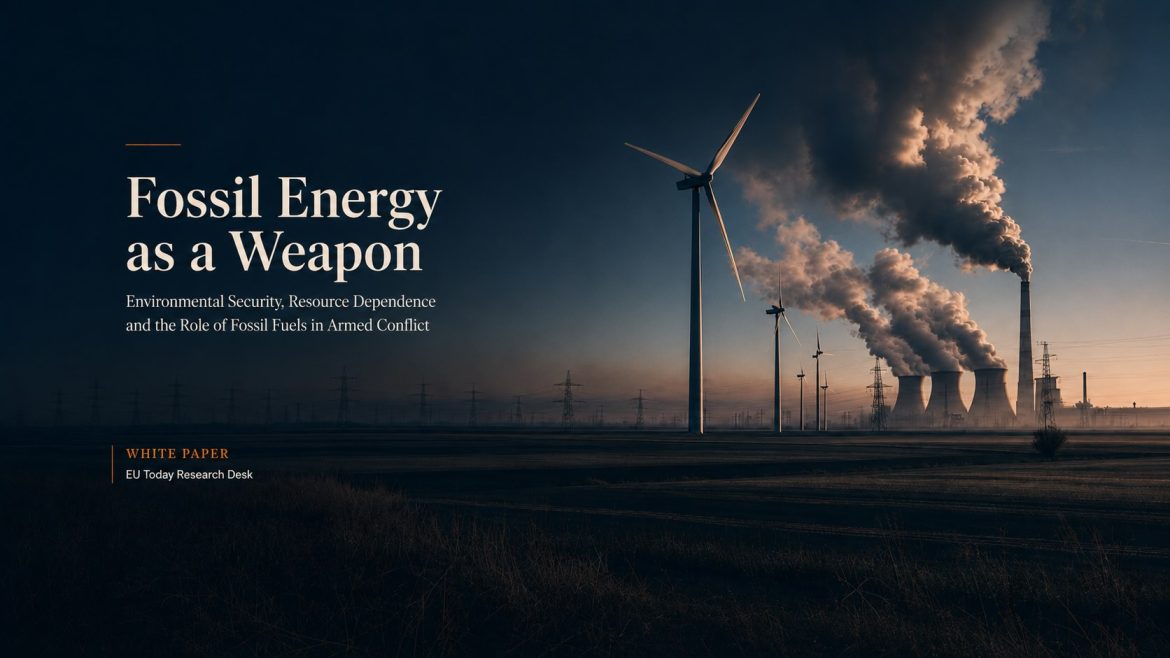
A new EU Today Research Desk White Paper argues that fossil fuel dependence should be treated not only as an energy or climate issue, but as a strategic security vulnerability for Europe and its partners.
The EU Today Research Desk has published a new White Paper, Fossil Energy as a Weapon: Environmental Security, Resource Dependence and the Role of Fossil Fuels in Armed Conflict, examining how oil, gas and coal can shape conflict, coercion, infrastructure vulnerability and strategic dependence.
The paper does not argue that fossil fuels are the sole cause of war. Instead, it sets out a narrower proposition: fossil fuel systems create recurring pathways through which insecurity can be financed, transmitted, amplified or prolonged.
According to the White Paper, these pathways include supply coercion, hydrocarbon revenues used for military or coercive purposes, vulnerable infrastructure and maritime chokepoints, price shocks, environmental damage and reduced strategic autonomy for import-dependent states.
The immediate context is Europe’s experience since Russia’s full-scale invasion of Ukraine in February 2022. Before the war, Russian gas was deeply embedded in the European energy system through long-term contracts, pipeline infrastructure and assumptions of mutual interdependence. The crisis exposed the weakness of treating fossil fuel supply as a purely commercial matter.
Russia’s manipulation of gas supplies, the surge in energy prices, Europe’s emergency search for alternative imports and the subsequent policy response demonstrated that energy dependence can limit political autonomy, impose economic costs and test alliance cohesion.
The paper notes that the European Union has reduced Russian fossil fuel dependence substantially since 2022. Russian coal has been banned, Russian oil imports have been restricted through sanctions and embargoes, and Russian gas imports have fallen sharply. However, the White Paper argues that Europe’s structural exposure has not disappeared. The EU remains a major energy importer, oil still dominates transport, and greater reliance on liquefied natural gas has created new exposure to global gas markets, shipping routes and supplier relationships.
The central argument is that the problem is not only dependence on one hostile supplier. It is the structure of fossil fuel dependence itself. Oil, gas and coal systems rely on continuous fuel flows, fixed infrastructure, centralised processing, long-distance transport, maritime chokepoints and politically exposed supplier relationships. These features make them vulnerable to coercion, disruption, market manipulation and conflict-related damage.
The White Paper identifies five main security pathways. The first concerns coercion. Fossil fuels can be used through supply cuts, threatened disruption, price manipulation, politically conditioned contracts, storage pressure, infrastructure ownership or threats to maritime routes. The paper refers to the 1973–74 oil embargo as a historical precedent and to Russia’s use of gas against Europe as the clearest contemporary European case.
A second pathway concerns war finance. Hydrocarbon exports provide revenue, foreign exchange and fiscal resilience. These resources may sustain military expenditure, sanctions evasion, internal security structures, proxy networks and patronage systems. The paper cites Russia’s fossil fuel exports during the war against Ukraine, ISIS oil smuggling in Iraq and Syria, militia competition over Libya’s oil infrastructure, South Sudan’s oil-linked fiscal vulnerability and Iran’s sanctioned oil economy as examples of different forms of this pattern.
Another risk lies in concentrated infrastructure exposure. Oil and LNG move through chokepoints such as the Strait of Hormuz, Bab el-Mandeb, the Suez Canal, the Turkish Straits and the Strait of Malacca. Pipelines, LNG terminals, refineries, ports, storage facilities and undersea infrastructure are exposed to sabotage, drones, mines, cyberattacks, accidents and hybrid operations. A local disruption can produce wider effects through prices, insurance costs, shipping delays, supply chains and market expectations.
Environmental damage forms a further pathway. Oil spills, gas flaring, methane leakage, refinery damage, coal pollution, scorched-earth tactics and attacks on energy infrastructure can contaminate land, water and air, damage livelihoods, weaken public health and increase reconstruction costs. The paper refers to Kuwait’s burning oil wells in 1991, oil-related contamination in Iraq, insecurity in the Niger Delta and Russia’s attacks on Ukraine’s energy infrastructure as examples of the link between fossil fuel damage and environmental security.
The final pathway concerns strategic autonomy. Countries dependent on imported oil and gas may be more exposed to coercion, less willing to impose sanctions, more vulnerable to inflationary shocks and less able to sustain foreign-policy decisions under pressure. Energy insecurity can also be exploited through disinformation, political influence and public anxiety.
The White Paper also recognises the limits of its own argument. It states that fossil fuels do not automatically cause war, that resource wealth does not always produce authoritarian rule, and that renewable energy does not eliminate geopolitical risk. Clean-energy systems create their own dependencies, including critical minerals, grids, storage, manufacturing capacity, digital systems, permitting and public consent.
The paper’s conclusion is comparative rather than absolute. A renewable, electrified and efficient energy system is not risk-free. However, if designed with resilience in mind, it can reduce several vulnerabilities associated with fossil fuels: continuous dependence on imported fuel, exposure to oil and gas chokepoints, pipeline coercion, fossil-funded aggression, price shocks and environmentally destructive extraction.
The EU Today Research Desk argues that energy transition should be treated as a security transition. Efficiency, electrification, renewable generation, storage, interconnectors, resilient grids and demand reduction should be understood not only as climate measures, but as instruments of strategic resilience.
The paper recommends that the EU, NATO and Member States formally treat fossil fuel dependence as a security vulnerability. It calls for closer integration of energy transition into defence planning, foreign policy, sanctions policy, industrial strategy, enlargement policy and development finance.
It also argues for stronger protection of critical energy infrastructure, including pipelines, LNG terminals, refineries, ports, grids, offshore wind farms, electricity interconnectors, battery storage and undersea cables. EU-NATO co-operation should be reinforced on maritime security, hybrid threats, cyber resilience, intelligence sharing, exercises and crisis response.
Sanctions policy, the paper says, should continue to target fossil fuel revenues that finance aggression, while closing loopholes involving shadow fleets, ship-to-ship transfers, opaque insurance, third-country refining and re-export channels.
The White Paper concludes that Europe should not respond to fossil fuel coercion only by finding different fossil fuel suppliers. Supplier diversification may be necessary during transition, but it is not sufficient. The deeper task is to reduce the strategic weight of oil, gas and coal in the European economy.
The less Europe depends on fossil fuels, the less exposed it is to energy blackmail, fossil-funded aggression, infrastructure sabotage, maritime chokepoints, price shocks and environmental damage.

