
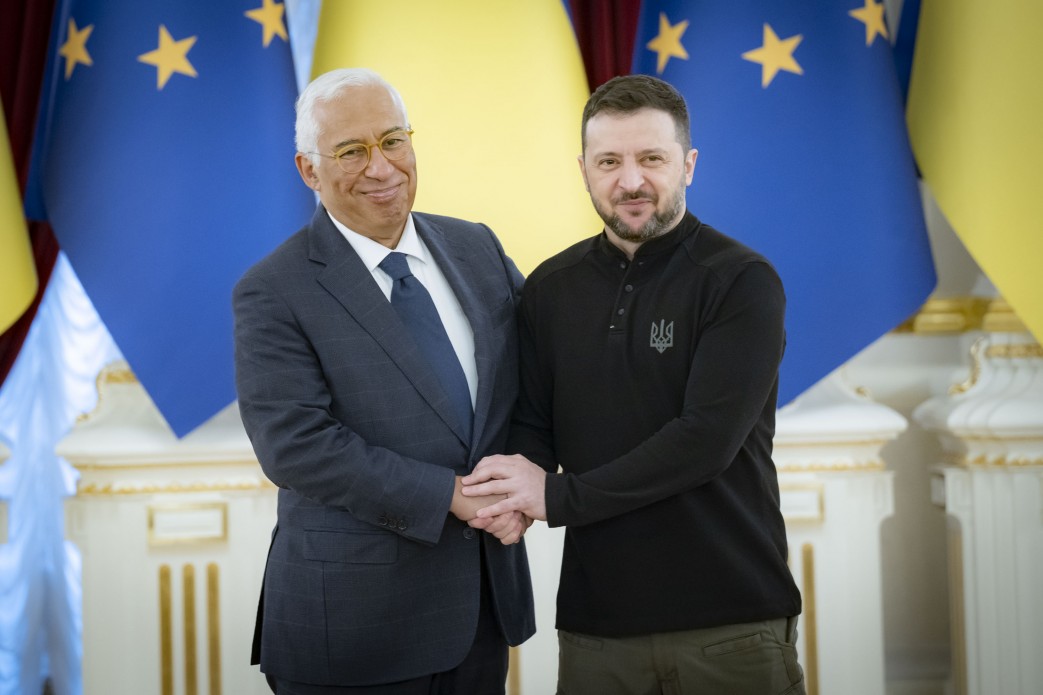
Ukraine’s president has urged European states to determine who would represent them in any future negotiations with Russia, exposing a question that has become harder to avoid as Washington and Moscow continue to dominate the diplomacy around the war.
Volodymyr Zelenskyy has urged European governments to decide who would speak for them in any future negotiations with Russia, sharpening a sensitive question for Brussels: whether Europe can act as a political participant in a peace process, rather than as a financial and military supporter outside the main room.
I spoke with António Costa @eucopresident. Thank you very much for supporting our state and our people. We discussed in detail the prospects of the negotiation process for peace for Ukraine and all of Europe. I informed him about our recent contacts with various leaders in Europe…
— Volodymyr Zelenskyy / Володимир Зеленський (@ZelenskyyUa) May 17, 2026
The Ukrainian president raised the issue after speaking with European Council President António Costa. Zelenskyy said both leaders agreed that Europe must be involved in negotiations and that it should have “a strong voice and presence” in the process. He added that it was now worth deciding who would represent Europe specifically, according to Ukrainian reporting on the call.
The remark matters because it moves the discussion beyond the standard formula that there can be no decisions about Ukraine without Ukraine. Kyiv is now also pressing the parallel point that there should be no settlement affecting European security without a defined European role. That is not merely procedural. Any agreement with Russia would affect sanctions, security guarantees, defence posture, reconstruction funding, frozen Russian assets and the long-term relationship between Ukraine and the EU.
The question of representation has been building for weeks. European ministers recently rejected Vladimir Putin’s suggestion that former German chancellor Gerhard Schröder could play a role in future security talks. EU officials argued that it was not for Moscow to choose who represents Europe, while pointing to Schröder’s long-standing ties to Russian energy interests and his relationship with Putin. The rejection, reported earlier this month, left open the more difficult question of who Europe itself would put forward.
Kyiv Says Former German Chancellor Schröder Cannot Represent EU in Russia Talks
That problem is partly institutional. The European Union has a European Council president, a Commission president and a foreign-policy chief, while member states retain control over much of foreign and security policy. France, Germany, Poland, Italy and other capitals have their own channels with Washington and Kyiv. The United Kingdom, outside the EU but central to European security, also has a direct role in military support for Ukraine and in wider NATO planning.
A single European representative would therefore require political agreement among governments that do not always share the same view of Russia, the United States or the acceptable terms of a settlement. Some countries on NATO’s eastern flank would be wary of any envoy seen as too ready to compromise with Moscow. Others may prioritise keeping Washington fully engaged. Brussels would have to avoid creating a structure that duplicates NATO, sidelines Kyiv, or produces another layer of institutional argument while battlefield conditions continue to change.
The issue has gained importance because Russia has repeatedly tried to frame the war as a matter for great-power negotiation. Moscow’s preferred format would limit Ukraine’s agency and treat European security as something to be discussed with Washington rather than with Kyiv and European governments as independent actors. Zelenskyy’s intervention is therefore aimed not only at Brussels, but at the wider diplomatic architecture now forming around possible talks.
Costa’s role is also relevant. As European Council president, he represents EU leaders collectively, rather than the Commission or a single national capital. That could make him a plausible figure for coordination, but not necessarily a negotiator with a mandate to discuss security guarantees, sanctions or territorial issues. Those questions would still require agreement among member states and coordination with NATO allies.
The EU’s existing Ukraine policy is already substantial. In March, EU leaders reiterated support for Ukraine and said the bloc had provided €194.9 billion in overall assistance, including €69.7 billion in military support, according to the European Council’s published conclusions. That scale gives Europe direct stakes in the outcome of any negotiation. It also creates a political argument for representation: the bloc is paying much of the cost of sustaining Ukraine and would be heavily exposed to the consequences of an unstable settlement.
For Kyiv, the risk is that European support remains large but politically fragmented. Ukraine needs air defence, ammunition, financing, reconstruction planning and accession momentum. It also needs security commitments that Russia and other powers would have to take seriously. A Europe that cannot decide who speaks for it may find that others define the terms of the conversation.
The immediate call between Zelenskyy and Costa does not mean negotiations with Russia are imminent. Moscow’s conditions remain incompatible with Kyiv’s core demands, and Ukraine has made clear that it will not accept arrangements imposed over its head. But diplomacy often begins with arguments over format before it reaches substance. Zelenskyy’s message is that Europe should settle its internal question before it is forced to answer it under pressure.
The central issue for Brussels is therefore not whether Europe supports Ukraine. That has been stated repeatedly. The unresolved question is whether Europe can convert that support into a coherent negotiating presence when decisions over war, peace and security guarantees eventually move from declarations to the table.

