
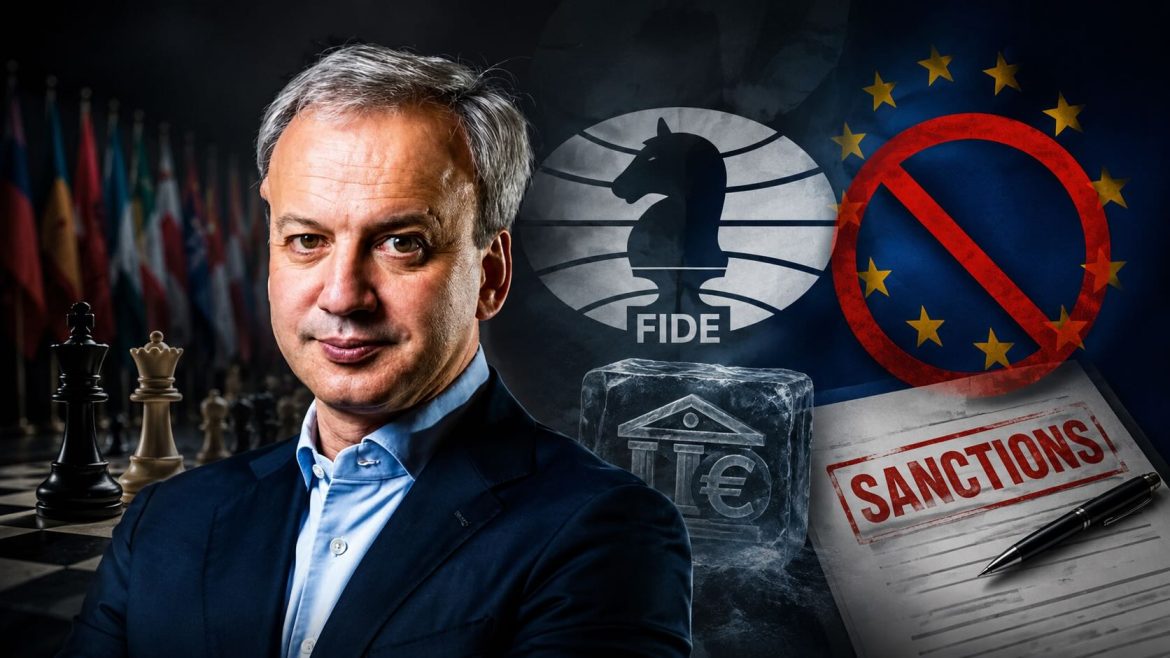
Arkady Dvorkovich’s suspension shows how an EU asset freeze can move rapidly from a foreign-policy measure into the governance of an international sporting federation.
The European Union’s latest sanctions against Russia have produced an immediate leadership consequence inside world chess, with Arkady Dvorkovich suspending his powers and duties as president of the International Chess Federation.
The development is more significant than a temporary absence. It demonstrates how sanctions aimed at an individual can affect contracts, banking, access to institutional assets and decision-making inside an organisation that is neither a Russian state body nor headquartered in the European Union.
In a statement published by FIDE, Dvorkovich said he regarded the EU decision as unlawful and unfair and would challenge it. He nevertheless suspended his presidential powers with immediate effect because the measures could hinder the stable functioning of the federation. FIDE’s Council accepted the decision and confirmed that Deputy President Viswanathan Anand would act as interim president.
The federation’s statement is unusually explicit about the operational concern. It says Dvorkovich will not exercise the rights and responsibilities provided by the FIDE Charter while the EU and corresponding Swiss measures remain in force. It also states that he will not act as an owner, holder or controller of FIDE or its assets.
That language moves the issue beyond reputation. Asset-freeze regimes generally prohibit making funds or economic resources available, directly or indirectly, to a listed person. For an international federation, that can create questions about who controls bank accounts, authorises expenditure, signs contracts and directs assets. Even where routine chess activity is far removed from the conduct cited in a sanctions designation, counterparties may be unwilling to transact while control is uncertain.
FIDE is governed under Swiss law, making Switzerland’s implementation especially important. The organisation operates internationally, however, and its events, sponsors, service providers and national federations span many jurisdictions. Banks and commercial partners frequently apply sanctions controls more broadly than the narrowest legal requirement because the cost of a breach can be severe.
The EU Council announced the 21st package of sanctions on 23 July. The package added 218 listings—48 individuals and 170 entities—alongside measures targeting finance, crypto services, the shadow fleet, military production and propaganda. The relevant legal acts and individual statement of reasons provide the binding basis for each designation.
EU Today’s earlier analysis of the negotiations over the 21st package examined the national commercial interests shaping the package before adoption. The FIDE case shows its next stage: once political compromise becomes binding law, consequences can appear immediately in organisations far removed from oil, banking or military production.
Dvorkovich has not accepted the EU’s case. His announced challenge matters because EU listings are subject to judicial review. A listed person can contest whether the Council relied on an adequate factual basis, respected procedural rights and provided sufficiently specific reasons. Litigation does not, however, suspend a measure automatically. That explains the governance gap between the date of designation and any future judgment.
The FIDE response attempts to contain that gap. By transferring presidential functions to Anand, the Council has sought to preserve continuity while avoiding a prolonged argument over whether decisions taken under Dvorkovich’s authority could expose the federation or its partners to sanctions risk.
The arrangement will still require careful implementation. An interim president needs clear authority over staff, finances, competitions and representation. Banks, auditors and sponsors will want evidence that the sanctioned individual no longer exercises control. National federations will also need confidence that electoral and disciplinary processes remain valid.
Timing adds political sensitivity. A leadership suspension ahead of a presidential election can affect alliances, candidacies and access to the institutional platform. FIDE must ensure that measures adopted for sanctions compliance do not become instruments for advantage in the electoral process. Minutes, delegations of authority and decisions concerning federation resources should therefore be recorded and published wherever confidentiality does not prevent it.
The case also illustrates the expanding reach of sanctions into international sport. Sporting bodies often describe themselves as politically neutral, but they depend on legal persons, banks, venues, insurers and governments. A designation can constrain an official even when the federation itself is not sanctioned.
This is not the first time chess governance has intersected with the consequences of Russia’s war against Ukraine. FIDE has faced disputes over flags, national participation, events and the positions of senior officials. Its recent decision to restore the Belarusian flag in competition has further exposed the difficulty of separating sporting governance from state conduct.
For the EU, the immediate effect may be presented as proof that individual sanctions have practical force. Yet the Union must also be prepared to defend the designation with evidence. Sanctions that reshape the leadership of an international body require especially careful reasoning because their effects extend to members and athletes who are not themselves targets.
For FIDE, the priority is narrower and more urgent: establish that Anand is exercising real and exclusive presidential authority, protect the independence of the coming election and ensure that no payment or resource is made available contrary to applicable law.
Dvorkovich’s suspension is therefore neither a final judgment on the EU listing nor a routine internal handover. It is a live test of how an international federation preserves lawful governance when its elected president becomes the subject of restrictive measures across the jurisdictions on which the organisation depends.

