
Ukrainian strikes on Russia’s oil and logistics infrastructure have forced the Kremlin to explain fuel shortages, refinery disruption and pressure in occupied Crimea, even as Vladimir Putin insists the war is proceeding according to plan.
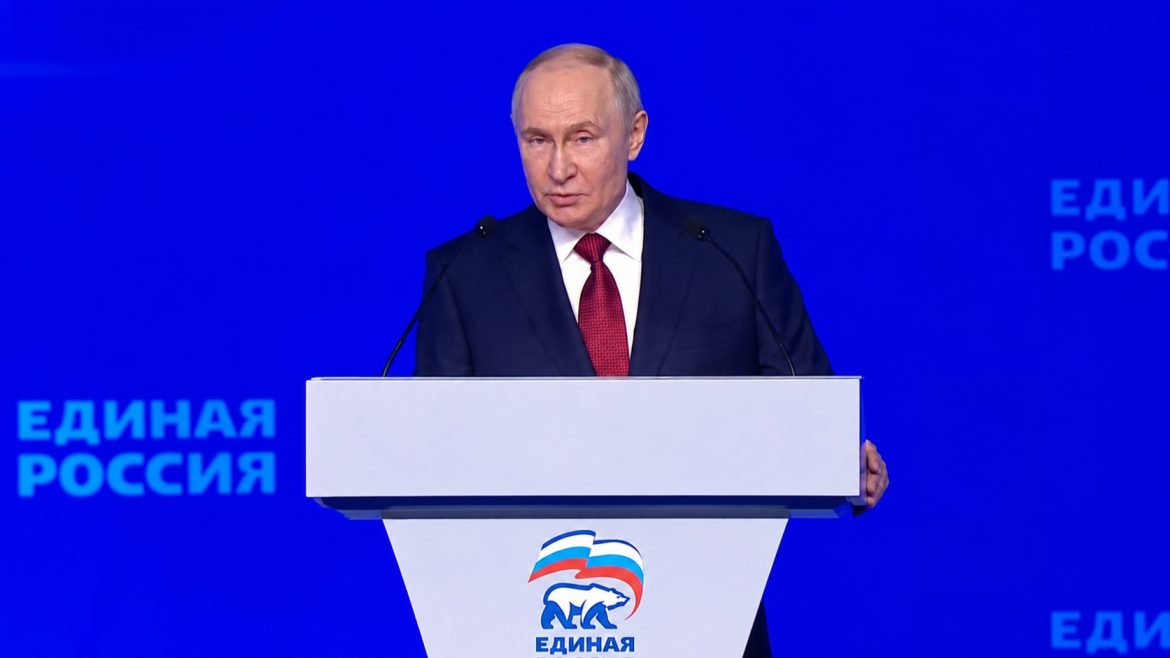
Vladimir Putin’s address to the United Russia party congress, followed by a long interview with Russian state television, revealed a growing contradiction in the Kremlin’s position. The Russian president continues to insist that his campaign against Ukraine is proceeding according to plan, while also acknowledging practical problems that were not supposed to appear in that plan at all.
The most immediate problem is fuel. Russia, one of the world’s largest oil producers, is now facing shortages in several regions, with queues, regional restrictions and pressure on supply chains following repeated Ukrainian attacks on refineries, depots and transport routes. Putin has tried to present the situation as manageable, saying reserves are being used and production will recover. He has also spoken of increasing air defence output to protect energy infrastructure.
That answer is politically convenient, but operationally limited. Russia’s problem is not only how many air defence systems it can produce. It is the scale of the territory and infrastructure it now has to defend. Refineries, fuel depots, rail junctions, ports, bridges, military factories and power facilities cannot all be protected at once. Every system deployed to defend one site leaves another exposed.
Ukraine’s campaign has therefore created a strategic dilemma for Moscow. Kyiv said its forces struck refineries in Krasnodar and Yaroslavl regions on June 28, continuing a wider effort to disrupt Russia’s fuel supply and weaken the logistics of its war. If Moscow concentrates air defences around refineries, other military and transport targets become more vulnerable. If it spreads those systems too thinly, Ukrainian drones and missiles retain the ability to impose costs deep inside Russia.
This does not mean Russia’s war machine is close to collapse. It does mean that the Kremlin can no longer maintain the fiction that the war remains safely distant from Russian society. Fuel supply, refinery capacity and internal logistics have become part of the battlefield.
Occupied Crimea shows the problem most clearly. Russian-installed authorities have declared an economic emergency in Crimea amid fuel disruption and queues. For civilians, this means uncertainty and shortages. For the Russian military, it is more serious. Crimea is not only occupied territory; it is a military platform used for operations against southern Ukraine. When fuel, power and transport become less reliable, the effect reaches repair bases, storage sites, troop movement and operational planning.
This exposes the weakness in Putin’s argument about territorial control. The Kremlin still presents the capture of Ukrainian land as proof of strategic success. Putin continues to treat Donetsk, Luhansk, Zaporizhzhia and Kherson regions as central objectives, despite the fact that Russia does not fully control several of the territories it claims to have annexed. Yet holding territory is less valuable if it cannot be supplied, powered, defended or used reliably as a base for further operations.
The same contradiction is visible on the front line. Russian forces continue to press towards Kostiantynivka, part of Ukraine’s eastern defensive line, but the campaign remains slow and costly. A recent battlefield assessment described Russia as pushing against Ukraine’s “fortress belt” in Donetsk region, while noting that gains elsewhere have largely stalled. Moscow repeatedly presents advances of a few kilometres as evidence of momentum. Yet similar claims have been made for years.
This is far from the campaign Putin expected in February 2022. The initial objective was not a prolonged struggle for individual towns after more than four years of war. It was a rapid operation to bring Ukraine under Russian control. The fact that Moscow is still trying to complete the occupation of Donetsk region underlines the distance between the original ambition and the present reality.
The diplomatic narrative is also under strain. Russian propaganda has tried to sustain the impression that the Trump-Putin meeting in Alaska produced some form of shared understanding on Ukraine. Moscow has used the idea of a “spirit of Anchorage” to suggest that the United States privately accepted a framework favourable to Russia. That claim has been weakened by Washington’s position. US Secretary of State Marco Rubio said no agreement was reached, prompting Sergei Lavrov to challenge Rubio’s account and call for clarity on the American role.
This matters because Putin needs more than battlefield claims. He needs a political story that explains why the war continues, why the costs are rising, and why negotiations have not delivered a settlement on Russian terms. If the Alaska narrative collapses, the Kremlin loses one of its arguments that Washington has quietly moved towards Moscow’s position. If fuel disruption continues, it becomes harder to tell Russians that the war remains distant, controlled and cost-free.
Putin’s message is therefore increasingly defensive. He is not offering a new strategy. He is asking Russians to believe that shortages are temporary, that strikes on infrastructure do not affect the front, that Russia is still advancing, and that diplomacy remains possible on Moscow’s terms. Each part of that message contains an unresolved problem.
Ukraine’s long-range campaign has not ended the war. Russian forces remain capable of offensive action, and the pressure on Ukrainian positions in Donetsk is real. But the strikes have changed the political and logistical environment in which Moscow operates. They have brought the war closer to Russian society, exposed weaknesses in the protection of critical infrastructure, and complicated the Kremlin’s claim that time is automatically on Russia’s side.
For Putin, the issue is not only whether petrol returns to stations or whether queues disappear. The deeper question is whether Russians continue to believe that a war producing shortages, refinery fires, drone alarms, uncertainty in Crimea and inconclusive diplomacy is still unfolding according to plan.

