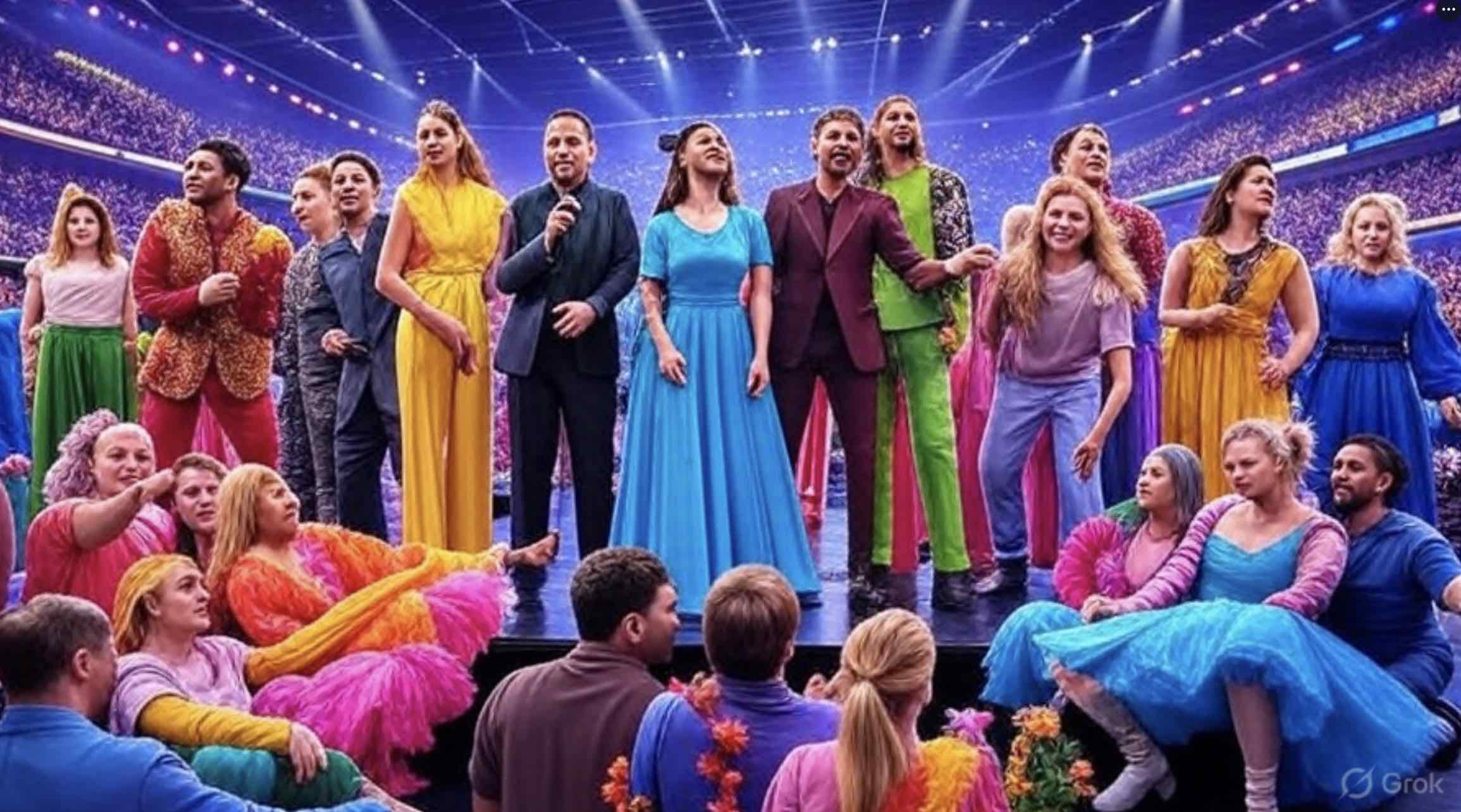
Eurovision 2025, held in a vast, hollow echo chamber masquerading as an arena in Switzerland (a country that rarely wins anything, but always has enough money to host international galas), was yet another chapter in the slow, operatic death of a once-great institution.
Let’s address the winner first. Not because it was particularly memorable—goodness no—but because it’s what everyone is pretending to care about. The winning act, from Austria, was a vision in calculated ambiguity.
A slim figure with cropped hair, oversized suit, and a voice that danced confusingly between soprano and falsetto. Twitter immediately lit up with questions: “Is it a boy singing like a girl?” “Is it a girl dressed like a boy?” .
Whatever, performing in a manner so androgynous, it seemed designed to tick every last diversity checkbox on the BBC’s compliance form. And of course, he/she/ or any of the currently fashionable alternatives, won.
The song? A wispy, melancholic dirge called “Wasted Years” which might have been about anything. Wasted three minutes might have been a better title.
Battery Sergeant Major Williams gives his verdict on Eurovision 2025.
But I’ll tell you what it definitely wasn’t: catchy. It was the sort of vaguely ethereal tune that dissolves into nothingness It wasn’t so much the best song of the evening, as possibly the least awful. This is Eurovision in 2025: not a festival of music, but a contest of semiotics.
Gone are the days when the stage was graced by genuine performers—Abba, Cliff Richard, even Celine Dion (who, in that glorious 1988 show, actually represented Switzerland).
Ms. Dion was widely expected to make an appearance at last night’s event, but to the disappointment of performers and fans alike she was unable to make it.
There was once room in this bonkers extravaganza for real melody, real showmanship. Engelbert Humperdinck—no stranger to kitsch, granted—stood up and sang an actual song. Can you imagine such a thing today?
The UK’s entry this year was something a tragicomic spectacle in itself. A trio called Remember Monday, undoubtedly the most pleasing on the eye of all the evening’s performers, and with a decade of West End stage experience behind them, took to the stage with their song, “”What the Hell Just Happened?”
I suspect that’s what a lot of viewers were asking. Last night, I had the feeling that a pub in Kent was missing one of it’s star karaoke turns. Maybe the song just wasn’t right for them, or maybe it’s just me, but I did not like that song at all.
This all made me long for the commentary of Sir Terry Wogan, may he rest in peace, whose gloriously inebriated sarcasm once made the whole ordeal bearable—nay, enjoyable. For years, many of us tuned in just to hear old Tel get increasingly shit-faced as the votes came in. His exasperated sighs, his jibes about block voting (“Ah yes, the Balkans voting for each other again—quelle surprise!”), his occasional lapses into full-blown giggles. The man was a national treasure, and his loss has been keenly felt ever since his demise in 2016. No amount of stylised camera drones or rotating LED floors can ever replace him.
I write all this with some degree of authority, having once attended Eurovision in person. I was at the 2009 final in Moscow. Now that was a moment of clarity.
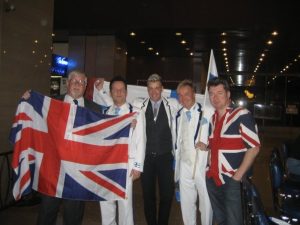
Myself and Tom Wise, Eurovision, Moscow 2009, with a bunch of random Finnish geezers.
I remember the show opened with great pomp—dancers, fireworks, giant projected eagles—and by the third song I was nodding off.
I quite literally fell asleep in my seat, waking only when Tom Wise, then a Member of the European Parliament, nudged me and said the UK entry was on next.
Jade Ewen, our entry that year, was genuinely superb—vocally strong, stylish, elegant. And she was accompanied on piano by none other than Andrew Lloyd Webber.
It felt like an actual effort. But did she win? Of course not. I have absolutely no recollection of who did win that year, and I doubt anyone else does either. Eurovision has that effect. The winners are, more often than not, instantly forgettable. 2025 will be no exception, I am sure.
There was a time when winning Eurovision meant something. Now it seems more like a cultural roulette wheel where geopolitical virtue-signalling outweighs musical merit. This year’s voting was, as usual, a masterclass in regional alliances. Scandinavia all likely voted for each other. Greece and Cyprus surely exchanged twelve points like a reflex. And the usual political undercurrents were certainly on full display—Hungary booed, and a not-so-subtle moment where the Estonian host declared music a “universal language, unlike certain passports.”
It’s hard to know who Eurovision is for anymore. It’s certainly no longer about Europe. Australia has been competing since 2014, and I am pretty sure that Armenia isn’t in Europe. (Mind you, the European Commission are so desperate for headlines I am sure that they would be delighted to open negotiations.)
What remains is the spectacle. And perhaps that’s all Eurovision can be now. A two-hour meme generator for the internet, a smorgasbord of irony and glitter, a stage where sincerity goes to die.
I know what you’re thinking: if I hate it so much, why do I follow it?
That’s the thing. Eurovision is like an old friend who’s gone off the rails. You still show up, year after year, hoping they’ll pull themselves together. And sometimes, in those brief flickers—a decent vocal here, a charming host there—you catch a glimpse of the magic that once was. But mostly, it’s a parade of the absurd, marching ever onward, in drag, into postmodern oblivion.
Having said all that, I sincerely hope that the competitors enjoyed the event, and I wish them every success in the future.
So here’s to Eurovision 2025: a night of forgettable songs, gender-fluid stylings, and the lingering ghost of Terry Wogan whispering, “Oh dear… what are we watching?” If nothing else, it reminds us of the treasures we’ve lost.