
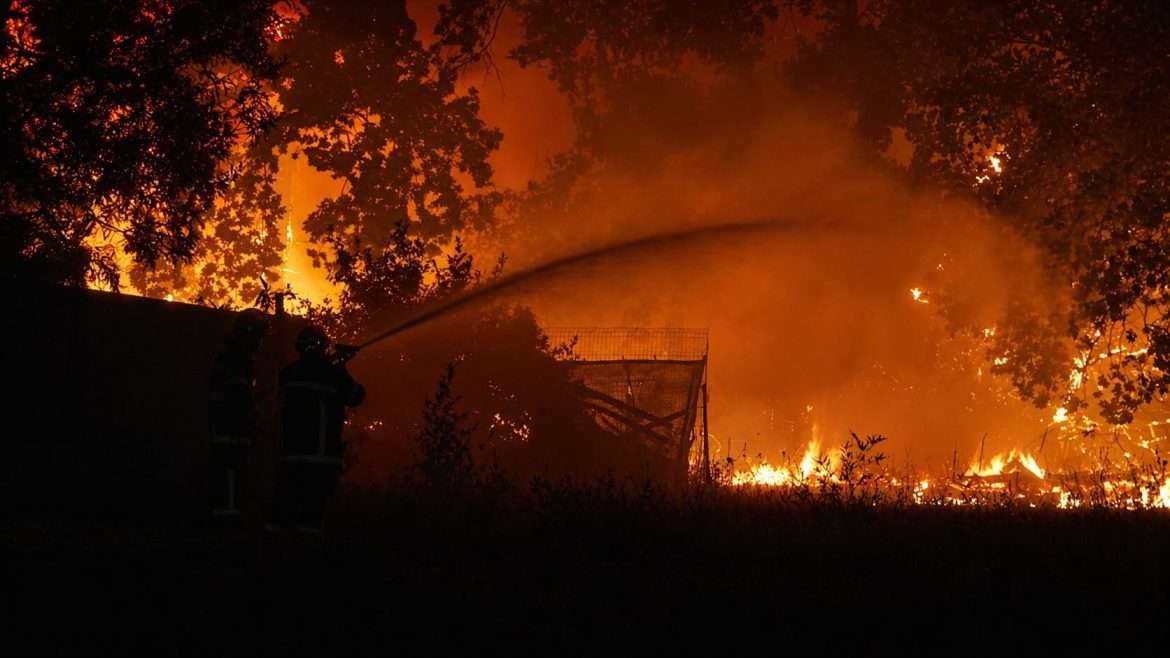
France’s need to move people from a vulnerable peninsula and seek outside firefighting support shows that repeated extreme fires are becoming a test of shared European capacity, not only national emergency planning.
The evacuation of the Cap Ferret peninsula as fires spread across south-western France has brought together two problems that European governments can no longer treat separately: moving large seasonal populations out of constrained coastal areas and finding enough specialist aircraft when several countries are burning at once.
Cap Ferret presents an unusually difficult evacuation environment. The peninsula is long, forested and connected to the mainland by a limited road network. During the summer, its population rises sharply as tourists join permanent residents. A fire that cuts the principal road can turn a conventional road evacuation into a maritime operation.
French authorities anticipated that risk after the catastrophic Gironde fires of 2022. The Gironde prefecture’s evacuation plan provides for the immediate movement of 10,000 to 14,000 people within 24 hours once all means are mobilised, prioritising vulnerable residents and using passenger vessels where road access is unavailable.
That planning is now operationally relevant. Evacuation orders are not simply a reaction to flames. They are timing decisions made under uncertainty. Authorities must move people early enough to prevent congestion and panic, while avoiding unnecessary displacement that can itself strain roads, shelters, medical services and neighbouring municipalities.
The civil-protection dimension extends beyond Gironde. France has sought European assistance during a season in which national aircraft and crews have already been heavily used. The EU Civil Protection Mechanism exists for precisely this problem: a participating state can request help when an emergency exceeds its available capacity, and the Emergency Response Coordination Centre then matches that request with aircraft, vehicles, teams or other assistance.
The European Commission describes a 24-hour wildfire support operation staffed by national experts and duty officers. The system includes rescEU aircraft financed as a common reserve rather than left entirely to voluntary national offers.
Earlier in July, France and Portugal activated the mechanism simultaneously. The Commission mobilised four rescEU aircraft for France, illustrating both the value of the reserve and the pressure created when several states require support at once.
EU Today’s recent coverage of the Fontainebleau wildfire showed how fires have reached areas not normally associated with the most severe Mediterranean risk. President Emmanuel Macron separately described the 2026 season as exceptionally intense and noted that unusual fires had affected several parts of France.
That geographic spread changes the capacity calculation. A national fleet sized around historical risk in the south may be inadequate when severe incidents occur concurrently in the west, north and east. Firefighting aircraft also require maintenance, pilots, ground crews, retardant supply and suitable operating bases. The number painted on a fleet list is not the number available every hour of a long season.
European solidarity can cover temporary gaps, but the same climate conditions often affect several countries. When France, Spain, Portugal, Italy, Greece and the Balkans face simultaneous extremes, states that normally provide aircraft may need them at home. The mechanism then becomes an allocation system for scarcity.
The EU needs transparent priorities for that situation. Aircraft should be sent according to risk to life, likely fire behaviour, the availability of local resources and the strategic importance of preventing escalation. Political influence should not determine which request is filled first.
Pre-positioning can reduce response time. The Commission already coordinates seasonal deployments, but climate trends may require a larger permanent reserve distributed across several regions. A common fleet can also standardise training, maintenance and spare parts.
Purchasing more aircraft is necessary but slow. Specialist water bombers have limited manufacturers and long delivery schedules. Europe therefore needs to preserve existing airframes, expand pilot training and use helicopters, drones and ground surveillance more effectively. Drones can map fire edges and detect new ignitions, freeing crewed aircraft for suppression.
Evacuation planning deserves equal investment. The Cap Ferret plan recognises that maritime routes may become essential. Authorities should regularly exercise the transfer of vulnerable people, the control of embarkation points, the management of pets and vehicles, and communication when mobile networks are congested.
Public warnings must be specific. Residents need to know whether they should leave, which route to use, what transport is available and what to take. Conflicting messages can cause dangerous delay or send traffic towards a threatened road. Systems such as FR-Alert provide reach, but the content and sequencing of warnings determine whether people act correctly.
Prevention remains cheaper than emergency response. Forest management, controlled clearance, building rules, defensible space and limits on ignition sources can reduce the intensity of a fire before aircraft arrive. In tourist regions, those measures must account for campsites, seasonal accommodation and visitors unfamiliar with local risk.
Cap Ferret is therefore more than another severe weather story. It is a practical test of an evacuation system designed after 2022 and of a European assistance mechanism operating during a season of repeated demand.
The measure of success is not only whether the current fires are contained. It is whether France and its partners learn how much capacity was actually available, where warnings or transport failed, and how many simultaneous incidents the European system can sustain. Wildfire solidarity works only if Europe builds enough common capability to share.

