
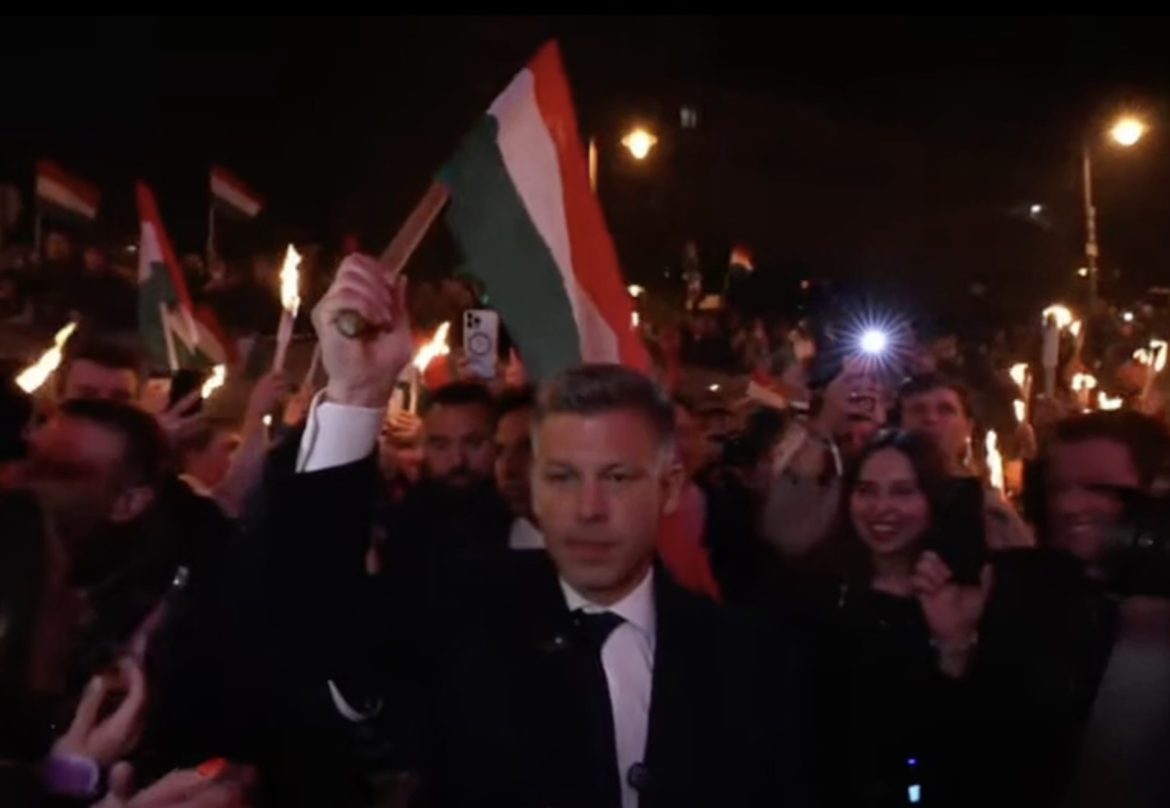
Hungary’s election has ended Viktor Orbán’s 16 years in power and handed Péter Magyar’s Tisza party a commanding mandate. In his first remarks after victory, Magyar promised to restore Hungary as a reliable partner in the European Union and NATO, rebuild regional ties and seek the return of suspended European funding.
Hungary’s parliamentary election on 12 April has produced one of the most significant political reversals in the European Union in recent years. After 16 years in power, Viktor Orbán conceded defeat as Péter Magyar’s opposition Tisza party secured a sweeping victory, opening the way for a substantial shift in Budapest’s relations with Brussels, NATO and its neighbours in Central Europe. The scale of the result, outlined in early election reporting and in seat projections published after polling day, is expected to give Tisza the two-thirds parliamentary majority required to amend key laws and pursue far-reaching institutional reforms.
Even though the final allocation of seats may take several more days because of the delayed counting of some ballots, there is no longer serious doubt about the overall outcome of the election. Orbán acknowledged the result within hours of the polls closing, according to accounts of his concession and the emerging final trend, bringing to an end a political era that had reshaped Hungary’s domestic institutions and its place within Europe.
In his victory speech in Budapest, Magyar sought to define the meaning of the result in unmistakably European terms. Addressing supporters who chanted “Europe, Europe”, he declared that Hungary would once again become a reliable ally in both the European Union and NATO, while restoring ties damaged by years of confrontation under Orbán. He said Hungary’s place “was, is and will be in Europe”, framing the election not merely as a domestic change of government, but as a strategic reorientation of the state, as reflected in coverage of his speech and initial foreign policy message.
Magyar also indicated the priorities of his early foreign policy. He suggested that his first visits after taking office would be to Poland, Austria and Brussels. That sequence is politically significant. Orbán’s relations with Warsaw deteriorated sharply over Russia and Ukraine, weakening what had once been a central partnership inside the Visegrád group. Magyar has now made clear that he wants to restore, strengthen and possibly expand cooperation among Hungary, Poland, the Czech Republic and Slovakia, while re-establishing Hungary as a constructive actor in Central and Eastern Europe, a point also reflected in reporting on the regional reset implied by his remarks.
Donald Tusk was quick to congratulate Magyar on his victory, underlining the importance attached in Warsaw to political change in Budapest. The result is likely to be seen across the region as an opportunity to rebuild diplomatic links that had frayed during the later Orbán years. Slovakia’s leadership also signalled readiness to work with the incoming Hungarian government, according to early reactions from neighbouring capitals and wider regional response.
The immediate significance for the European Union lies in the prospect of a thaw between Budapest and the EU institutions. Under Orbán, Hungary repeatedly clashed with Brussels over rule-of-law standards, judicial independence, public procurement and democratic safeguards. These disputes contributed to the freezing of substantial EU funds and left Hungary increasingly isolated within the Union. Magyar has linked political change directly to institutional repair, saying that a constitutional majority would be used to restore checks and balances and ensure the democratic functioning of the state. He has also pledged that Hungary would join the European Public Prosecutor’s Office, a point central to the reform agenda now being discussed in relation to EU funding and anti-corruption commitments.
That could prove central to Hungary’s efforts to regain access to suspended European funding. The incoming government has made clear that one of its main tasks will be to restore confidence in Budapest and normalise relations with the EU. Magyar’s stated intention to travel to Brussels early in his term appears designed not only as a diplomatic gesture, but as part of a broader effort to secure the release of funds withheld during the Orbán era. Yet better political relations with Brussels will not automatically produce a rapid financial settlement, as suggested in financial market reaction to the election and in reporting on the likely conditions attached to any funding release.
The wider geopolitical implications are considerable. Orbán had become one of the European Union’s most disruptive leaders on Russia and Ukraine, frequently testing the limits of European unity. His removal therefore has consequences well beyond Hungary’s domestic balance of power. A government led by Magyar would be expected to take a more predictable line within both the EU and NATO, reducing one of the most persistent sources of internal friction in both organisations. That wider significance was reflected in the speed and tone of international reactions and in broader reporting on European leaders’ responses.
For Magyar, the scale of victory creates opportunity but also raises expectations. A parliamentary supermajority may provide the legal means for change, but it does not guarantee administrative success, political cohesion or rapid economic recovery. Hungary’s economy has remained under pressure in recent years, and the new leadership will be judged not only by its diplomatic tone but by whether it can restore institutional credibility, attract investment and revive growth, against the background described in current reporting on Hungary’s economic position and reform prospects.
Still, the political message from Budapest is unmistakable. Magyar has presented his victory as more than an electoral win. He has cast it as the beginning of Hungary’s return to the European mainstream after years of self-imposed isolation and confrontation. If that promise is matched by action, Hungary could move from being the EU’s habitual dissenter to a cooperative member once again, with significant consequences for regional politics, EU decision-making and the internal balance of NATO.

