
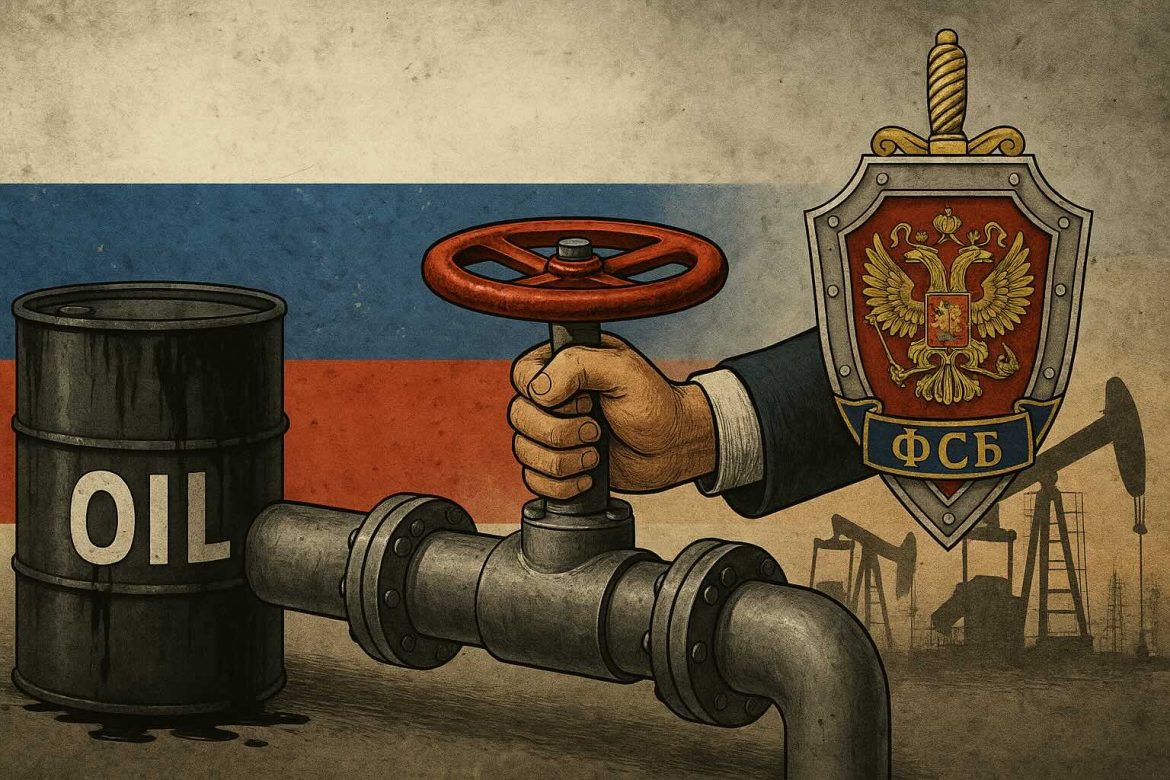
Moscow uses oil contamination and FSB port controls to restrict Kazakh and Azerbaijani exports, leveraging market disruption for geopolitical and economic gain.
At the Turkish terminal marking the final destination of the Baku–Tbilisi–Ceyhan (BTC) pipeline — used to transport Azerbaijani crude to the Mediterranean market — oil with a high content of organochlorine compounds, hazardous for refining, was discovered on 22 July. Under normal circumstances, this would have drawn attention only from industry specialists.
However, against the backdrop of strained relations between Moscow and Baku, the appearance of contaminated oil in the pipeline at this particular time appears highly questionable. Almost simultaneously, tensions began to rise in the anchorage area of the port of Novorossiysk due to new measures introduced by presidential decree from 21 July, under which the FSB imposed controls on all foreign vessels entering Russian ports.
The decree obliges all ships — without exception and regardless of cargo or port type — to obtain authorisation from the Federal Security Service (Russian FSB). These developments may not appear connected. At first glance.
A Few Words About the New Regulation
Under Presidential Decree No. 502 of 21 July 2025, “On Amendments to the Regulation on the Entry of Foreign Vessels into the Seaports of the Russian Federation”, it is stipulated that vessels arriving from foreign ports may only enter Russian ports with the authorisation of the harbourmaster, which must be coordinated with an authorised officer of the FSB.
This provision entered into force immediately upon publication, on the same date. It is worth noting that this decree was preceded by FSB Order No. 205 of 25 May 2024, “On Amendments to the Border Regime Rules, approved by FSB Order No. 454 of 7 August 2017”.
The FSB Directorate in Saint Petersburg and Leningrad Region was the first to announce the introduction of the new border regime rules last year. According to these rules, captains of foreign vessels transiting Russian territorial waters or entering Russian ports were required to submit a notification, in a prescribed format, to the FSB for each actual port call. The format, contact details, and methods of communication (telephone, email, fax, VHF) were specified in the order.
Captains were obliged to provide notice 24 hours prior to entering the port and again four hours before actual arrival. Entry, departure, and manoeuvring within the vessel traffic service zone of the port are strictly controlled: movement requests must be submitted 15 minutes in advance, and constant VHF radio contact must be maintained with the authorised operator.
The impetus for these changes came in response to this year’s acts of sabotage against five tankers carrying Russian oil. All five had docked at Russian ports several weeks prior to the unexplained explosions. As a result, many experts pointed the finger at Ukraine. Who was actually behind the incidents remains unknown, but Moscow opted to take additional precautionary measures. In reality, however, the Kremlin’s intention is more complex than simply preventing sabotage. Indeed, the Kremlin appears to have chosen to engage in acts of sabotage itself — of a hybrid nature.
Pressure on Kazakhstan
Kazakhstan is dependent on the port of Novorossiysk for the export of its key raw materials and goods — oil, coal, grain, ferroalloys, copper concentrates, and mineral fertilisers. Despite efforts to develop alternative routes — via the Caspian Sea, the South Caucasus and Turkey to Europe, or through the Caspian and Iran to the Middle East — Kazakhstan remains reliant on the Russian route.
This provides Moscow with leverage over Kazakhstan’s economy and political course. As a result, any additional complications along the primary logistics corridor, particularly those involving FSB inspections, are viewed in Astana with concern — all the more so given the already strained relations with Moscow. The Kremlin has not forgiven President Tokayev for his refusal to recognise the so-called DNR/LNR, Russia’s claim to Crimea, and other Ukrainian territories occupied by Russia, among other matters.
Kazakhstan’s principal export commodity is crude oil from the Tengiz, Kashagan, and Karachaganak fields, which are developed by consortia of Western companies. The leading players in Kazakhstan’s oil sector are the American firms Chevron and ExxonMobil, along with the European companies Shell, ENI, and TotalEnergies. Russia’s Lukoil holds a minority stake.
According to available information, Putin’s decree of 21 July was driven not only by the aim of preventing sabotage against vessels transporting Russian oil. Russia’s strategic objective, amid falling oil prices and rising wartime expenditure, is to reduce the volume of oil supplied by competitors, thereby pushing prices up. Kazakhstan and Azerbaijan are among those competitors.
While they are in a different league compared to Russia or Saudi Arabia, the volumes they export nonetheless affect the global oil market. Kazakhstan is particularly significant in this regard, with annual production approaching 90 million tonnes and exports in 2024 amounting to nearly 69 million tonnes. This is all the more relevant given that Kazakhstan, a landlocked country in the heart of Central Asia, relies primarily on export routes passing through Russian territory.
Through the imposition of additional security inspections, the Kremlin is aiming to:
- create obstacles to the export of oil from Kazakhstan, thereby reducing its supply on the market and prompting an upward trend in prices;
- prompt European companies to exert pressure on their governments (in Italy, France, the Netherlands, and the United Kingdom) and on the European Commission to alter their sanctions policy towards Russia’s oil sector — specifically, to end the clampdown on the so-called shadow fleet — since Kazakh crude accounts for 11.5% of EU oil imports, and any reduction in supply would affect European refining capacity;
- generate further tension between the government of Kazakhstan and US oil companies, which are seeking to increase exports following recent years of investment in production expansion, while Astana remains bound by export quotas under OPEC+ commitments;
- compel US companies to press the Trump administration to, in turn, increase pressure on Ukraine to bring about a rapid end to the war by halting the supply of arms and military equipment.
As is typical, shipowners and oil traders remained silent for several days, unwilling to draw the ire of the FSB by publicly disclosing the delays of tankers at the Novorossiysk anchorage and the refusal of permission to dock for loading.
The Chain of Blackmail in Operation
Particular attention should be paid to the concealed and non-public actions of American companies, notably Chevron. The company has long acted as an unofficial lobbyist for Russian interests in the United States. Since 2012, Chevron has been a co-founder — alongside Russia’s oil pipeline monopoly Transneft and Sovcomflot — of the Russian-American ‘Fort Ross Dialogue’.
Since 2014, Chevron has opposed the imposition of sanctions against Russia’s oil sector, and in 2021 participated in lobbying efforts to lift US sanctions on the Nord Stream 2 pipeline. The specifics of Chevron’s activities in this regard were reported by ZN.UA in 2023.
Russia has proven highly effective in using pressure on American companies to achieve its strategic objectives. A recent illustrative example demonstrates this tactic in action. On Sunday, 30 March this year, President Trump stated during an NBC News broadcast that he was “very angry and furious” with President Putin, and threatened to introduce additional tariffs on buyers of Russian oil. The following day, Monday 31 March, Transneft issued an order for the temporary closure of two out of three loading berths at the Yuzhnaya Ozereyevka terminal within the port area of Novorossiysk.
Tellingly, on Tuesday 1 April, Chevron announced that oil production at its Kazakh Tengiz field, as well as deliveries to the CPC pipeline, were continuing uninterrupted. However, the company notably avoided addressing delays in the tanker loading schedule, despite only one of the three berths being operational. Kazakhstan’s Ministry of Energy also issued a statement, asserting that “loading continues as usual, according to schedule, via the third berth, which remains in operation”.
On 2–3 April, Kirill Dmitriev, head of the Russian Direct Investment Fund, visited Washington, where he held meetings with Trump administration special representative Steve Witkoff. In the days that followed, President Trump softened his rhetoric towards Putin and diluted the prospect of additional sanctions targeting Russian oil exports.
The Dmitriev-Witkoff Pact as the Basis of the Putin-Trump Partnership
It is important to note that Russia has on several occasions used the tactic of “shutting the valve” on American oil majors by halting crude shipments under various pretexts. This occurred in 2022 and 2023, ostensibly due to adverse weather conditions and security concerns, such as Ukrainian maritime drone attacks.
Currently, Moscow is working to persuade the Trump administration to abandon the prospect of sanctions against countries that import Russian oil — including China, India, and Brazil — in exchange for maintaining the status quo regarding the shipment of Kazakh oil owned by American companies from Novorossiysk. Otherwise, the “valve will be closed”, with all the associated commercial consequences: lower export volumes, reduced revenues, diminished shareholder dividends, and challenges for corporate leadership.
Lobbyists for Chevron and ExxonMobil, along with contacts along the Dmitriev–Witkoff channel, are involved in efforts to resolve the issue caused by Putin’s decree of 21 July. At the same time, Moscow is proposing that the Trump administration halt deliveries of arms and military equipment to Ukraine, arguing that “the Zelenskyy regime does not want peace and is demonstrating dictatorial tendencies.”
In return, Russia is offering to resolve the issue of uninterrupted oil shipments from Novorossiysk by granting priority loading access to tankers operated by the American companies Chevron and ExxonMobil. The narrative currently being promoted informally to the White House is that “because of Zelenskyy, American oil business cannot operate properly.”
Putin’s decree of 21 July this year will negatively affect Kazakh exporters — particularly KazMunayGas — through lost revenue. This will deal a further blow to Kazakhstan’s already troubled economy, leading to additional devaluation of the tenge and a decline in household incomes.
Contaminated Oil
The contaminated batches of Azeri Light may, in theory, be the result of oversight by the laboratory responsible for quality control at Azerbaijan’s Sangachal terminal, from which the crude is dispatched towards the Turkish port of Ceyhan. The Azeri–Chirag–Gunashli oil field group is now in a late stage of depletion, necessitating the use of enhanced recovery methods. Organochlorines could have entered the crude stream in the process, although this should not have occurred.
However, in recent years, the BTC pipeline has not exclusively transported Azerbaijani oil. Small volumes — up to 1.5 million tonnes annually — originate from the eastern shore of the Caspian Sea, primarily from Kazakhstan, and to a lesser extent from Turkmenistan. The BTC operator, BP-Azerbaijan (a subsidiary of the British oil major), has clearly stated that third-party crude is only permitted if it does not compromise the quality of Azeri Light.
Kazakh crude is shipped by tanker across the Caspian from the Aktau terminal and injected into the BTC pipeline on the western shore. It is therefore theoretically possible that oil with an excessive concentration of organochlorine compounds that entered the system may have originated from Kazakhstan. KazMunayGas, for its part, denies this categorically.
However, Kazakh sources claim that private security firms traditionally contracted by Tengizchevroil — the American–Kazakh joint venture — are staffed with mercenaries from Russian private military companies, whose activities reportedly extend well beyond conventional security provision.
In 2023, Kazakhstan exported 1.1 million tonnes of oil via the BTC pipeline; in 2024, the volume rose to 1.4 million tonnes, and for 2025, 1.5 million tonnes is planned — indicating a steady increase in transit through Azerbaijan along this route.
This reflects Kazakhstan’s intent to reduce its reliance on the CPC route, which is controlled by Russia and increasingly prone to various disruptions. While the BTC volumes remain relatively modest — especially compared to KazMunayGas’s total oil exports of nearly 12 million tonnes in 2024 — even this minor shift irritates Moscow. No less aggravating for the Kremlin is the growing closeness between Astana and Baku, which bypasses Russia’s pseudo-integrationist structures in the post-Soviet space.
Moscow took note when President Tokayev thanked Azerbaijani President Ilham Aliyev for supporting Kazakhstan’s efforts to boost oil exports to Europe. This was stated on 21 May during the summit of the Organisation of Turkic States. Tokayev also remarked that the proposal to construct a Trans-Caspian oil pipeline — linking the Kazakh and Azerbaijani shores of the Caspian Sea — was once again under discussion among experts and had been placed on the agenda.
The Kremlin has been developing plans to punish Astana and Baku for their perceived insubordination for some six months. It is no coincidence that in March this year, Russian Defence Minister Andrei Belousov inspected the Caspian Flotilla, paying particular attention to naval special forces, notably the 336th Independent Marine Battalion and its diving and sabotage unit, as well as the 137th Special Purpose PDSS Detachment (anti-sabotage forces and means). This is in addition to regular training exercises simulating amphibious landings on the shores of Azerbaijan and Kazakhstan, first introduced during the “Caucasus 2020” military drills. These exercises rehearse scenarios involving the seizure of ports, maritime installations, and the destruction of underwater infrastructure.
In other words, Russia could, without great effort, stage a significant act of sabotage disguised as a “technical accident” at Azerbaijan’s offshore oil infrastructure in the Caspian Sea. However, such an incident would quickly become apparent and lead to diplomatic fallout not only with Baku but with a number of other capitals whose companies are involved in developing Caspian oil fields or transporting crude.
The reaction from London could likely be dismissed, as usual, with the claim that “the British are up to their tricks.” Paris might also be overlooked. But Ankara’s position is a different matter — Russian oil still passes through the Bosphorus. Hence, a more refined approach has been chosen: sabotage in the form of subtle signals that do not result in catastrophic consequences but cause short-term disruptions and financial losses for those deemed uncooperative. The message to Baku and Astana is clear — next time, it could be different, involving an oil spill, fire, and casualties.
Thus, Russia is acting in its characteristic manner, attempting through simultaneous moves to achieve success on several fronts. Coercion and intimidation remain the traditional methods of the KGB/FSB. The message is clear: impose more sanctions on Russian oil, and there will be more problems for non-Russian crude.
Can such actions be neutralised? Yes. Tougher EU measures against Russian oil in the Baltic region, and a shift by President Trump from rhetoric to action in his pledge to flood Europe with American energy resources, would be effective. However, the most impactful form of “sanctions” should come from Ukraine’s Defence Forces — targeting the aggressor’s oil infrastructure directly.

