
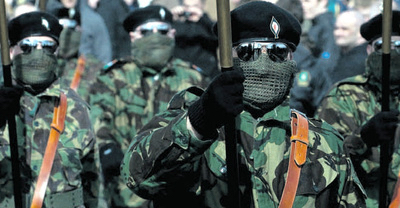
The attempted bombing of a police station in Lurgan, Northern Ireland, has sent a chill through a society that, for many, believed such scenes had been consigned to history.
The incident, in which a hijacked vehicle carrying an improvised explosive device was driven to the station under duress, is being treated by investigators as the likely work of dissident Irish republican militants.
According to police, a fast-food delivery driver was forced at gunpoint to transport the device after being intercepted by masked men late at night. The driver managed to raise the alarm upon arrival at the station, allowing security personnel to respond swiftly. A controlled explosion was later carried out, and while the device was described as “crude,” it was nevertheless viable and posed a very real threat to life.
Around 100 homes were evacuated as a precaution, underlining the seriousness with which authorities treated the incident. For residents of Lurgan, the disruption and fear were immediate and tangible. Yet beyond the local impact, the episode resonates far more widely, precisely because of what it appears to represent: a re-emergence, however limited, of tactics associated with the darkest years of Northern Ireland’s past.
The method used—a coerced civilian driver forced to deliver a bomb—has particularly disturbing historical echoes. During the decades of violence known as the Troubles, such “proxy bomb” attacks were among the most notorious tactics employed by the Provisional IRA. Civilians were kidnapped, threatened, and used as unwilling couriers in lethal operations against military or police targets. These acts left deep scars on communities and became emblematic of the brutality of the conflict.
That such a method has resurfaced, even in a relatively unsophisticated form, is what makes this incident especially worrying. Political leaders have already described it as a “chilling throwback” to that era, a phrase that captures both the symbolism and the danger inherent in the attack.
For years, Northern Ireland has experienced a fragile but largely sustained peace. While dissident republican groups—often fragmented and lacking broad support—have never fully disappeared, their activities in recent times have tended to focus less on high-profile terror attacks and more on criminal enterprises. Smuggling, fuel laundering, and extortion have become their primary sources of funding, reflecting both reduced capability and diminished political relevance.
This shift away from large-scale violence had fostered a cautious optimism. Occasional incidents—such as pipe bombs discovered in public areas or isolated attempts to target police officers—served as reminders that the threat had not vanished entirely. Yet these were sporadic and limited, lacking the sustained intensity that defined earlier decades.
The Lurgan incident, however, disrupts that narrative. Even if the device itself was relatively crude, the intent and method suggest an effort to revive tactics designed to shock, intimidate, and attract attention. It points to a willingness, at least among some factions, to escalate beyond the low-level criminality that has characterised their recent activities.
To understand why this matters, it is necessary to recall the scale and persistence of violence during the Troubles. Between the late 1960s and the Good Friday Agreement of 1998, Northern Ireland endured a sustained campaign of bombings, shootings, and sectarian attacks. The Irish Republican Army alone carried out thousands of bombings, developing increasingly sophisticated devices and delivery methods. Car bombs, roadside explosives, and remote-controlled devices became grimly familiar features of daily life.
The legacy of that period is still visible, not only in physical scars but in the collective memory of communities. Peace, while real, has always required vigilance. The existence of dissident groups—such as the so-called New IRA—has ensured that security services remain alert to the possibility of renewed हिंence.
What makes the current situation particularly delicate is the contrast between perception and reality. For many younger people in Northern Ireland, the Troubles are history rather than lived experience. The relative quiet of recent years has allowed normality to take root. Against that backdrop, an incident like the Lurgan bomb attempt can feel disproportionately alarming, precisely because it disrupts that sense of stability.
At the same time, it is important not to overstate the capabilities of those responsible. Dissident republican groups remain small, divided, and lacking the widespread support that once sustained the IRA’s campaign. Their reliance on criminal activity reflects these limitations. Yet history demonstrates that even small groups can inflict significant harm if they choose to escalate their tactics.
The response of the local community and political leaders has been unequivocal in condemning the attack. There is little appetite for a return to violence, and those responsible are widely seen as isolated from the broader population. This isolation is a crucial factor in maintaining peace; without community support, militant campaigns struggle to gain momentum.
Nevertheless, the Lurgan incident serves as a stark reminder that the conditions which allowed influence to flourish in the past cannot be taken for granted as permanently resolved. Economic disparities, political tensions, and identity issues still exist beneath the surface, and these can be exploited by those seeking to destabilise the peace.
In that sense, the attempted bombing is not just a criminal act but a warning. It highlights the need for continued vigilance, effective policing, and sustained political engagement. Above all, it underscores the importance of remembering the lessons of the Troubles—lessons written in decades of bloodshed and death.
For now, Northern Ireland remains far removed from those dark days. But the events in Lurgan demonstrate that the embers of conflict have not been entirely extinguished. Even a crude device, delivered by a terrified civilian, is enough to remind a society how fragile peace can be—and how essential it is to protect it.
Click here for more News & Current Affairs at EU Today
Click here to check out EU TODAY’S SPORTS PAGE!
___________________________________________________________________________________________________________________

