
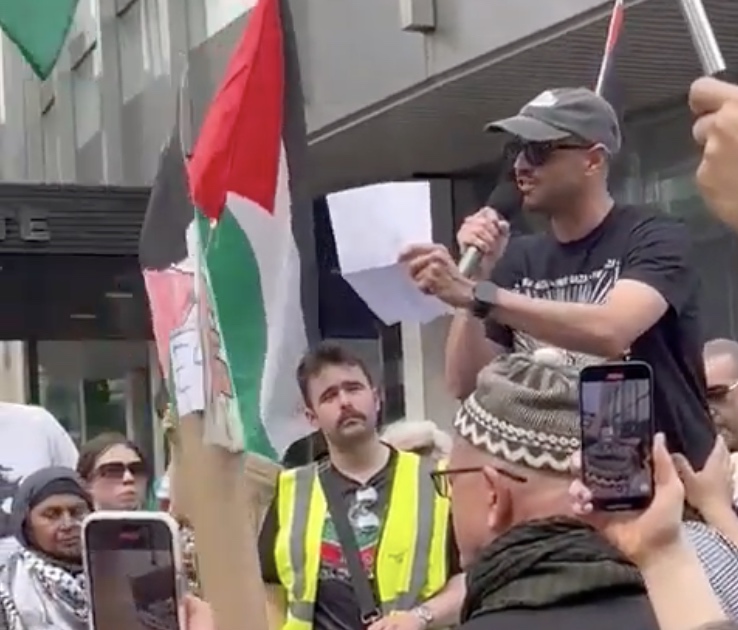
The Green Party likes to present itself as the conscience of modern Britain: compassionate, progressive, enlightened. However, the latest revelations surrounding the newly elected Green mayor of Lewisham suggest that beneath the party’s carefully cultivated image lies something far darker — a willingness to indulge extremist voices so long as they fit neatly into fashionable identity politics.
According to reporting in The Times, Liam Shrivastava, the Green Party’s newly elected mayor in Lewisham, maintained close ties with the Lewisham Islamic Centre, an institution whose senior figures have repeatedly promoted deeply troubling views. One imam, Ashraf Dabous, reportedly declared that women who refuse sex with their husbands are committing a sin. Another, Shakeel Begg, was formally described by a High Court judge as an “extremist Islamic speaker” who had promoted religious violence.
And yet none of this appears to have troubled the Green Party in the slightest.
Instead, Shrivastava praised the organisation lavishly, describing it as a pillar of “respect, tolerance and peace”. He spoke admiringly of Imam Begg himself, saying he was “always inspired” by him and the centre’s work.
One might reasonably ask: inspired by what, exactly?
For years Britain’s political class has developed an almost pathological fear of criticising Islamist extremism when it emerges within certain minority communities. Politicians who would rightly denounce far-Right extremism without hesitation suddenly become paralysed when confronted with radical Islamist rhetoric. The result has been a disastrous double standard that corrodes public confidence and undermines social cohesion.
Had a newly elected politician been photographed alongside figures linked to white supremacist organisations, there would be national outrage. Careers would end overnight. Police investigations would swiftly follow. But when extremist Islamist views are involved, Britain’s progressive establishment suddenly rediscovers the virtues of nuance, dialogue and “community engagement”.
The Green Party is hardly alone in this moral cowardice, but it increasingly appears to be among the worst offenders.
The modern Greens have drifted a long way from environmentalism. Once associated with countryside conservation and clean rivers, the party now seems obsessed with performative radicalism and grievance politics. It is no longer enough simply to advocate lower emissions or renewable energy. Increasingly, Green politicians appear desperate to align themselves with every fashionable activist cause, regardless of the ideological contradictions involved.
That is how a supposedly feminist political movement ends up embracing organisations whose leading figures espouse profoundly reactionary attitudes towards women.
It is also how a party that endlessly lectures the public about “hate” and “inclusion” ends up normalising individuals accused of encouraging religious violence.
Britain has reached a dangerous point where Islamist extremism is too often treated as merely another cultural sensitivity to be accommodated rather than confronted. This has had catastrophic consequences over the past two decades, from radicalisation networks operating in plain sight to repeated failures by public institutions too frightened of accusations of “Islamophobia” to act decisively.
The country’s political leadership has consistently underestimated the seriousness of the threat. Worse still, parts of the activist Left have effectively become apologists for Islamist reactionaries, viewing them through the warped prism of anti-Western identity politics. In this worldview, virtually any group positioned against the British establishment can be reframed as an oppressed minority deserving protection.
It is a profoundly reckless ideology.
Support for Islamist terrorism should not be treated as a regrettable opinion or an unfortunate by-product of multiculturalism. It should be treated as what it is: support for terrorism. Full stop.
Any organisation openly endorsing Islamist terrorist groups, glorifying jihadist violence, or providing platforms for extremist preachers should face immediate legal sanction, including closure where appropriate. The law already recognises support for proscribed terrorist organisations as a serious criminal matter, but enforcement remains inconsistent and timid. Britain’s authorities have too often tolerated extremist networks until tragedy forces action.
That culture of hesitation must end.
Freedom of religion is a cornerstone of British democracy. Millions of British Muslims contribute enormously to national life and reject extremism entirely. But religious freedom cannot mean immunity from scrutiny. Nor can “community cohesion” become a euphemism for ignoring dangerous ideology.
Shrivastava defended his relationship with the Lewisham Islamic Centre by arguing that local leaders must engage with a wide range of faith groups. Of course they must. Nobody is suggesting elected officials should refuse dialogue with religious communities. But there is an enormous difference between maintaining civic contact and publicly celebrating individuals with records of extremist rhetoric.
Politicians exercise judgment every time they decide whom to legitimise through association. That judgment matters.
The Green Party’s defenders will inevitably accuse critics of manufacturing outrage or demonising Muslims. Yet such accusations merely reinforce the problem. Serious concerns about extremism are too often shut down through moral intimidation rather than addressed honestly.
The public is growing tired of it.
Ordinary voters understand instinctively that Britain cannot maintain a coherent society if political leaders excuse extremism whenever it emerges from supposedly protected groups. They understand that genuine tolerance requires defending liberal democratic values consistently — including women’s rights, free speech and opposition to religious violence.
The Greens once claimed to represent principled politics. Increasingly, however, they resemble a movement so intoxicated by ideological posturing that it can no longer distinguish between tolerance and surrender.
That is not progressivism. It is political collapse.
Islamic Terrorist Organisations Added to UK list of Proscribed Groups
Click here for more News & Current Affairs at EU Today
Click here to check out EU TODAY’S SPORTS PAGE!
___________________________________________________________________________________________________________________

