
The closing days of Hungary’s 2026 parliamentary election campaign have exposed a striking contradiction at the heart of contemporary geopolitics.
On one hand, American Vice President J.D. Vance has accused the European Union of interfering in Hungary’s democratic process. On the other, his own highly visible intervention—campaigning in Budapest and openly backing Prime Minister Viktor Orbán—has raised profound questions about double standards, sovereignty, and the emerging alignment between nationalist governments and Moscow.
At first glance, Vance’s claim appears to echo a familiar narrative. Orbán himself has long argued that “Brussels” seeks to undermine Hungarian sovereignty, particularly through legal pressure, funding conditionality, and criticism of democratic backsliding. Yet the timing and context of Vance’s remarks suggest something more coordinated: a convergence of messaging between Washington’s Trump-aligned leadership, Budapest, and, increasingly, the Kremlin.
The contradiction at the centre
During his visit, Vance denounced what he described as EU interference in Hungary’s election, calling it among the worst examples of foreign meddling. Yet he did so while appearing at campaign events, endorsing Orbán publicly, and even facilitating a live endorsement from Donald Trump.
This is not subtle diplomacy. It is direct political engagement in a sovereign electoral process—precisely the behaviour he himself condemns. Critics across Europe have pointed out the inconsistency: if statements from Brussels constitute interference, what does one call a foreign vice president urging voters to support a specific candidate?
The answer lies less in logic than in political alignment. Vance’s rhetoric mirrors Orbán’s long-standing portrayal of the EU as an intrusive, ideologically driven force. It also overlaps with Russian narratives that depict Western institutions as hypocritical and illegitimate.
Orbán’s Moscow connection
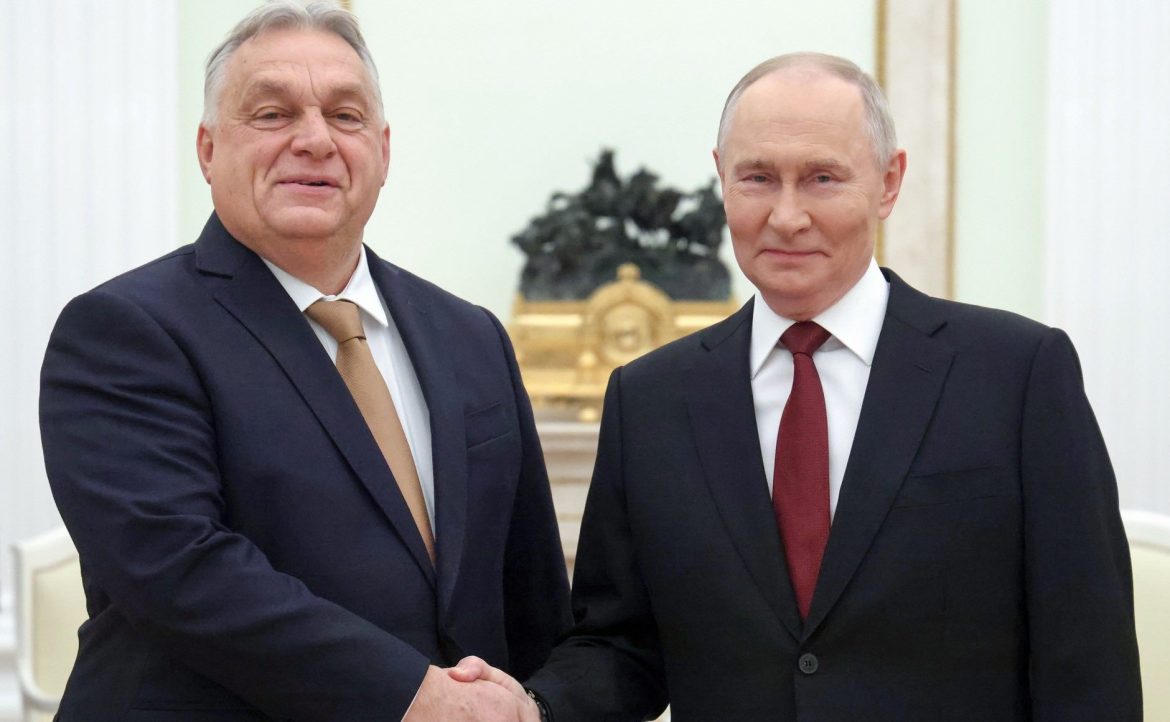
To understand the deeper implications, one must examine Orbán’s relationship with Vladimir Putin. Unlike most European leaders, Orbán has maintained regular contact with Moscow since Russia’s full-scale invasion of Ukraine. His visits to the Russian capital—often framed as “peace missions”—have repeatedly broken with EU consensus.
Recent reporting suggests that this relationship goes beyond pragmatic diplomacy. In a leaked account of a 2025 conversation, Orbán reportedly offered extensive assistance to Putin, even likening Hungary’s role to that of a “mouse helping a lion.” Such language is quite remarkable for a leader of an EU and NATO member state.
This pattern is not new. Hungary has consistently sought to preserve energy ties with Russia, resisting efforts to diversify away from Russian oil and gas. It has also positioned itself as an intermediary in discussions about Ukraine—though critics argue this role often serves Moscow’s interests more than Kyiv’s.
The veto as a strategic tool
Perhaps the most consequential aspect of Orbán’s policy has been Hungary’s repeated use of the veto within EU institutions. Since the outbreak of war in Ukraine, Budapest has blocked or delayed multiple initiatives aimed at supporting Kyiv or increasing pressure on Russia.
Hungary has obstructed sanctions packages, delayed financial assistance, and even halted progress on Ukraine’s accession talks to the EU. In early 2026, it went further, suspending support for Ukraine through EU mechanisms altogether amid a dispute over energy transit.
This is not mere obstructionism. It is leverage. By exploiting the EU’s requirement for unanimity in key areas, Orbán has been able to extract concessions while simultaneously shielding Russian interests. The effect has been to weaken the bloc’s collective response to the war.
An emerging axis?
It is in this context that Vance’s intervention takes on broader significance. His alignment with Orbán’s positions—on energy, migration, and the EU—suggests the emergence of a transnational political axis. This axis is not formal, but it is ideologically coherent: nationalist, sceptical of liberal institutions, and open to engagement with Moscow.
Some analysts have gone further, describing this alignment as an “axis of convenience” between illiberal democracies and authoritarian regimes. The term “axis of evil,” once used in a very different geopolitical context, has resurfaced in commentary to describe the perceived convergence between Budapest and Moscow.
Such language may be provocative, but the underlying concern is real. Orbán’s Hungary has become a focal point for networks that blend political influence, economic dependency, and information operations. Reports of Russian intelligence activity and disinformation campaigns linked to the Hungarian election only reinforce this perception.
Election interference—real and imagined
The irony is that allegations of interference are not entirely unfounded—just misdirected. There is credible evidence of foreign influence efforts in Hungary, including Russian-backed narratives and online campaigns.
At the same time, the Hungarian government has accused Ukraine and the EU of meddling, often without substantiation. These claims serve a political purpose: to frame external criticism as hostile interference, thereby reinforcing a siege mentality among voters.
Vance’s remarks fit neatly into this framework. By amplifying accusations against Brussels, he strengthens Orbán’s narrative while deflecting attention from his own intervention—and from Russia’s role.
A test for Europe
For the European Union, the Hungarian election represents more than a domestic political contest. It is a test of the bloc’s cohesion and its ability to respond to internal dissent. Orbán’s use of veto power has already exposed structural vulnerabilities within EU decision-making.
If his approach continues, the EU may face increasing difficulty in maintaining a unified stance on Ukraine, sanctions, and broader foreign policy. The risk is not only paralysis but fragmentation—particularly if other member states adopt similar tactics.
The spectacle of an American vice president accusing the EU of interference while actively campaigning in Hungary encapsulates the contradictions of the current moment. It reflects a world in which traditional alliances are shifting, and where narratives of sovereignty and interference are deployed selectively. It also reflects on the political integrity of the messenger.
At the centre of this dynamic stands Viktor Orbán: a leader who has mastered the art of balancing between Brussels and Moscow, leveraging Hungary’s position to pursue a distinctly illiberal agenda. His frequent engagement with Vladimir Putin, his strategic use of the EU veto, and his resistance to supporting Ukraine all point to a broader realignment.
Whether this amounts to an “axis of evil” or simply a convergence of interests is open to debate. What is clear, however, is that the Hungarian election has become a focal point for competing visions of Europe’s future—one rooted in integration and collective security, the other in sovereignty, nationalism, and accommodation with authoritarian power.
Main Image: Photo: Vladimir Gerdo, TASS, via Kremlin.ru
Click here for more News & Current Affairs at EU Today
Click here to check out EU TODAY’S SPORTS PAGE!
___________________________________________________________________________________________________________________

