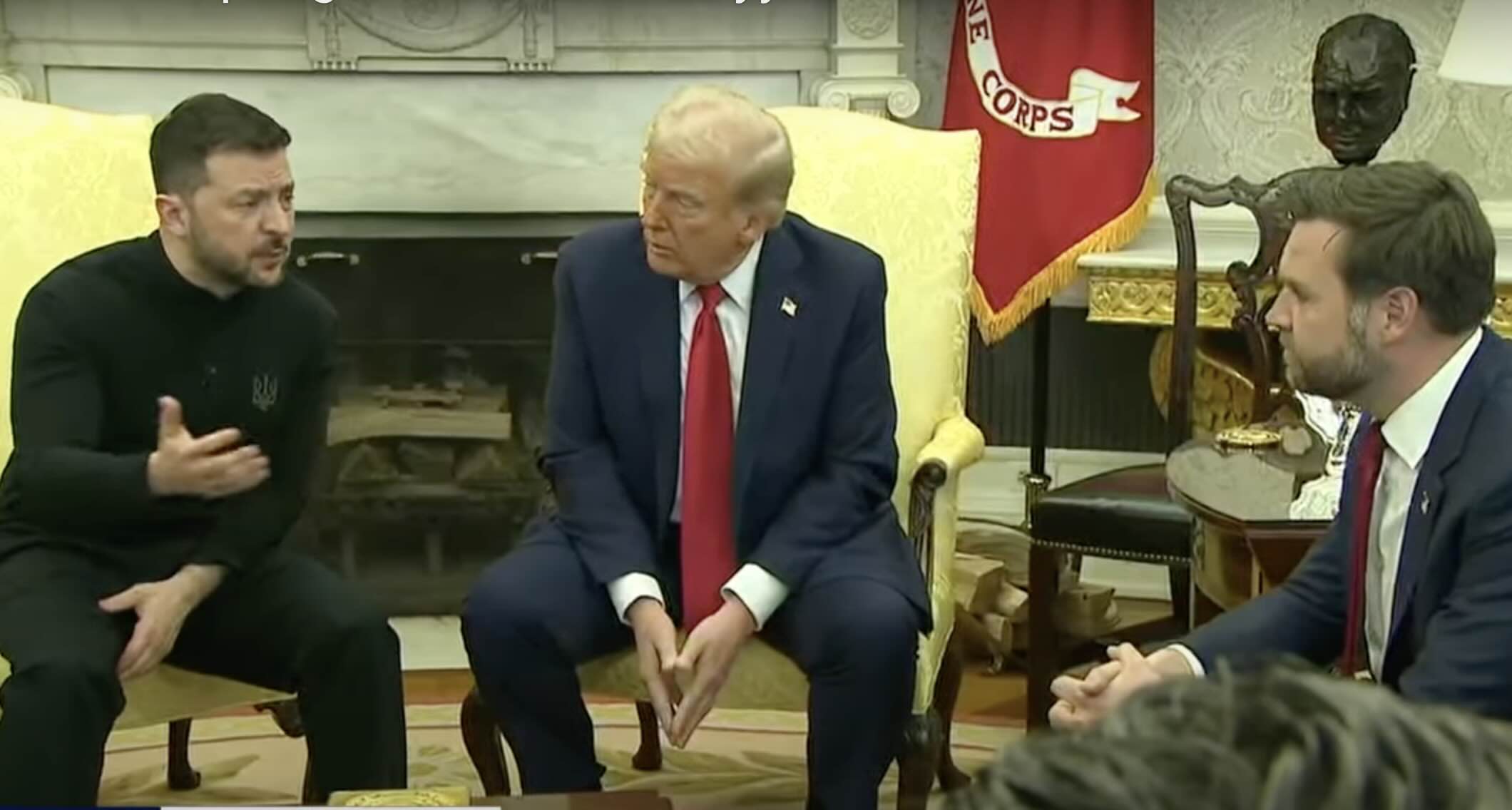
The much-anticipated meeting between Ukrainian President Volodymyr Zelenskyy and US President Donald Trump ended in failure, with no agreements reached and heightened tensions marking the discussions.
Despite earlier claims from Trump that an agreement on rare earth minerals would be signed on 28 February, no deal materialised. The meeting, rather than strengthening ties, underscored the growing divide between the two leaders, with Zelenskyy leaving the White House prematurely.
Inside the Oval Office, Trump acknowledged the courage of Ukrainian soldiers and praised their resilience in resisting Russian aggression for three years, though his words lacked genuine commitment to Kyiv’s cause. A key topic of discussion was the rare earth minerals agreement, which Trump had initially touted as a “fair deal” for both nations. However, Trump and Zelenskyy failed to reach an agreement, leaving the fate of US-Ukrainian cooperation on critical resources uncertain.
Trump’s insistence that Ukraine make “compromises” in negotiations with Russia further fuelled tensions. “Ukraine will have to make compromises,” Trump said, reflecting a stance that aligned with Russian narratives. Zelenskyy, however, reaffirmed that Ukraine would not accept peace terms that compromised its sovereignty. He stressed the importance of a robust security framework to guarantee that any agreement would be both durable and just.
Tensions escalated further when Trump stated, “I am for Ukraine, and I am for Russia,” positioning the US as a neutral party rather than a steadfast ally of Kyiv. This statement did not sit well with Zelenskyy, who viewed such an approach as a betrayal of US commitments to Ukraine. The situation deteriorated when Trump suggested that Ukraine should be “grateful” for American support and should not “gamble with World War III,” an assertion that dismissed the existential stakes for Kyiv.
It appeared that both Trump and Vice President J.D. Vance were deliberately provoking Zelenskyy, pushing him into a defensive stance. Their approach seemed calculated to paint him as uncooperative or unreasonable, feeding into a broader narrative that the US should scale back its support for Ukraine.
Following this heated exchange, the White House confirmed that the planned joint news conference between Trump and Zelenskyy had been cancelled. Shortly thereafter, Zelenskyy and the Ukrainian delegation left the White House earlier than scheduled, signalling the collapse of the discussions.
Trump later took to Truth Social to declare that Zelenskyy “can come back when he is ready for peace,” implying that the Ukrainian president’s refusal to accept Trump’s terms was an obstacle to ending the war. “We had a very meaningful meeting in the White House today. Much was learned that could never be understood without conversation under such fire and pressure. It’s amazing what comes out through emotion, and I have determined that President Zelenskyy is not ready for Peace if America is involved, because he feels our involvement gives him a big advantage in negotiations. I don’t want advantage, I want PEACE,” Trump wrote.
Trump further accused Zelenskyy of disrespecting the United States in its “cherished Oval Office,” a remark that underscored the growing rift between the two leaders. His comments reinforced concerns that Trump’s administration is willing to distance itself from Kyiv at a time when Ukraine relies heavily on US support to counter Russian aggression.
Trump also faced questions from reporters about the security of NATO’s eastern flank. He reassured Poland of continued US commitment to its defence, calling it a “model ally.” However, when pressed on broader support for NATO allies concerned about Russian expansionism, he avoided direct commitments and instead reiterated his desire to “end the war”—a vague phrase that suggests an interest in pushing Ukraine toward an unfavourable settlement rather than ensuring lasting security in the region.
The failure to sign the rare earth minerals deal and the abrupt cancellation of the press conference raised further questions about the stability of US-Ukraine relations. While the US Treasury Secretary had earlier confirmed that the deal was “mutually beneficial,” critics have raised concerns about its economic viability and strategic significance. Analysts point out that reliable data on Ukraine’s rare earth reserves is outdated, with some estimates dating back to the Soviet era. Questions remain over the feasibility of large-scale extraction and whether American investments in Ukraine’s mining sector would yield tangible returns. Trump, as usual, presented the deal as a win for the US, with little regard for how it would impact Ukraine’s long-term economic stability.
Vice President J.D. Vance also weighed in on the discussion, reportedly challenging Ukraine’s ability to sustain its war effort. In an astonishingly dismissive manner, Vance claimed that Ukraine was running out of manpower and that diplomacy was the only way forward. Zelenskyy pushed back, pointing out that Vance had never visited Ukraine and was not in a position to assess the country’s resilience. Vance’s remarks echoed isolationist rhetoric that seeks to abandon Ukraine at a critical moment, disregarding the sacrifices Ukrainians have made in defending their country and European security as a whole.
The tensions were further highlighted by a minor but symbolic dispute over Zelenskyy’s attire. Trump questioned why the Ukrainian president was not wearing a suit, suggesting that some Americans viewed this as a lack of respect for formal diplomatic protocol. The remark, which bordered on pettiness, added to the increasingly confrontational atmosphere of the meeting and demonstrated Trump’s preference for optics over substantive policy discussions.
As the talks concluded, it was clear that the meeting had not resulted in a significant shift in US policy towards Ukraine. With the failure to sign the rare earth minerals deal, along with the abrupt cancellation of the press conference, the broader issue of continued US military and financial support for Ukraine remained uncertain. Trump’s reluctance to unequivocally support Kyiv and his fixation on a so-called “deal” with Putin raised alarms about the future of US-Ukrainian relations.
Meanwhile, Zelenskyy’s firm stance signalled that Ukraine was unwilling to accept a settlement that could compromise its sovereignty or territorial integrity. The Ukrainian president’s refusal to entertain concessions to Russia may create further friction in future interactions with the Trump administration, but it reaffirmed Ukraine’s determination to fight for its survival rather than be pressured into a premature and unjust peace.
With global implications at stake, this meeting marks a pivotal moment in defining the US approach to the ongoing war in Ukraine. Trump’s emphasis on negotiation—without acknowledging Russia’s role as the aggressor—raises concerns that his administration is willing to sacrifice Ukraine’s security for a misguided attempt at diplomacy.
Read also:
EU Security Summit to Affirm Europe’s Role in Peace Negotiations and Ukraine’s Security Guarantees