
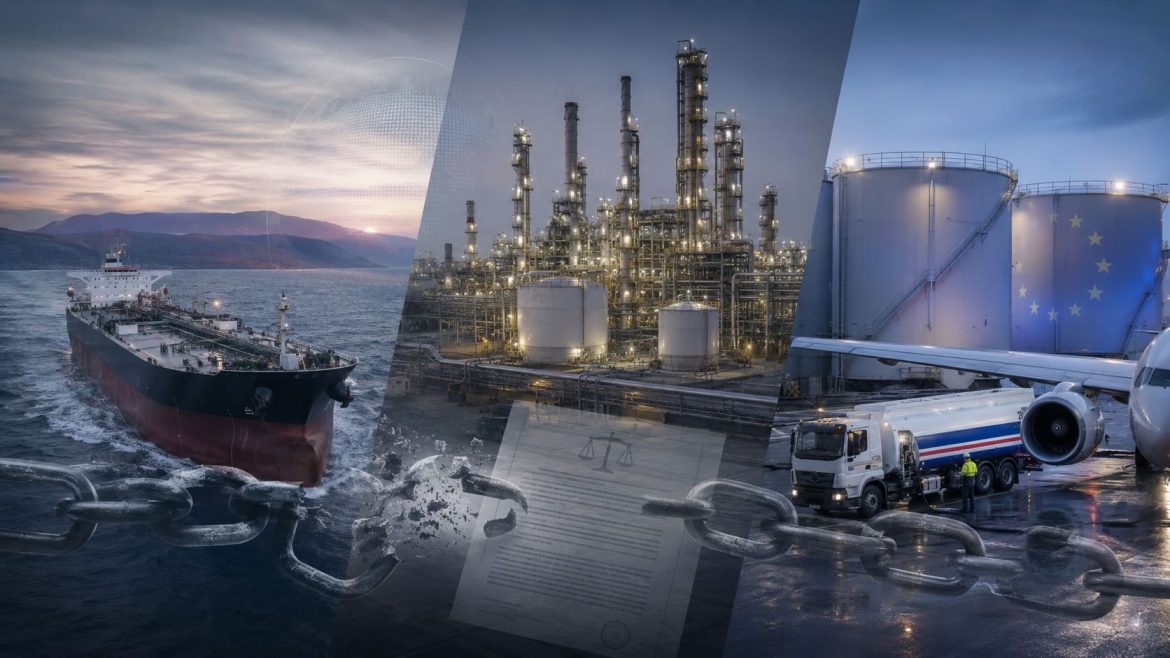
A new British trade licence allows imports of diesel and jet fuel refined in third countries from Russian crude, raising questions over the consistency of Western sanctions policy as energy markets tighten.
The UK has issued a new trade licence allowing imports of sanctioned processed oil products, including diesel and jet fuel refined from Russian crude in third countries, in a move that exposes the tension between sanctions policy and energy security.
The General Trade Licence for sanctioned processed oil products, issued by the Department for Business and Trade on 19 May, came into force on 20 May. It is of indefinite duration, subject to periodic review by the Secretary of State, and can be varied, revoked or suspended at any time.
The licence allows activity that would otherwise be restricted under the UK’s Russia sanctions regime. Its practical effect is to permit the import and servicing of refined petroleum products made from Russian crude oil, provided they have been processed outside Russia. The policy does not amount to a direct resumption of Russian oil imports, but it creates a route by which Russian-origin crude can re-enter the British market after refining in third countries.
The distinction is legally important, but politically sensitive. The UK has repeatedly presented its Russia sanctions as part of a wider effort to restrict the Kremlin’s energy revenues and increase the economic cost of the war against Ukraine. Current UK sanctions guidance states that the import or acquisition of Russian oil, oil products, coal and liquefied natural gas is generally prohibited, while maritime services connected to Russian oil are subject to the oil price cap framework.
The new licence therefore highlights a familiar sanctions problem: once Russian crude is processed in another country, enforcement becomes more complex. Countries such as India and Turkey have played an important role in refining Russian crude and selling processed products into global markets. Those products may no longer be legally classified in the same way as crude imported directly from Russia, but their origin still raises questions about the effectiveness of Western restrictions.
The immediate justification is supply security. Reuters reported that the measure was introduced as Britain faced pressure from rising fuel prices and wider supply disruption linked to conflict in the Middle East. Diesel and jet fuel are particularly sensitive products because of their importance to road freight, aviation, logistics and essential services.
That pressure has been reinforced by volatility in global energy markets. The Guardian reported that the decision followed concerns over supply strains linked to disruption around the Strait of Hormuz and wider fears about fuel availability. For the British government, the licence can be presented as a practical measure to protect domestic supply rather than a change in political support for Ukraine.
The problem is that sanctions depend not only on their legal text, but on their perceived consistency. Allowing processed fuel derived from Russian crude may help stabilise short-term supply, but it also risks weakening the message that Russian energy revenues should remain under sustained pressure. Even if the crude is refined elsewhere, Russia may still benefit from the initial sale.
The issue is not confined to Britain. Western sanctions on Russian energy have relied on a combination of direct import bans, price caps, maritime services restrictions and coordination among G7 partners. That system has always depended on compliance by traders, insurers, shipowners, refiners and third-country intermediaries. Where fuel is transformed through refining and then traded internationally, the chain becomes harder to police.
The EU faces a similar challenge. Its sanctions packages have progressively targeted Russian oil, refined products, maritime services and the so-called shadow fleet. The Council’s sanctions timeline lists measures including port restrictions, tanker due diligence and the basis for a future maritime services ban on Russian crude and petroleum products. Yet enforcement gaps remain where Russian-origin energy moves through third countries before reaching European or allied markets.
For Ukraine, the political question is whether Western governments will maintain pressure when sanctions begin to conflict with domestic energy costs. Moscow has adapted to successive rounds of restrictions by rerouting exports, using non-Western shipping and expanding relationships with buyers outside the sanctions coalition. Each exemption or licence risks being read as evidence that economic pressure can be diluted when market conditions worsen.
There is also a commercial dimension. Refiners outside the sanctions coalition may gain from purchasing discounted Russian crude and selling higher-value products into Western-linked markets. That creates an incentive structure in which Russian oil does not disappear from global supply chains, but changes form and route before reaching end users.
The British licence may be reviewed, amended or revoked, but its indefinite duration gives it wider significance. It suggests that governments are preparing for a period in which sanctions policy must be balanced more openly against fuel prices, aviation demand and industrial resilience.
For London, the decision may be defensible as a supply-management tool during an energy shock. For the sanctions coalition, it raises a more difficult question: whether restrictions on Russian energy can remain credible if refined products derived from Russian crude continue to circulate through third-country markets and return through legal exemptions.

