
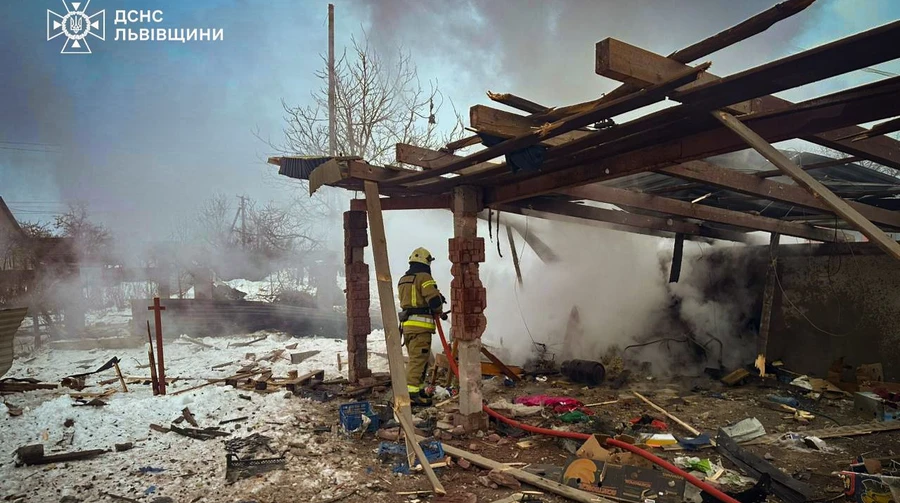
Thousands of residents in Ukraine’s Lviv region were left without water and heating on Saturday after a Russian attack hit critical infrastructure in the town of Dobrotvir, regional authorities said.
The Lviv Regional Military Administration said about 6,000 local people were affected after the strike damaged an infrastructure facility in Dobrotvir, a settlement in western Ukraine. Emergency and utility services were working to restore supply, according to the regional administration.
The disruption to heating and water came amid wider electricity restrictions across the region. Lviv officials reported that hourly power cut schedules were in place, while more than 600,000 electricity customers across the region were without power at the time of reporting.
The incident formed part of a large-scale overnight Russian air assault on Ukraine’s energy system, which Ukrainian officials described as one of the largest combined drone and missile attacks in recent months. President Volodymyr Zelenskyy said Russia launched more than 400 drones and around 40 missiles of various types in the overnight operation, with the main targets described as electricity networks, power generation facilities and distribution substations.
The strike campaign hit energy infrastructure across multiple regions, including western Ukraine, and contributed to emergency measures in the power sector. Damage was recorded in several oblasts, including Lviv region, as air defences engaged drones and missiles during the night.
In Lviv region, the focus on Saturday morning was on restoring essential services in and around Dobrotvir. The Lviv Regional Military Administration said specialised services were already working to resume supply, without providing a specific timetable for full restoration. The same statement underlined that electricity supply across the region remained unstable, with restrictions and outages affecting a large portion of customers.
Dobrotvir lies in an area that hosts energy infrastructure, and its disruption during winter can quickly translate into household-level impacts. Local heating systems in parts of Ukraine rely on a combination of electricity, district heating networks and fuel supplies that can be affected when power distribution is damaged. Saturday’s reports from the region pointed to simultaneous pressure on several basic services: electricity availability, water supply and heating.
The broader national context on 7 February was a renewed focus on the vulnerability of energy assets during the cold season. Reuters cited Zelenskyy as saying the attacks targeted the power grid, generation facilities and substations, and noted that Ukrainian officials were dealing with damage to distribution networks and generation capacity.
In Ukraine’s western regions, which have served as logistics and reception hubs for displaced people and for cross-border trade, the stability of electricity supply has been closely watched through successive winter periods. Emergency schedules of rolling outages have been used repeatedly across the country to balance the grid after strikes and to manage scarcity when repairs are under way.
Lviv officials did not report casualty figures in the initial public updates on Dobrotvir. Their statements concentrated on service disruption, repair efforts and the scale of power outages across the region.
Ukraine has repeatedly accused Russia of deliberately targeting energy infrastructure, while Russia has said its strikes are aimed at military and strategic assets. The overnight operation described by Ukrainian officials on 7 February again placed the power sector at the centre of the war’s winter dynamics, with regional administrations reporting impacts on civilian services as repair teams worked under air-raid constraints and ongoing security risks.

