
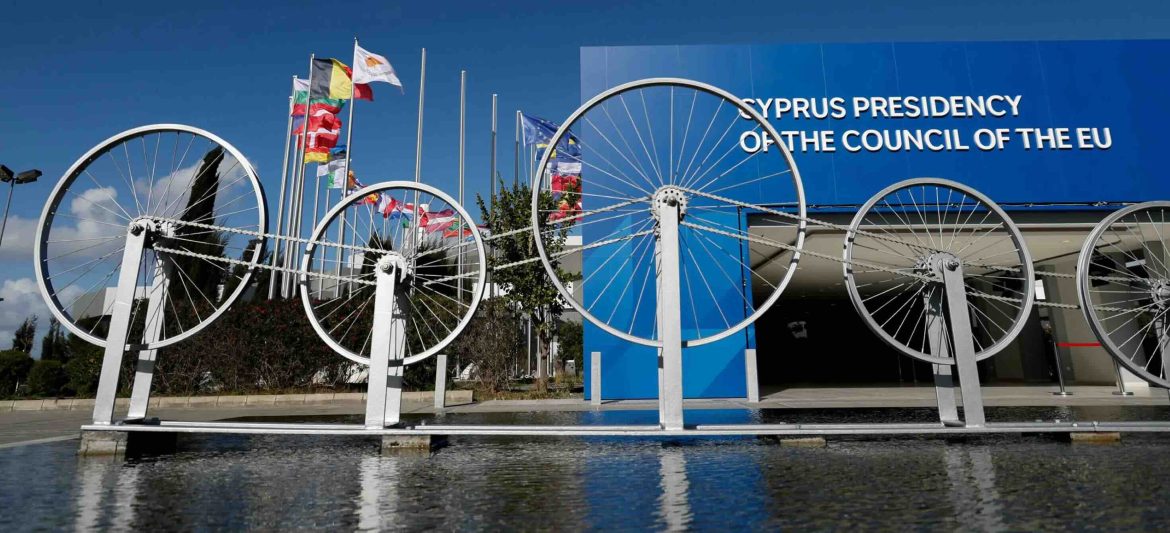
EU heads of state or government begin an informal meeting in Cyprus on Thursday evening with discussions centred on the conflict in Iran and the Middle East, the impact on energy prices and shipping, and the opening political debate on the EU’s 2028-2034 long-term budget.
EU leaders begin an informal meeting in Cyprus on Thursday evening, with the agenda focused on two immediate questions: the worsening geopolitical situation around Iran and the Middle East, and the opening political discussion on the EU’s next long-term budget for 2028-2034. The meeting is being chaired by European Council President António Costa and hosted by Cyprus President Nikos Christodoulides, with sessions in Lefkosia and Agia Napa.
According to the official meeting agenda, leaders are due to start gathering from 17:00 on 23 April. The Council says the first substantive discussion will cover the conflict in Iran and the wider Middle East, including Europe’s contribution to de-escalation, freedom of navigation in the Strait of Hormuz, and the effect of higher fossil fuel prices on European households and businesses. The same agenda page states that leaders will also review follow-up to the energy-related decisions taken at the March European Council.
In his invitation letter of 14 April, Costa said the dinner discussion on 23 April would begin with an address by President Volodymyr Zelenskyy by videoconference on Russia’s war against Ukraine. He then set out the second part of the evening’s agenda: the conflict in Iran and the Middle East, Europe’s response to it, the question of freedom of navigation, the economic effect of high fossil fuel prices, and the Union’s wider readiness to respond to the security environment. Costa also noted that this could include aspects related to Article 42(7) of the Treaty on European Union, the EU’s mutual-defence clause.
That wording gives the meeting a broader significance than a standard informal retreat. The discussion is not confined to diplomacy in the Middle East. It also reaches into energy security, economic resilience and, potentially, the institutional question of how the EU frames collective response mechanisms in a more volatile security environment. The Council’s agenda note makes clear that the leaders will be looking at the effects of high fossil fuel prices and the instruments available to the Union, linking the geopolitical discussion directly to economic policy.
The second core item is the multiannual financial framework, the EU’s long-term budget for 2028-2034. Costa wrote that this discussion had originally been foreseen for March but was postponed, and argued that it has since become more urgent. Leaders are expected to address the level of financing needed to match EU ambitions, the role of new own resources, and the extent to which the next budget should serve the bloc’s competitiveness agenda. The Council says this budget discussion will continue regularly through 2026 in order to prepare the ground for a timely agreement.
That makes the Cyprus meeting an early political marker rather than a negotiating end point. No final budget numbers are expected from an informal gathering, but the discussion matters because it begins to test the balance between strategic ambition and financing capacity. In practical terms, leaders are being asked to confront the link between external pressure, internal policy priorities and the size and structure of the next EU budget. Costa’s letter to leaders explicitly describes the MFF as the Union’s main instrument for common strategic action.
The meeting also carries a regional diplomatic dimension. The official programme says that, after the EU-27 session on 24 April, the leaders will be joined by key regional partners from the Middle East for an informal working lunch to discuss the situation, shared challenges and possible areas of cooperation. That adds an external-facing component to what is otherwise framed as an internal strategic discussion.
For Brussels, the significance of the Cyprus meeting lies in that combination: immediate crisis management, energy and economic implications, Ukraine, and the first substantial exchange on the next seven-year budget. The setting is informal, but the subjects are not. The Council’s own papers present the gathering as a moment to revisit implementation of March decisions, provide further political guidance on the Middle East crisis, and move the budget debate onto a more structured footing. That is enough to make it the main EU political event of 23 April.

