
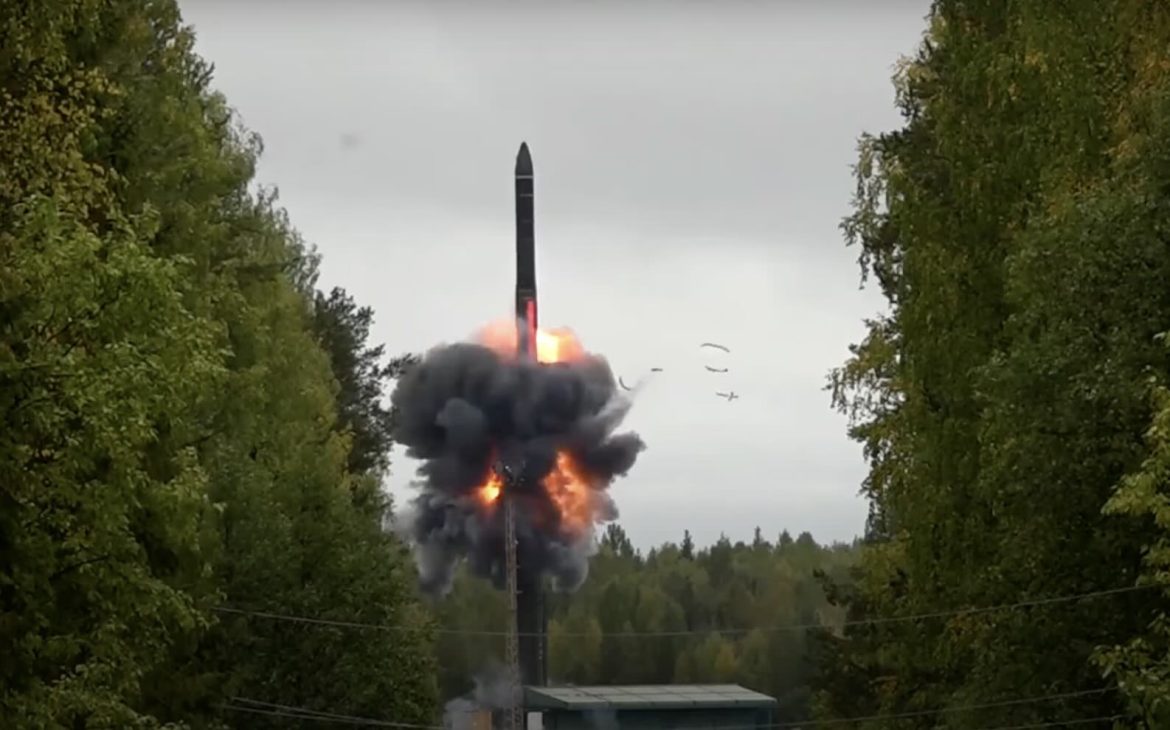
Despite an officially notified intent to carry out a training-combat launch of a RS-24 Yars intercontinental ballistic missile (ICBM) during the night of 18–19 May, no evidence has emerged to confirm that the missile was successfully launched — or launched at all.
The Ukrainian Defence Intelligence Directorate (HUR MO) initially reported the plan, citing unusual activity near the village of Svobodny in Russia’s Sverdlovsk Oblast. However, as of the morning of 19 May, no imagery, telemetry, or public confirmation of a launch has been observed.
According to defence analysts, the lack of any visual confirmation — either from residents near the launch area or observers along the missile’s expected flight path to the Kura Test Range in Kamchatka — strongly suggests that the event was either cancelled or failed at an early stage. The area near Svobodny is home to the 433rd Regiment of Russia’s 42nd Missile Division, part of the 31st Army of the Strategic Rocket Forces.
A launch from this location would almost certainly have been captured on video or reported by civilians in nearby settlements. In addition, a missile of this class would be observable across a large portion of Siberia and the Russian Far East — regions that remain heavily monitored, not least by international reconnaissance satellites and open-source intelligence.
Analysts point to multiple plausible explanations. The most probable scenario is a technical failure during pre-launch procedures or shortly after deployment of the mobile launcher. The Yars system, although relatively modern, is known to have experienced complications in the past. In 2023, two attempted test launches reportedly ended in failure due to navigational anomalies. Additionally, an RS-28 Sarmat missile exploded in its silo at Plesetsk in September 2024, highlighting broader challenges in Russia’s strategic missile programmes.
The Ukrainian intelligence report is understood to have been based in part on advance notifications required under the still-partially observed provisions of the New START Treaty framework. While the treaty formally expired, both Russia and the United States continue to exchange limited information on scheduled ICBM launches to avoid misinterpretation. This mechanism is intended to prevent training or test launches from being mistaken for actual offensive action.
The Russian designation of the planned event as a “training-combat” launch has attracted attention due to the ambiguity of the term. Unlike standard test launches, which verify technical performance, or training launches, which simulate operational readiness, the use of the term “combat” implies targeting scenarios, albeit without live warheads. Observers note that such language may be part of a strategic signalling effort, possibly aimed at Western audiences in the context of upcoming discussions between Presidents Putin and Trump.
However, experts are sceptical that such a display would have had much practical impact. The U.S. and NATO maintain continuous surveillance of Russia’s strategic launch sites and mobile assets. Although the precise technical status of each unit may be unknown, the locations and deployment patterns of Yars systems are well documented by both satellite and other intelligence means.
There are currently over 200 Yars missiles in service, the majority deployed on mobile launchers. While these platforms provide strategic flexibility, they are more vulnerable to pre-emptive strikes compared to silo-based missiles. Mobile Yars systems lack the hardened protection of silos, and thus are more susceptible to neutralisation in a first-strike scenario.
The possibility that the event was a calculated deception has also been raised. Some suggest that Russia may have leaked plans for a “training-combat” launch to raise geopolitical pressure ahead of negotiations. However, as one analyst observed, such manoeuvres are unlikely to unsettle experienced defence planners in Washington or NATO capitals. Missile launches of this class are easily tracked and, if not conducted with volume or payloads, pose no meaningful operational threat.
Moreover, the use of a strategic nuclear missile like Yars against a non-nuclear target such as Ukraine is widely regarded as implausible. The missile’s throw weight — up to 1,200 kg — is designed for multiple nuclear warheads, not conventional payloads. Delivering a non-nuclear explosive of a few hundred kilograms via an ICBM would be both militarily inefficient and economically irrational.
The suspected failure or cancellation of the Yars launch underscores broader concerns about the current state of Russia’s strategic forces. With ageing Topol missiles nearing obsolescence and the Sarmat programme facing repeated delays, Yars remains Russia’s principal ground-based strategic delivery system. Any malfunction or failed demonstration risks undermining Moscow’s deterrence posture — particularly at moments of heightened political signalling.
Read also:
Nuclear Showdown: China’s CSS-10 Success Amid Russia’s Satan 2 Failure in Joint Tests

