
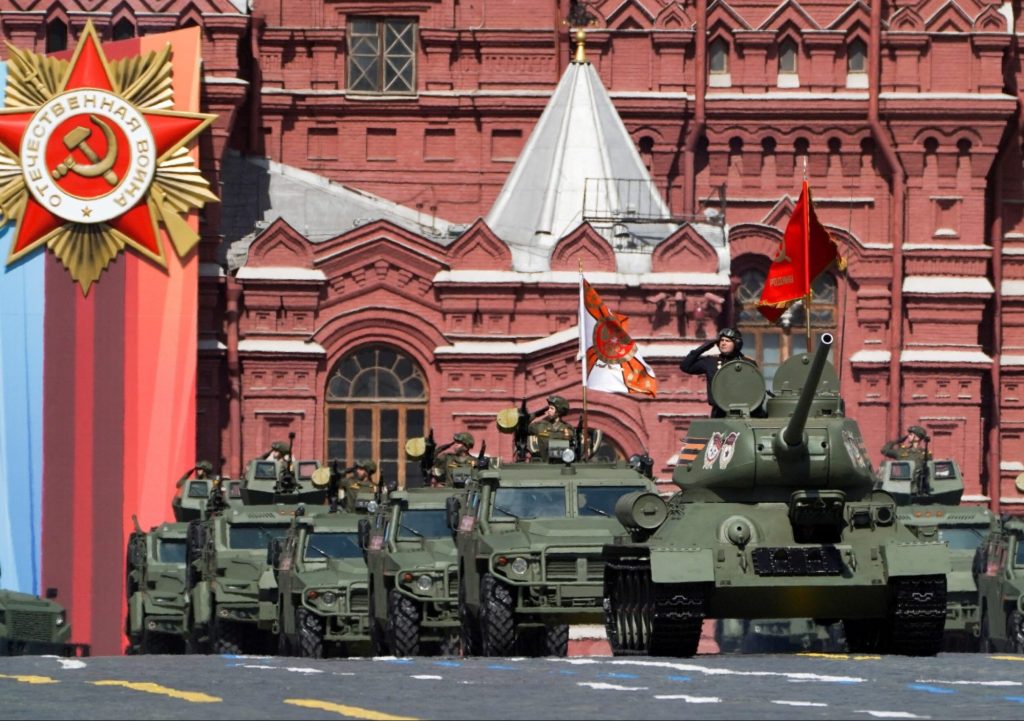
Unconfirmed reports circulating in Russia’s pro-war information space suggest that the Kremlin may be considering cancelling this year’s 9 May Victory Day parade on Red Square because of concerns over possible Ukrainian strikes on Moscow.
At the time of writing, however, there is no public confirmation from the Kremlin or the Russian Defence Ministry that the parade has been cancelled. On the contrary, a 24 March Interfax report said that parade units were preparing to take part in the Moscow celebrations, indicating that official planning was still under way.
The claim appears to have emerged from Russian military bloggers and commentators rather than from any formal state source. According to those accounts, Russian officials fear that Ukraine now has the capability to threaten even heavily protected targets in and around the capital. Such speculation reflects a broader shift in the war’s geography. What began as a conflict concentrated in eastern and southern Ukraine has increasingly extended deep into Russian territory through long-range drone and sabotage operations against airfields, refineries, ports and military infrastructure. Reuters reported on 16 March that Russia said it had foiled what it described as its biggest Ukrainian drone attack in a year, with drones approaching Moscow and temporary restrictions imposed at the capital’s airports.
Victory Day remains one of the most important dates in the Russian political calendar. The Red Square parade is not simply a military ceremony but a central state ritual, linking the memory of the Soviet victory in the Second World War to the authority of the present Kremlin leadership. Reuters noted in its coverage of the 2025 celebrations that the event is used to project military strength, continuity and national resolve. In May 2025, despite the war in Ukraine and clear security concerns, Russia still staged a large parade in Moscow attended by foreign leaders, including China’s Xi Jinping, and there were no reported Ukrainian attacks during the ceremony.
Putin’s Hollow May 9th Parade: The Coveniently Forgotten Truth of Soviet-Nazi Collaboration
That precedent is important, because it shows both the symbolic weight the Kremlin attaches to the parade and the degree of risk it has previously been willing to absorb in order to preserve the event. Even so, the security environment has worsened since then. Ukrainian strikes have increasingly targeted strategic assets far from the front line. Reuters reported in recent days that Ukrainian attacks hit Russian oil infrastructure, including Baltic export facilities and the Ust-Luga port, while Russian authorities have also reported drones intercepted on routes towards Moscow. These incidents do not confirm any specific threat to Red Square on 9 May, but they do illustrate why security calculations around mass military events in the capital may now be more acute than in previous years.
If the parade were ultimately to be scaled down, postponed or cancelled, the political significance would extend well beyond logistics. For more than two decades, the event has functioned as a demonstration of state control and military prestige. Since the full-scale invasion of Ukraine in February 2022, that symbolism has become even more central to the Kremlin’s domestic narrative. Any visible disruption to the ceremony on security grounds would therefore carry an unavoidable message: that the war has created vulnerabilities which can no longer be kept far from the Russian capital. That would be especially striking given Moscow’s extensive air defence network, which is generally regarded as one of the most protected areas in the Russian Federation. Reuters and other reporting have repeatedly shown, however, that Ukraine’s growing drone reach has challenged assumptions about the depth of Russia’s rear-area security.
For now, caution is required. There is a clear difference between online speculation, even when repeated by well-connected Russian commentators, and an official decision by the Kremlin. Publicly available reporting does not confirm that Vladimir Putin has cancelled the 2026 parade. The most recent direct indication from Russian media points instead to continued preparations for the 9 May event in Moscow.
Yet the fact that such reports are circulating at all is revealing. They point to a climate in which the security of even Russia’s most carefully choreographed state ceremony is no longer treated as beyond question. Whether or not the parade goes ahead as planned, the rumour itself underlines a broader reality of the war’s fifth year: Ukraine’s capacity to threaten high-value targets deep inside Russia has become a factor that Moscow must now take seriously.

