
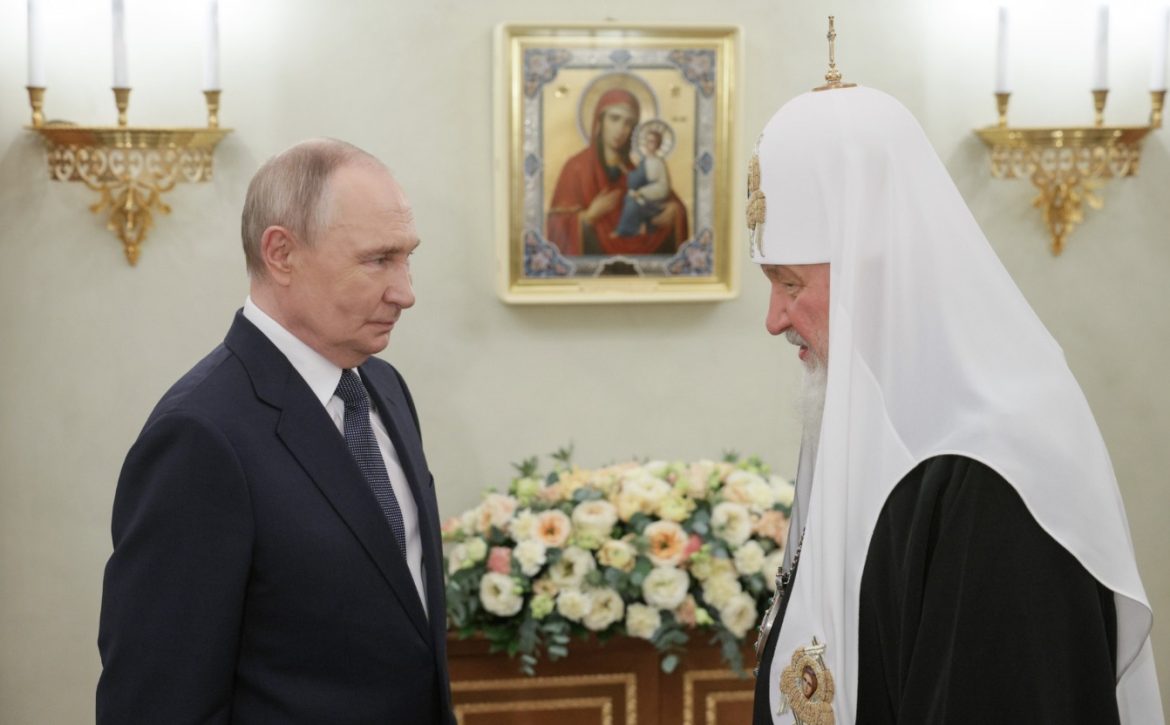
In Europe today, Russian Orthodox Churches that remain institutionally tied to the Moscow Patriarchate — closely aligned with warmonger President Vladimir Putin — have become not just places of worship but nodes of geopolitical influence and soft power.
Their continued operation on European soil demands urgent reassessment, including closure where ties to the Kremlin and its war agenda are maintained.
The relationship between Vladimir Putin and Patriarch Kirill, the head of the Russian Orthodox Church (ROC), is not merely ceremonial. It has evolved into a political alliance in which the Russian Church has lent spiritual legitimacy to the Kremlin’s nationalist and militaristic project. When wars are fought, narratives matter — and Kirill has repeatedly supplied the ideological “cover” for Moscow’s aggression.
In state ceremonies and public appearances, Putin invites Kirill to bless military ventures. As recently as January 2025, Putin asked Patriarch Kirill to consecrate crosses and icons as gifts for Russian troops fighting in Ukraine, framing warfare in religious terms and reinforcing the idea that Russia’s military actions carry spiritual weight.
This is not a passive relationship. The Russian Orthodox Church is deeply involved in the Kremlin’s narrative about the Ukraine conflict, portraying it not as an unprovoked invasion but as a defense of Orthodoxy against moral decay in the West. Kirill has echoed Kremlin rhetoric suggesting that Russia’s struggle is against liberal Western values and the acceptance of homosexuality, implying that these cultural battles justify broader political and military goals.
Patriarch Kirill’s Support for the War
Patriarch Kirill’s public statements go beyond neutral commentary. In sermons and addresses, he has characterised the war not simply as a geopolitical conflict but as a metaphysical and moral struggle. He has implied that God is on Russia’s side and that Western cultural values are part of the cause for confrontation.
Many in the Orthodox world have recoiled at this framing. Other religious leaders, including the Ecumenical Patriarch of Constantinople, have publicly criticised Kirill for aligning the Church with the Kremlin’s war machine and have suggested that he should have denounced Putin’s actions even at great personal cost — potentially at the price of his position. These comments illustrate how far Kirill has diverged from global Christian expectations of peace and reconciliation.
Even within the Russian Church itself, dissent exists. A significant number of lower-ranking priests have signed appeals for reconciliation and an immediate ceasefire, urging an end to the violence — but they are exceptions rather than the rule within a hierarchy that remains tightly bound to Moscow’s position.
European Responses and Controversies
Across Europe, the stance of the Moscow Patriarchate has sparked intense debate. Governments in several countries have moved to restrict or limit the activities of Orthodox parishes tied to the Russian Church, not simply because of their faith but because of their political alignment. For example, in Ukraine, legislation was passed expressly targeting religious organisations connected to Moscow, reflecting concern that these institutions serve as vehicles of Russian influence and propaganda.
Even the President of Germany has criticised the Russian Church’s stance, accusing it of appropriating “God’s will” to support imperial ambitions — an accusation that should give European policymakers pause when considering the civic space these churches occupy.
Many congregations and clergy in Europe have already broken from Moscow in protest, distancing themselves from the Patriarch and his politics. In Amsterdam, for instance, clergy left a Russian Orthodox parish after being pressured to support the war stance of the Moscow Patriarchate. These fractures underline how the war has fractured spiritual unity and injected geopolitics directly into religious life.
Church Scandals and Credibility Deficits
The argument for closing these churches is not solely about geopolitics. Moral authority — the very reason people seek spiritual guidance — is seriously compromised when religious institutions fail to uphold basic ethical standards.
Recent scandals involving high-ranking clergy in Europe have deepened concerns. In Budapest and Hungary, Metropolitan Hilarion Alfeyev, a senior Russian Orthodox bishop, was suspended amid credible reports of sexual harassment by his former assistant. Allegations included coercive behaviour and inappropriate advances, and they sparked an internal ecclesiastical investigation. This episode illustrates a broader problem within the Russian Church’s hierarchy: rhetoric about “traditional values” often belies the behaviour of those in positions of moral authority.
Even beyond this high-profile case, independent reporting and church dissidents note that sexual misconduct among clergy is more widespread than often acknowledged, with victims finding it difficult to come forward due to institutional protections and tacit complicity.
Hypocrisy of values damages credibility. When church leaders loudly condemn “Western decadence” while concealing or failing to adequately address abuses among their own ranks, they erode moral legitimacy. This duplicity weakens trust among both believers and the broader public.
Church as Political Actor, Not Spiritual Safe Haven
Churches should be sanctuaries of compassion, moral reflection, and peace. But when an institution become a vehicle for foreign influence — especially in the context of a brutal war causing massive loss of life — European democracies have a responsibility to protect social cohesion, public safety, and sovereign decision-making.
Kremlin-backed parishes have been accused of acting as soft power hubs. Even nuns and clergy in Europe have faced allegations — not just of political advocacy but of participation in espionage or propagandistic activities linked to the Russian state.
States routinely regulate foreign influence — from media outlets to NGOs — when there is a clear risk to national security or public order. Why should religious institutions be treated differently when they operate as extensions of an authoritarian regime’s ideological and cultural strategy?
Respect for Freedom of Religion Must Be Balanced With Public Interests
This is not a call to ban Russian Orthodox believers from practicing their faith in Europe. Individuals are free to worship. But institutions that are formally tied to the Moscow Patriarchate — and by extension to Russian state narratives — should not enjoy the same legal and cultural privileges as independent churches that uphold peace and democratic values.
European states should consider requiring clear separation of religious institutions from foreign political influence, especially from governments engaged in aggression that contravenes international law. Churches that refuse to break administrative and financial ties with the Moscow Patriarchate and refuse to denounce the war should face restrictions, including closure of buildings used for officially sanctioned activities.
Individuals retain freedom of belief, but institutions acting as agents of geopolitical agendas do not automatically merit protection under freedom of religion when their activities undermine peace, social cohesion, and democratic values.
Closing Kremlin-backed Russian Orthodox Churches in Europe would be a gesture of ethical solidarity with the victims of Russia’s war in Ukraine, as well as a statement that democracy and peace take precedence over foreign political influence disguised as religion. It is a necessary step for safeguarding the integrity of both European societies and the spiritual lives of those who wish to practise their faith free from manipulation.
Europe can — and must — distinguish between genuine spiritual life and institutions that have traded their prophetic voice for political power. If a church cannot clearly separate itself from the authoritarian state it is aligned with, protect basic human rights, and reject violence, then that institution has ceased to function as a legitimate moral authority in a democratic society.
Closing these institutions, or at least revoking their official status and requiring reorganisation under independent governance, is not an attack on faith. It is a defence of religious freedom untainted by political coercion and violence.
Main Image: http://en.kremlin.ru/catalog/persons/445/events/78507
Belgium Silently Continues to Finance the Russian Orthodox Church

