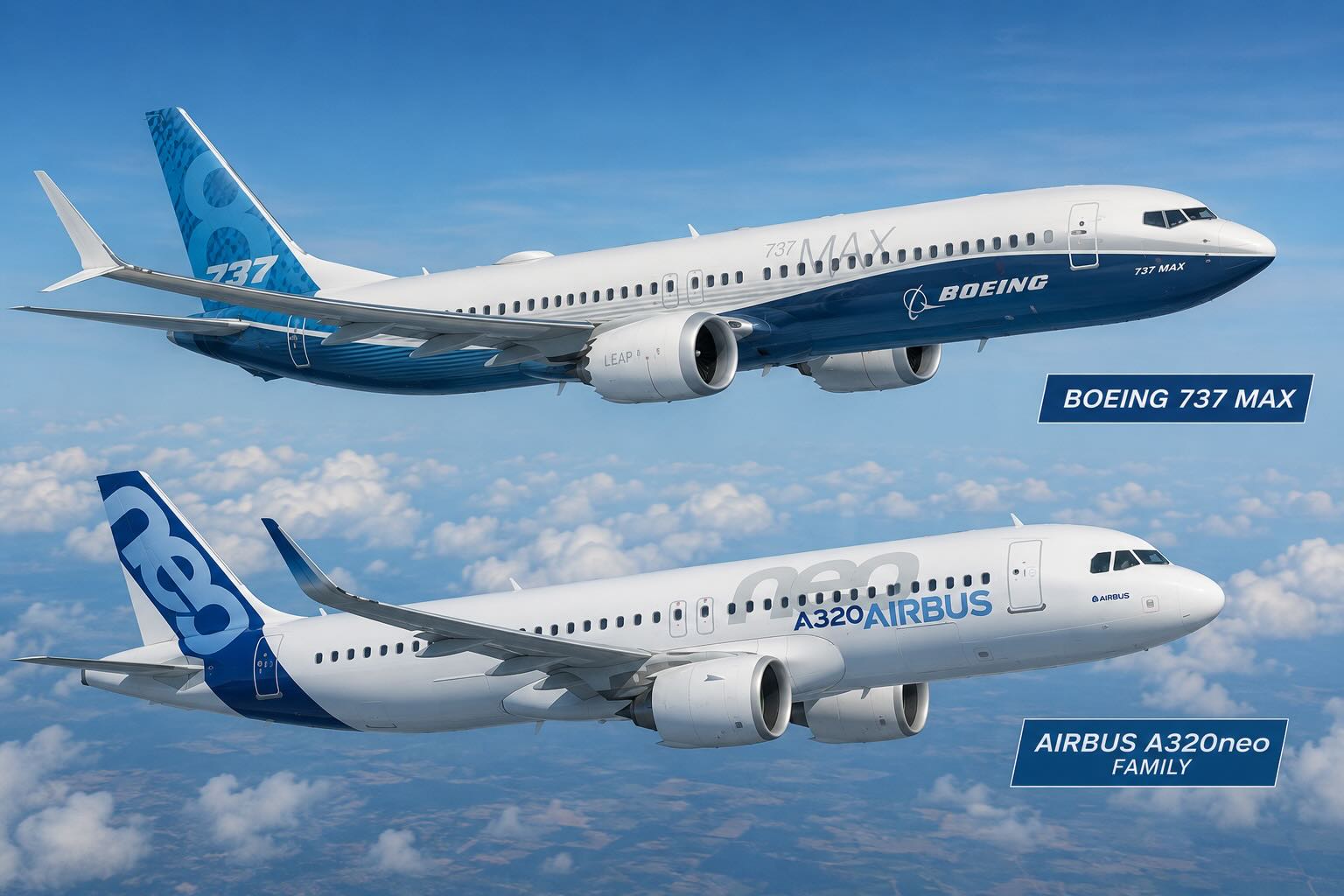
A major lessor’s near-even split between Airbus and Boeing shows how customers are balancing demand, delivery uncertainty and residual-value risk.
SMBC Aviation Capital has announced orders for 200 narrow-body aircraft, splitting the commitment between 100 Boeing 737 MAX jets and 100 Airbus A320neo-family aircraft. The company’s official announcement says the Airbus order covers 65 A321neo and 35 A320neo aircraft, while the Boeing order includes 60 737 MAX 10 and 40 737 MAX 8 aircraft. Reuters reported the orders as part of the Farnborough Airshow deal flow.
The size of the order is important, but the split is more interesting. SMBC is not choosing one manufacturer. It is balancing exposure between Airbus and Boeing, between aircraft variants, and between delivery schedules extending into the next decade. For a lessor, diversification is not a slogan. It is a risk-management tool.
Aircraft lessors sit between manufacturers and airlines. They buy aircraft, place them with carriers and manage residual values over many years. Their order choices indicate expectations about airline demand, financing conditions, fuel efficiency and future availability. A 200-aircraft commitment tells the market that SMBC expects strong long-term demand for latest-generation narrow-bodies despite current production constraints.
The Boeing portion is notable because it includes SMBC’s first 737 MAX 10 purchases. That variant still carries certification and delivery-timing significance for customers. By ordering 60 MAX 10s, SMBC is expressing confidence that airlines will want the higher-capacity version and that Boeing’s production and certification path will support deliveries into the 2030s.
The Airbus portion leans heavily towards the A321neo, reflecting the broader market preference for larger narrow-bodies that can carry more passengers and serve longer sectors. Airlines increasingly want aircraft that can replace older wide-bodies on thinner routes or provide more seats where airport slots are constrained.
Recent analysis of Boeing’s Farnborough production focus argued that aircraft demand is not the central problem for manufacturers; delivery discipline is. SMBC’s order reinforces that point. Lessors want aircraft, but they also want reliable delivery streams. A split order reduces the risk of being trapped by one manufacturer’s production delays.
Engine and maintenance constraints also matter. SMBC said it signed a separate agreement with CFM International for up to 90 additional LEAP 1-A engines for its Airbus orders. EU Today has previously examined how CFM engine repair investment reflects continuing bottlenecks in the narrow-body market. Engine availability can determine whether aircraft are delivered, leased and flown on schedule.
For airlines, lessor orders can help manage uncertainty. Carriers that cannot obtain near-term delivery slots directly from manufacturers may lease aircraft instead. A large lessor with a diversified order book can offer airlines more flexibility in fleet planning. That is particularly valuable when travel demand, fuel prices and aircraft-production rates are all uncertain.
For manufacturers, the order sends different signals. Boeing gains a vote of confidence at a time when it is trying to stabilise production and restore trust. Airbus strengthens an already powerful A320neo-family backlog. Both companies gain long-term demand, but both must convert orders into deliveries.
The timing also fits the broader Farnborough theme. Airshow orders create headlines, but investors and airlines increasingly care about whether aircraft can be built on time. Supply chains, quality control, certification and engine durability remain constraints. A large order is valuable only if delivery performance follows.
SMBC’s strategy is therefore conservative in a sophisticated way. It is committing to growth while avoiding concentration. It is buying fuel-efficient aircraft while spreading manufacturer exposure. It is betting on long-term aviation demand while recognising that production risk is now one of the defining problems of the sector.
The 200-jet order shows that the narrow-body market remains strong. It also shows that customers have learned from recent disruption. In today’s aircraft market, the best fleet strategy is not only about which model performs best on paper. It is about which mix gives airlines and lessors enough resilience when delivery schedules, engines and geopolitics refuse to behave predictably.
For SMBC, the order also protects relevance with airline customers years before the aircraft arrive. Lessors compete on access to scarce delivery positions as much as lease pricing. By locking in slots with both manufacturers, SMBC can offer carriers optionality when fleet plans change. That optionality has become valuable in a market where airlines want growth but cannot rely on a single supply chain to deliver it.