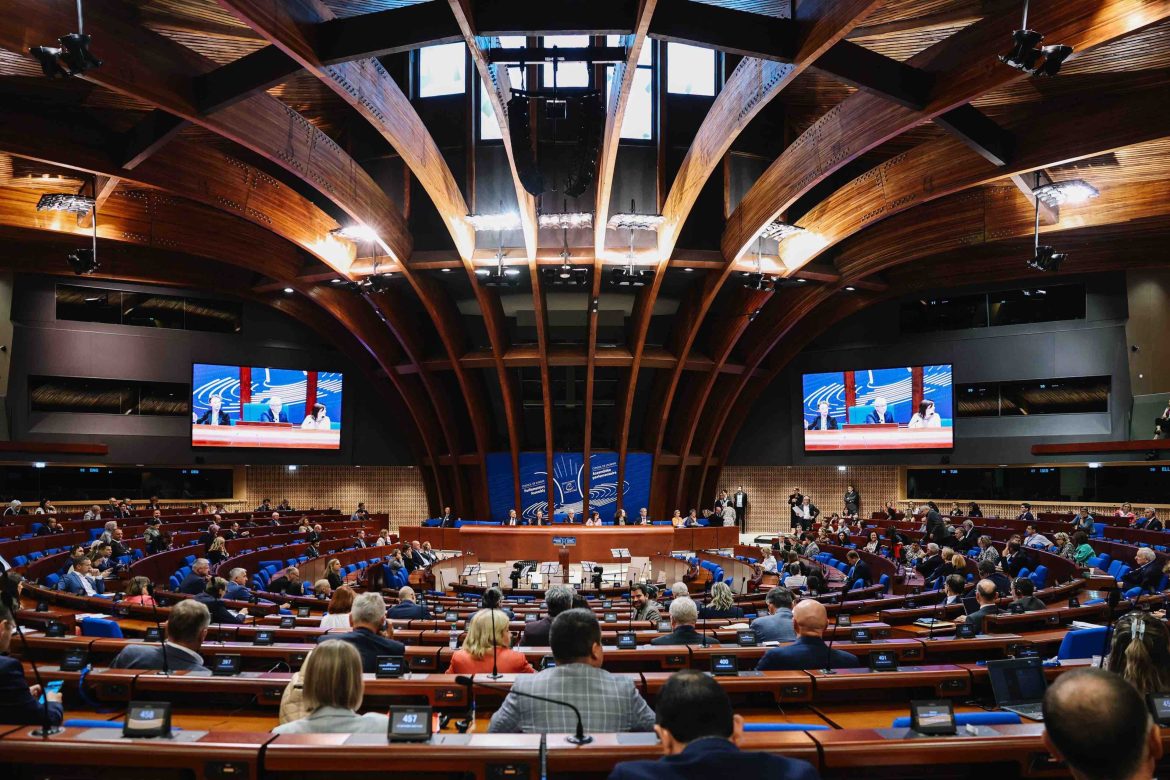
Speaking to EU Today at the Parliamentary Assembly of the Council of Europe (PACE), former Danish MP Sascha Faxe said the threat posed to snow leopard habitat in Kyrgyzstan by the China–Kyrgyzstan–Uzbekistan railway should no longer be treated as a peripheral environmental concern, but as an issue requiring political scrutiny in Brussels, European capitals and beyond.
Her remarks follow the publication of EU Today’s white paper, Vanishing Tracks: The Snow Leopard and the China–Kyrgyzstan–Uzbekistan Railway, which argues that the CKU project crosses one of Kyrgyzstan’s most important snow leopard landscapes and presents a material risk of habitat fragmentation, ecological disruption and wider governance failure unless its route, design and safeguards are significantly strengthened.
The paper identifies the Kyrgyz section as passing through high-mountain terrain in the Naryn and Jalal-Abad regions, part of a wider transboundary landscape linking Kyrgyzstan with China and Kazakhstan. In such terrain, the report argues, tunnels, cuttings, embankments and associated construction corridors are not neutral engineering features. They can become barriers in landscapes where wildlife movement already depends on narrow and highly sensitive ecological corridors.
Faxe said she had not been aware of the issue before receiving the white paper, a point that illustrates a wider political weakness. Major infrastructure projects in remote regions can carry long-term ecological consequences while receiving little meaningful attention in Europe until construction is already under way.
That concern sits at the centre of EU Today’s report. It describes the CKU railway as a high-risk linear infrastructure project, warning that the likely effects extend well beyond direct habitat loss. Among the risks identified are disrupted movement patterns, fragmentation of habitat, disturbance of prey species, increased human access to previously isolated areas and a greater exposure to poaching and wildlife crime.
New EU Today white paper examines CKU railway’s ecological impact on snow leopard range
In her interview, Faxe argued that the snow leopard cannot be treated as an isolated case. As a dominant species within a fragile mountain ecosystem, its decline would point to a broader disruption of ecological balance. The issue, she suggested, is therefore not only the protection of an endangered animal, but the preservation of an entire mountain environment whose resilience may already be limited.
The white paper makes much the same point in more technical terms. It notes that Kyrgyzstan’s snow leopard population is believed to number in the low hundreds, and that the species depends on ecological connectivity across high-altitude terrain. In that setting, fragmentation is not a secondary inconvenience; it can isolate sub-populations, weaken breeding resilience and gradually erode the wider ecological system.
Faxe also raised the political implications for the European Union. Referring to Kyrgyzstan’s GSP+ status, she said environmental harm of this kind cannot simply be ignored while a country continues to benefit from international recognition and trade arrangements presented as consistent with sustainable standards. If such contradictions are left unaddressed, she suggested, the credibility of the wider framework is weakened.
That argument is reflected in the white paper’s governance analysis. The report notes that Kyrgyzstan is party to several multilateral environmental agreements directly relevant to the case, including the Convention on Biological Diversity, the Convention on Migratory Species and CITES. It also notes that Kyrgyzstan benefits from the EU’s GSP+ trade scheme, which is linked not merely to the formal ratification of key conventions but to their effective implementation. In that sense, the handling of the railway project becomes a practical test of environmental commitments that exist on paper but are often less visible in practice.
One of the paper’s more serious findings concerns transparency. It states that there is no full consolidated Environmental Impact Assessment for the Kyrgyz section publicly available in Kyrgyz or Russian, and that detailed route alignment and engineering documentation have not been formally disclosed for public scrutiny. As a result, independent assessment has relied on partial official statements, schematic route material and secondary reporting rather than full technical disclosure.
That lack of transparency matters because the project is no longer theoretical. According to the paper, construction has already begun on environmentally sensitive sections, including tunnel works in Naryn Region. Once works of that kind advance beyond a certain point, the scope for meaningful mitigation narrows considerably.
Faxe said the response should not be confined to EU institutions alone. In her view, the issue should also be raised in national parliaments and potentially at the United Nations, particularly because it exposes a wider weakness in international law. Endangered species and vulnerable ecosystems remain insufficiently protected, she argued, when nature itself is treated primarily as a resource rather than as something entitled to meaningful legal defence.
This is where the issue moves beyond conservation language and into questions of governance, accountability and strategic policy. The EU Today paper does not rely on rhetorical claims. Its conclusion is more restrained, but its meaning is plain: the decisions taken now on route design, safeguards, disclosure, monitoring and financing will determine whether the CKU railway becomes an example of infrastructure adapted to a sensitive mountain environment, or a case in which connectivity objectives prevail over an endangered flagship species and the ecosystems on which wider biodiversity depends.
Faxe’s intervention suggests that the question is beginning to gain political traction. The test now is whether European institutions, member states and international bodies are prepared to act while there is still time to affect the outcome.

