
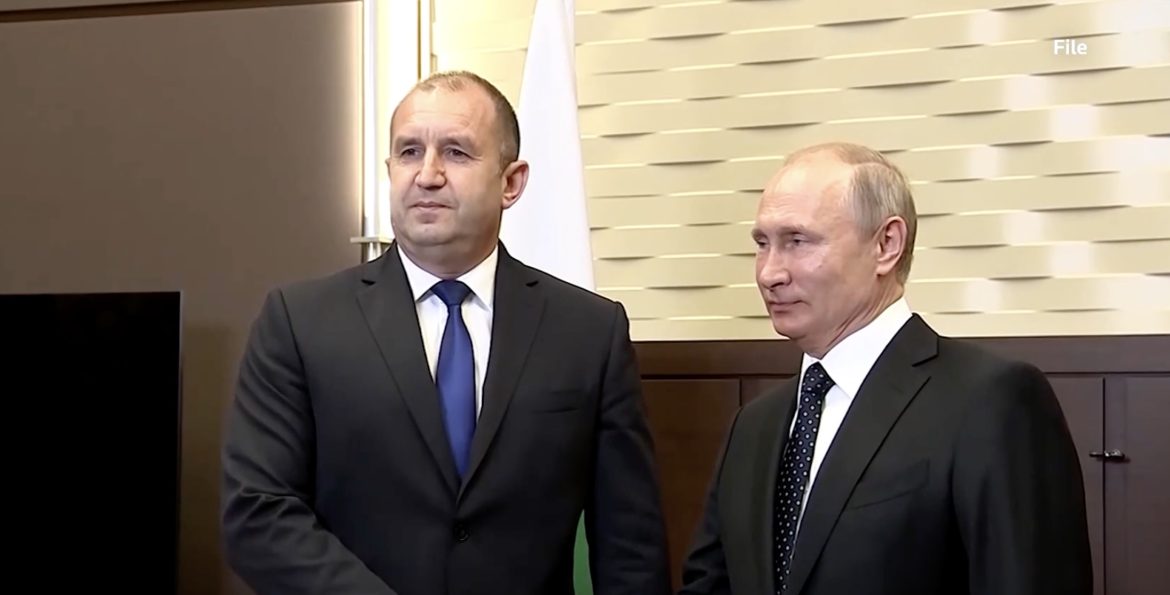
As Bulgaria returns to the polls for the eighth time in five years, former president Rumen Radev is seeking to turn public anger over corruption and instability into political power, while positioning himself as the EU’s most prominent advocate of renewed engagement with Moscow after Viktor Orbán.
As Bulgaria heads to the polls, former president Rumen Radev leads the race in a country worn down by instability, corruption and repeated political breakdown. This is Bulgaria’s eighth parliamentary election in five years, a remarkable measure of the crisis that has gripped one of the EU’s poorest and most politically fragile member states. The immediate backdrop to the vote is another failed government, another caretaker administration, and another public mood shaped by distrust of the political class. Reuters reports that Radev has drawn support particularly from older and rural voters who see him as someone capable of ending years of disorder and entrenched corruption.
That domestic frustration is central to understanding his rise. Bulgaria’s instability is not simply the result of fragmented party politics. It is rooted in a longer failure of governance, in which successive coalitions have struggled to establish legitimacy while corruption allegations, oligarchic influence and weak institutions have remained constant features of public life. The previous government fell in December 2025 after protests over taxation and corruption, while current election coverage has focused again on vote-buying, clientelism and local pressure networks, particularly in poorer and rural areas. On the eve of the vote, authorities had recorded more than 1,000 alleged election violations and around 180 detentions.
Radev has built his campaign around that anger. He presents himself as an anti-graft figure prepared to confront what he calls the political oligarchy that has dominated Bulgaria since the democratic transition. His message has resonated because the country’s crisis is not new. In many respects, it reaches back to the moment Bulgaria entered the European Union in 2007. Bulgaria was admitted to the EU, but not because Brussels believed all major rule-of-law concerns had been settled. On the contrary, the European Commission and the European Parliament made clear at the time that serious problems remained, especially in judicial reform, high-level corruption and organised crime. Those concerns were serious enough for the EU to create a special post-accession monitoring system, the Cooperation and Verification Mechanism, specifically to track Bulgaria’s progress after entry.
That history matters now because Radev’s rise is not taking place in a normal electoral cycle. It is emerging from a state that joined the EU with unresolved structural weaknesses and has never fully escaped them. The country’s repeated elections, fragile cabinets and recurring corruption scandals are not isolated events. They are evidence of a political system that has struggled for years to produce stable authority and public confidence. Radev has understood that vacuum better than his rivals.
Yet his candidacy is significant for another reason. His opponents argue that he is attempting to fill the political space left vacant in the EU by Viktor Orbán. Critics see him positioning himself as the remaining EU leader openly willing to improve relations with Moscow after Orbán’s fall in Hungary. That does not mean Bulgaria would suddenly reverse its formal EU and NATO commitments. Nor is there current verified evidence to support a claim that Radev is directly competing for Russian money. But there is sufficient evidence to argue that he is seeking to become the new political voice inside the Union for a softer line towards Russia.
Radev’s foreign policy profile has long set him apart from the mainstream pro-European consensus. Though he has formally condemned Russia’s invasion of Ukraine, he has opposed military support for Kyiv and argued for renewed engagement with Moscow. He has also campaigned against recent EU-aligned decisions, including Bulgaria’s euro adoption and the country’s security pact with Ukraine. In that sense, his appeal is a combination of domestic anti-establishment rhetoric and geopolitical positioning: anti-corruption at home, strategic dissent abroad.
Whether he can govern is another question. His bloc is expected to finish first, but still short of a majority, making coalition bargaining inevitable. Bulgaria’s fractured parliament may again prevent any clean outcome. But even if he does not secure unchecked power, a strong result for Radev would carry wider significance. It would suggest that in a member state long marked by weak institutions and unresolved corruption, pro-Russian positioning still offers political value. For Brussels, the risk is not simply another unstable Bulgarian government. It is that, after Orbán, the EU may once again find that one of its own members is prepared to act as Moscow’s most accommodating voice from within.

