
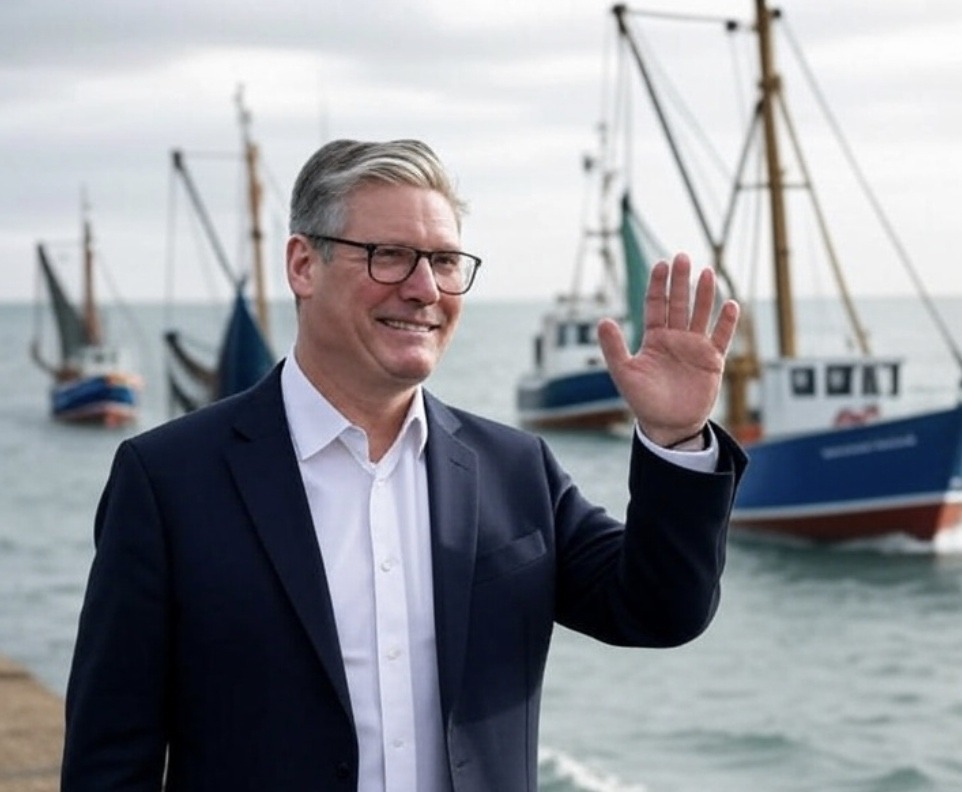
Five years after Britain formally departed the European Union, Prime Minister Keir Starmer welcomes European Commission President Ursula von der Leyen and a cadre of EU leaders to London today for the first official UK-EU summit since Brexit—a diplomatic overture heralded by some as a “reset” of fractured relations, but one already mired in accusations of betrayal.
At the heart of this political storm lies a controversial agreement granting EU vessels extended access to British fishing waters—terms which the Opposition has branded “a capitulation” and “a disaster” for Britain’s coastal communities.
While the summit’s official agenda promises to focus on trade, defence cooperation, and youth mobility, it is the fishing deal that has provoked the most vociferous backlash from Conservative MPs and fishing industry advocates. The deal, reportedly offering EU vessels 12 years’ access to UK waters, has stunned many in Westminster.
‘A rule-taker once again’
Kemi Badenoch, leader of the Conservative Party, did not mince words in her scathing assessment of the government’s handling of the negotiations. “Twelve years’ access to British waters is three times longer than the government initially intended,” she said this morning. “We’re becoming a rule-taker from Brussels once again.”
Badenoch warned that the concessions signal a broader erosion of British sovereignty—one that will fuel growing fears among Leave voters that Brexit is being slowly reversed under Labour rule.
“There are no details on any cap or time limits on youth mobility either,” she continued. “Fears of free movement returning will only increase. This is very concerning.”
Fishing fleet ‘sacrificed’
Victoria Atkins, the shadow environment secretary, echoed those concerns, condemning the deal as “far worse than we anticipated.”
“The fishing industry has been sacrificed to get a deal over the line. Coastal communities who were promised a renaissance after Brexit are once again being told to wait—and this time, it could be for another generation.”
While Downing Street insists the deal will provide “clarity and long-term certainty” to both British and EU fishermen, critics argue that it locks the UK into another disadvantageous arrangement with limited flexibility or recourse in the event of future disputes.
“This is exactly the kind of deal that led many to vote Leave in 2016,” said one senior Tory MP. “We were promised control of our borders and our waters. What we’ve got today looks like a return to the bad old days of Brussels diktats.”
For Sir Keir Starmer, the summit is a moment of high political stakes. Having campaigned to “make Brexit work,” the Labour leader has walked a tightrope between restoring smoother relations with the EU and avoiding the impression of backtracking on Britain’s hard-won sovereignty.
Speaking ahead of the summit, Starmer defended the fishing access agreement as a “balanced and pragmatic arrangement” that would “ensure sustainable cooperation while protecting British interests.”
“We’ve spent far too long shouting across the Channel,” he said. “It’s time for a grown-up relationship that works for both sides. This summit is a vital first step.”
Indeed, much of the official tone surrounding today’s meetings has been steeped in diplomacy. President von der Leyen praised the UK’s “willingness to engage in good faith,” and spoke optimistically of a “new chapter” in EU-UK relations. The European side is especially keen to strengthen cooperation on defence and energy security, particularly given the ongoing instability to Europe’s east.
Youth mobility under scrutiny
Alongside fisheries, the youth mobility proposals have triggered their own wave of controversy. Although Downing Street has emphasised that any arrangements would be “reciprocal” and “time-limited,” critics fear the door to mass EU migration is once again being nudged open.
Badenoch described the lack of clarity as “alarming,” warning that “without firm limits, we could be sleepwalking back into free movement.”
For Brexit stalwarts, the summit raises uncomfortable questions. Is the UK drifting back into Brussels’ orbit under the guise of cooperation? Is the price of economic and diplomatic pragmatism too high for the principles of independence?
Among the UK’s fishing communities, where support for Brexit was often overwhelming, feelings of betrayal are raw. In the Cornish town of Newlyn, one trawlerman stated: “We were told we’d finally have our waters back. Now we’ve got 12 more years of French and Spanish boats scooping up our catch. It’s a kick in the teeth.”
While Labour may see the summit as a diplomatic triumph, albeit at British worker’s cost, the political cost is mounting. If Starmer’s goal was to usher in a new era of post-Brexit realism, he may have also awakened old resentments that no handshake in Downing Street can soothe.
Certainly, Starmer has handed a great opportunity – and possibly even the keys of 10 Downing Street – to Nigel Farage.
As the summit continues, the government faces a difficult balancing act: delivering cooperation with the Continent while convincing voters that Brexit still means what it once did. On fishing, at least, many will believe that balance has already been lost.
Main Image (illustrative): GROK.

