
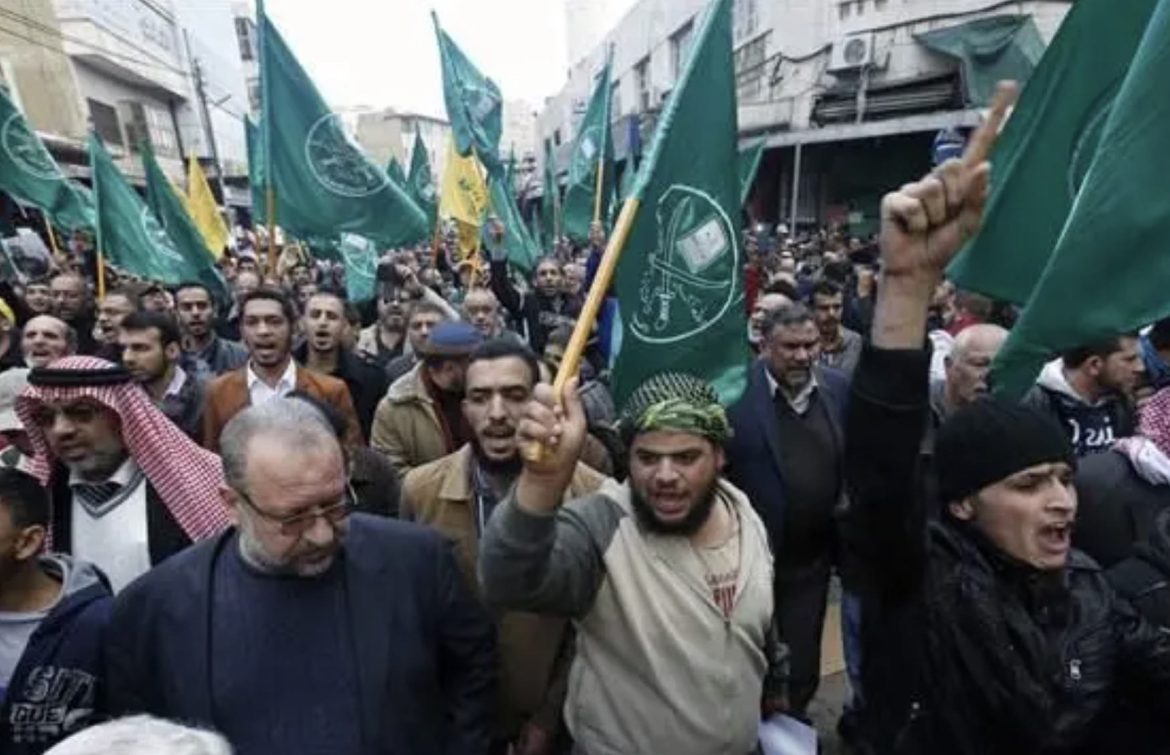
For decades, the Muslim Brotherhood has existed in a strange, almost liminal space in global politics. Founded in Egypt in 1928 by Hassan al-Banna, it presents itself as a movement of social reform, charitable work, and Islamic political activism.
Yet beneath this veneer lies a history of violent insurgency, extremist ideology, and relentless efforts to subvert democratic institutions wherever it gains influence. Its rise and persistence across multiple continents has forced governments — from Cairo to Riyadh, Vienna to Nairobi — to make a stark choice: tolerate a movement that openly espouses an Islamist political agenda or confront it as the security threat it clearly is.
The Brotherhood’s record is far from ambiguous. In its country of origin, Egypt, it orchestrated an armed insurgency against the state in the 1970s and 1980s, leaving thousands dead and entire communities terrorised. More recently, the brief tenure of Mohamed Morsi as Egypt’s president ended with a military coup after evidence emerged that the Brotherhood intended to entrench itself in power at the expense of civil liberties, minority rights, and the rule of law.
Saudi Arabia, the United Arab Emirates, and Bahrain — all nations historically wary of political Islam — have classified the group as a terrorist organisation, citing its active efforts to destabilise regimes and foment unrest.
This is not a regional phenomenon alone. Russia banned the Brotherhood in 2003, citing links to extremism. Austria became the first European nation to proscribe it under anti-terror legislation in 2021, explicitly recognising that its activities within Austrian territory — including recruitment, dissemination of radical materials, and influence operations — posed a tangible threat. Kenya and Jordan, too, have taken decisive legal action against affiliated organisations. The scale and breadth of these measures underscore a simple truth: the Brotherhood’s ideology cannot be neatly separated from its often violent or coercive strategies.
Yet in much of the Western political and intellectual establishment, the Muslim Brotherhood is still regarded with a measure of benign tolerance. Some argue that it is simply a political party or a charitable network, worthy of the same protections as other civic organisations. This approach is deeply misguided. The Brotherhood does not merely advocate for policy change; it promotes a worldview in which the state should be governed by Sharia, civil liberties are conditional on conformity to a religious orthodoxy, and opposition — political, social, or ideological — is delegitimised. In practical terms, this ideology undermines the pluralistic principles on which liberal democracies are founded.
Recent developments illustrate the consequences of misplaced caution. In Paris, authorities decided to tone down New Year celebrations due to the perceived risk of Islamist terrorism. Fireworks displays and public gatherings were scaled back under security advisories. Similarly, security in Sydney — and across Australia — has been massively stepped up on New Year’s Eve in the wake of the devastating terror attack at the Bondi Beach Hanukkah event on 14th December, in which 15 people were killed and dozens more were injured when Muslim gunmen opened fire on a crowd of more than 1,000.
These measures, while necessary for public safety, prompt uncomfortable questions: is this an acceptable situation in a free society? Should any community, religious or secular, be allowed to operate in ways that endanger the public? How will such displays of caution, or perceived weakness, be interpreted by extremists?
There is an uncomfortable parallel here to other forms of extremism. Just as society rightly treats racist, anti-Semitic, or homophobic speech as socially and legally unacceptable, so too must it scrutinise, challenge, and, where necessary, outlaw the organised promotion of Islamist fundamentalism that seeks to subvert democracy. Expressing ideological support for movements whose ultimate objective is the imposition of a theocratic order should not be treated as a mere political opinion; it is, in effect, advocacy for the erosion of fundamental freedoms. Failure to confront this threat is not neutrality — it is tacit complicity.
Western governments, in particular, face a profound challenge. Unlike states in the Middle East or Central Asia, where bans are clear and enforced, much of Europe and North America have allowed the Brotherhood and affiliated organisations to operate with varying degrees of freedom. In the United States, some state-level actions have designated specific branches as terrorist, yet at the federal level, the organisation remains largely unmonitored. In the United Kingdom, groups linked to the Brotherhood enjoy the protection of charitable law and civic freedoms. Even in Germany and France, scrutiny is limited to certain affiliates, leaving the wider network intact.
This inconsistent approach has consequences. The Brotherhood’s network of schools, charities, and advocacy organisations functions as a soft-power arm, normalising an ideology that, in other contexts, has been used to justify violence and political subversion. Its influence is not hypothetical; it manifests in lobbying, in the shaping of public debate, and in the cultivation of political allies sympathetic to its objectives. In short, it acts as a Trojan horse, blending legitimate civic activity with an overarching commitment to Islamist ideology.
The path forward must be clear-eyed and unapologetic. First, governments must pursue honest, meticulous scrutiny of the Brotherhood and all affiliated groups within their jurisdictions. This requires transparency, intelligence-led investigation, and full cooperation between security services and judicial authorities. Second, where evidence demonstrates that the organisation or its subsidiaries are promoting extremist ideology, interfering with democratic institutions, or supporting violence, formal bans must follow. Legal action must not be symbolic; it must be enforceable, with consequences for those who attempt to circumvent restrictions.
Finally, the public discourse around Islamist fundamentalism must shift. Political correctness and misplaced notions of tolerance should not shield ideologies that, if allowed to flourish unchecked, seek to dismantle the very foundations of open society. Just as it is unacceptable to normalise racial or homophobic prejudice, it is equally unacceptable to normalise political Islamism that rejects pluralism, suppresses dissent, and advances theocratic governance. Democracies must confront this ideology with the same moral and legal rigor they apply to other forms of extremist thought.
The global record is instructive. Countries that have acted decisively — Egypt, Saudi Arabia, UAE, Bahrain, Jordan, Austria, Kenya — have recognised that the Brotherhood is not merely a benign political actor. Its record of subversion, extremism, and political manipulation warrants serious legal scrutiny. Western democracies, with their commitment to both freedom and security, should adopt a comparable approach: vigilant investigation, clear legal frameworks, and decisive enforcement. Anything less is to leave a door open to an ideology whose ultimate goal is fundamentally at odds with liberal democracy.
The Muslim Brotherhood is not merely an historical curiosity or a regional political player. It is an ideology with global reach, a network with tangible influence, and a movement whose objectives have repeatedly been proven incompatible with open, pluralistic societies. It is time for Western nations to confront this reality honestly, apply rigorous scrutiny, and impose bans where evidence justifies them. Equally, support for such fundamentalist movements should be treated with the same seriousness as support for racist, anti-Semitic, or homophobic causes.
Liberal democracies cannot afford neutrality when confronted by a movement that seeks, not to debate ideas, but to impose an uncompromising religious orthodoxy on all. The time for careful tolerance has passed; the time for principled, decisive action is now. And as Paris’s muted fireworks and Sydney’s heavy security remind us, hesitation and excessive concession may be interpreted by extremists not as prudence, but as weakness — a weakness that can be exploited at enormous human cost.
Brussels Rally Calls for EU to Designate Muslim Brotherhood a Terrorist Organisation
Click here for more News & Current Affairs at EU Today
Click here to check out EU TODAY’S SPORTS PAGE!
____________________________________________________________________________________________________________________________

