
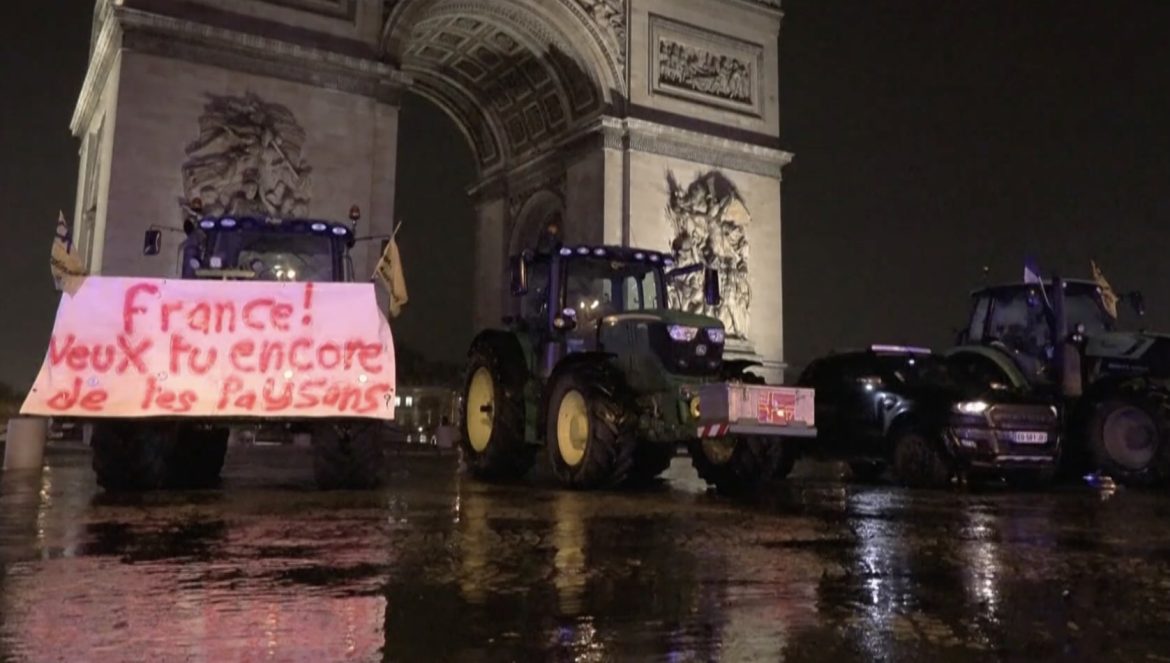
French farmers brought tractors into central Paris before dawn on Thursday, blocking arterial routes and gathering at prominent landmarks to protest against the European Union’s planned trade agreement with the Mercosur bloc and against domestic measures on cattle disease.
Farmers linked to several unions drove through police checkpoints and moved along the Champs-Élysées, before positioning tractors around the Arc de Triomphe and near the Eiffel Tower. Police contained the protest without attempting to remove the vehicles immediately.
The action also targeted access roads into the capital. Dozens of tractors obstructed motorways leading into Paris ahead of the morning rush hour, including the A13 from the western suburbs and Normandy. Transport minister Philippe Tabarot said the disruption created traffic queues stretching 150 km. He said officers were seeking to avoid confrontation. “Farmers are not our enemies,” he told reporters.
Union representatives said the protests were driven by concern that the EU–Mercosur agreement would increase competition from imports produced under different cost structures and regulatory regimes. Stephane Pelletier, a senior figure in Coordination Rurale, described a sense of abandonment and cited Mercosur as an example, speaking beneath the Eiffel Tower.
The demonstration came as EU member states prepared to decide whether to authorise signature of the agreement, which has been negotiated for decades and would be among the bloc’s largest trade deals in terms of tariff reductions. EU ambassadors were expected to vote on Friday, with approval requiring a qualified majority of member states representing 65 per cent of the EU population, under EU rules referenced by Reuters.
The Mercosur bloc includes Argentina, Brazil, Paraguay and Uruguay. The European Commission states that a political agreement with those four countries was reached on 6 December 2024.
France has been one of the strongest opponents of the deal and President Emmanuel Macron’s final position was not clear on Thursday, even after what Reuters described as last-minute concessions. The protests added to domestic political pressure on Macron’s government, which does not hold a majority in the National Assembly. The policy setbacks risk provoking a no-confidence vote in parliament.
In Brussels, the Commission has sought to consolidate support among wavering member states by offering measures aimed at farm incomes and input costs. On Wednesday, European Trade Commissioner Maroš Šefčovič said the EU would remove standard import duties of 6.5 per cent on urea and 5.5 per cent on ammonia, and would encourage legislation allowing temporary exemptions to the EU’s carbon border levy in defined circumstances. The Commission framed the steps as part of a wider effort to secure the necessary majority for the Mercosur decision.
Italy, whose stance has been closely watched in the final stretch, has pressed for tighter safeguards. Italy’s agriculture minister, Francesco Lollobrigida, said Rome was pushing to lower the threshold for triggering an import “safeguard” to 5 per cent from an 8 per cent level under discussion, arguing this would make it easier to suspend the agreement if import volumes surged or EU prices fell sharply.
A separate, long-running grievance among French farmers has been the handling of lumpy skin disease, a highly contagious cattle illness. Protesters in Paris demanded an end to a policy of culling animals, which they consider excessive, and called for vaccination instead.
The disease issue has already triggered protests outside Paris in recent weeks. In December, France’s agriculture minister Annie Genevard said France would vaccinate one million head of cattle in the coming weeks, as farmers protested against culls and raised concerns about market impacts and exports.
Thursday’s blockades underscored how trade policy, animal health controls and farm input costs have converged into a single pressure point for governments across the EU. With an EU-level vote imminent and member states divided over the agreement’s implications for agriculture, Paris’s streets became a focal point for a debate being decided in Brussels.

