
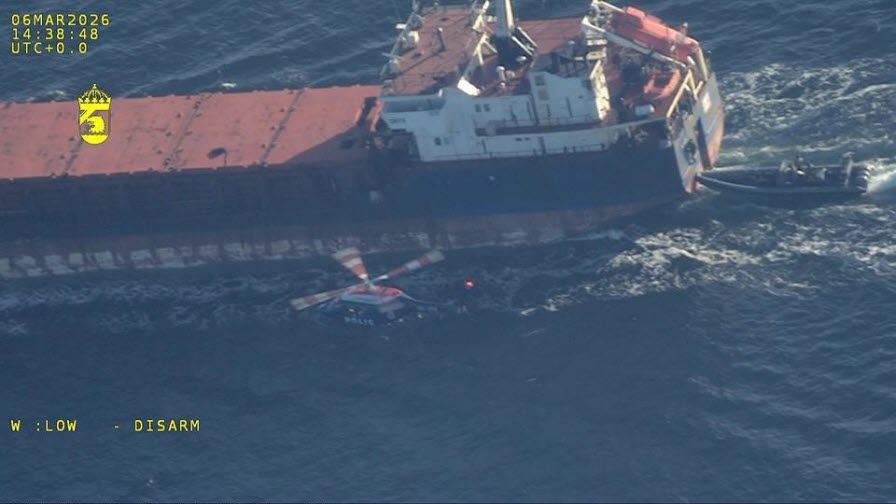
Sweden’s Coast Guard has detained the cargo vessel Caffa in the Baltic Sea near the southern city of Trelleborg, after opening a preliminary investigation into suspected breaches of maritime regulations.
According to the Swedish Coast Guard, the operation was carried out with police support and remains ongoing at sea. Officials said the case concerns suspected violations of maritime law linked to the vessel’s failure to meet required shipping standards.
The ship, identified as Caffa, was said to be sailing under the flag of Guinea. However, Swedish authorities stated that its flag status is unclear. On the basis of national and international law, the Coast Guard said it regards the vessel as not belonging to any state.
That classification is significant. Under maritime law, a ship without a clearly recognised state affiliation may not enjoy the same protections as a vessel lawfully sailing under a valid national flag. Swedish authorities therefore concluded that Caffa was not engaged in what is known as innocent passage through Swedish territorial waters.
The Coast Guard said the absence of a valid and verifiable flag raised questions about who was responsible for guaranteeing the vessel’s safety, seaworthiness and legal standing. In practical terms, that uncertainty appears to have provided the basis for Swedish intervention.
A national operational unit, a specialised Coast Guard team and a police helicopter were involved in boarding the vessel while it was in Swedish territorial waters. Authorities said personnel are now processing information collected on board, and that additional agencies may join the operation depending on how the case develops.
Swedish public broadcaster SVT reported that Caffa appears on Ukraine’s sanctions list. According to the Ukrainian side, the vessel was allegedly involved in the theft or illegal transportation of grain from Crimea, which Russia occupied in 2014 and has since used as a hub for the export of agricultural products and other goods.
Kyiv has repeatedly accused Russia and associated shipping operators of removing grain from occupied Ukrainian territory and routing it through ports in Crimea or Russia for sale abroad. Such allegations have formed part of a broader Ukrainian effort to expose shipping networks linked to sanctions evasion, illicit trade and the logistics structure supporting Russia’s war economy.
In a statement cited by Swedish media, Coast Guard spokesman Mattias Lindholm said the Swedish state had the right to act against a vessel whose flag status was highly questionable. He added that the authorities believed the ship may have been registered under a false flag.
If confirmed, that would place the case within a wider pattern of deceptive maritime practices increasingly associated with sanctions circumvention and so-called shadow fleet activity. Ships operating under opaque ownership structures, frequently changing registries, or carrying uncertain documentation have come under closer scrutiny across Europe since the start of Russia’s full-scale invasion of Ukraine.
Risk in European Waters: The Shadow Fleet, Sanctions Evasion and Safety Gaps
Information from on board the vessel indicated that Caffa was headed for Saint Petersburg in Russia. That detail is likely to attract additional attention, given the growing concern among European governments over shipping routes in the Baltic linked to Russia, sanctions enforcement and maritime security.
Russia’s Hybrid Escalation from Dnipro to the Baltic – “Europe Must Act Now”, Mykhailo Gonchar
For Sweden, the Caffa case also highlights the legal and operational challenges posed by vessels whose formal status is uncertain. A ship sailing with disputed registration creates not only a sanctions question but also a direct jurisdictional and safety issue for coastal states.
At the time of reporting, Swedish authorities had not announced any final legal determination, charge or seizure outcome. The preliminary investigation remains under way, and officials said the response may broaden depending on what is found on board.
The incident nevertheless stands out as a notable example of a European state intervening against a vessel linked by Ukraine to sanctions-related wrongdoing, while also invoking concerns over flag legitimacy and maritime compliance. In the Baltic, where commercial traffic, security interests and sanctions enforcement increasingly intersect, such cases are likely to receive close attention well beyond Sweden.

